Tuesday, September 28, 2010

Magic in the Backyard


Alice stepped in a rabbit hole and fell into Wonderland. A twister whisked Dorothy away to Oz. Peter, Susan, Edmund, and Lucy opened a wardrobe door and found the land of Narnia. Even Harry Potter discovered a magical world lurking just beyond the edges of the everyday. The parallel worlds that exist in fiction are by turns fantastic, quirky, dark, and dangerous. The books in this list prove that there’s magic right and left and in our very own backyards—if we know where to look.

The Magicians by Lev Grossman, 2009, Viking Press (Literary Fiction/ Fantasy)


Nerdy high school genius Quentin Coldwater spends most of his time wishing he were in Fillory, the fictional magic land featured in the children’s books that Quentin never outgrew. The Fillory series guarantees adventure and enchantment when the real world fails to live up to expectation—which, for Quentin, it frequently does. He’s too smart to be interested in school, he’s in unrequited love with his best friend’s girl, and happiness seems perpetually just out of reach. Even when Quentin discovers that magic is real, it’s a bit of a letdown. Admitted to an exclusive college of sorcery, Quentin is thrilled to finally belong—and then exhausted when the study of magic turns out to be just as grueling as the study of anything else. Quentin becomes a skilled magician with a close and catty group of friends, but the sense of completion that he expected magic to fulfill is still painfully absent. It’ll take something major to halt Quentin’s downward spiral into disillusionment—something like the revelation that Fillory is real and reachable. Fillory is a real place, but it’s not all happy adventures and talking bunny rabbits. It’s a dangerous place teeming with its own histories, politics, and enemies, and Quentin will have to face all his demons in order to survive. The Magicians is, at first glance, like a grown-up Harry Potter venturing into The Chronicles of Narnia, complete with the sex, drugs, and alcohol-fueled lifestyle of the modern party-school undergrad. But there’s a great deal of mystery, intrigue, and complexity behind the scenes as author Lev Grossman balances the power of fantasy with the harshness of reality. Every bit as satisfying as the fantasies of our youth, The Magicians is not to be missed—nor is the sequel, The Magician King, due out in 2011.

P.S. Fans of The Magicians have had a whale of a time creating plots and histories for the Fillory and Further books and their fictional author Christopher Plover. Check out these websites—and the “official” site for the Brakebills Academy of Magic.

Neverwhere by Neil Gaiman, 2003, Harper Perennial, originally published 1996 (Fantasy)


Richard Mayhew lives in London. He has a job. He has an apartment. He has a fiancé. He has a regular everyday sort of life. All that is about to change. Richard, bumbling and late to dinner, stops to help a dirty, bleeding young woman lying on the sidewalk. Much to fiancé’s chagrin, Richard scoops her up and takes her home to recuperate. The waiflike girl is named Door and there’s something very odd about her. Sure, she refuses to go to the hospital or call the police, and yes, she heals rather quickly and hides rather too well when a pair of ominous men in black come looking for her, but it’s more than that. When Door thanks Richard and leaves again, it seems the brief adventure is over. But then Richard begins to change. His friends don’t recognize him, his fiancé barely notices him, and strangers can’t even see he’s there. Knowing Door can answer his questions, Richard picks up on the few hints she dropped and plunges into London Below, a weird and wild world than exists under the sidewalks and subway tunnels of London proper and is inhabited by those who “fell between the cracks”—people who live in the sewers, people who talk to rats, people who can do magic. Soon Richard is one of Door’s companions on a dangerous quest through this bizarre subterranean land. If Richard wants to get back to his blissfully humdrum life, he’s got to prove his worth against all manner of assassins, monsters, and mayhem. Always inventive author Neil Gaiman is at his best here as he skillfully weaves myths and legends together with bits and pieces of the familiar to create a magical world that is entirely original. Witty and wickedly inventive, Neverwhere is fantasy at its finest.

Coraline by Neil Gaiman, illustrated by David McKean, 2002, Harper Collins (Fantasy/ Teen Fantasy/ Children’s Fantasy)
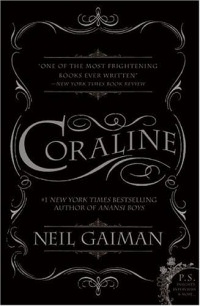


For a “lost-in-a-magical-realm” story, author Neil Gaiman is, hands down, the go-to guy. The more he writes, the more fantastic his fantasy worlds get. In Coraline, for example, a bored little girl wiles away the rainy day exploring the rambling house she’s just moved into with her preoccupied parents. One intriguing door opens onto a brick wall—a division built when the big house was converted into units. But one night, in true Chronicles of Narnia fashion, Coraline turns the knob and walks into a parallel world where everything in her dull life is mirrored with fantastic effect. The toys are better, the scrawny black cat that hangs around outside can talk, and Coraline’s “other” parents are kind and attentive and loving—even if their sewn-on black button eyes are decidedly creepy. Coraline chooses to go back to her own world, but in doing so she sets off a chain of events with dangerous consequences. Her real parents have disappeared, and only another venture into the not-quite-right realm of the “other mother” can bring them back. A distinct air of menace pervades this suspenseful children’s story, harking back to ghost stories and grim fairy tales of yore. Tapping into age-old fears and complimented by the dark, scratchy illustrations of David McKean, Coraline’s chills have thrilled readers of all ages. Winner of the Hugo, Nebula, and Bram Stoker Awards, the book has also been adapted into a sophisticated graphic novel (illustrated by P. Craig Russell) and a whimsical animated movie.

InterWorld by Neil Gaiman and Michael Reaves, 2007, HarperCollins (Science Fiction/ Fantasy/ Teen Fantasy)


Fifteen-year-old Joey Harker has a gift for getting lost. So lost, in fact, that one day he wanders right out of our world and smack into another. This is Joey’s real gift—he’s a Walker, able to move effortlessly between countless parallel worlds. Joey’s new ability is also a dangerous one. Almost before he can blink, he’s being hunted by not one but two evil forces who seek to harness his world-walking power—the Binary, fierce members of a scientific world from one end of the spectrum, and the HEX, cruel citizens of a magical land from the other extreme. Joey’s only refuge is the InterWorld, an in-between place of balance populated by lots of other Joey Harkers from lots of other alternate Earths. These Joeys are anything but identical. There’s werewolf-ish Jakon Haarkanen from an Earth where evolution took a twist and humans descended from wolves, and J/O HrKr, part boy, part computer, from a scientifically advanced futuristic world, to name just a few. Joey must prove himself to these alternate selves as they all learn to wield their power to Walk—because Joey is about to cause several worlds’ worth of trouble. Fast-paced and action-packed, InterWorld is an adventure story that expects its readers to be familiar with science fiction standards like parallel universes and alternate timelines, and then expects readers to put everything they know on hold and just go along for the wild ride. Fantasy favorite Neil Gaiman is (no surprise) one of the inventive minds behind InterWorld. The other collaborator is Michael Reaves, television writer for such sci-fi gems as The Twilight Zone and Star Trek: The Next Generation. Together, Gaiman’s and Reaves’ genius for inventing new worlds rises to new heights of creativity and daring. Let’s hope there’s more where that came from.

Malice by Chris Wooding, 2009, Scholastic Press (Teen Fantasy/ Horror/ Graphic Novel)


Everyone knows about the underground comic book Malice. Supposedly it doesn’t even exist, but if you get your hands on a copy, mix a few ingredients, and chant “Tall Jake, take me away,” you’ll find yourself yanked into the pages of the comic’s sinister world. Of course, that’s just an urban legend. It’s a coincidence that the kids in the comic look like missing children. Those kids must be runaways, and the artist just uses their photos for inspiration…right? Wrong, and teenagers Seth and Kady are about to find out the hard way. When their friend Luke disappears, danger-loving Seth and curious Kady are immediately suspicious. When they find a blank comic book emblazoned with a big red M in Luke’s room, they begin to suspect that there’s more to Malice than mere rumor. Seth, bored of everyday hum-drum living, is eager to call Tall Jake and jump into the comic. But when the chant works, Seth is overwhelmed by a menacing world filled with clockwork monsters and mechanical mayhem. Not one to take any sort of adventure lying down, Seth joins forces with a rag-tag group of teens who have managed to defy Tall Jake and survive. Back in the real world, Kady is hot on the trail of Malice’s unknown creators—who turn out to be every bit as dangerous as the chaotic alternate world they’ve created. Toying with the conventions of horror movies, urban legends, and comic books, author Chris Wooding has crafted a heart-pounding, nail-biting tale of suspense. The packaging is part of the fun of Malice, with its three-dimension cover and interspersed sections of eye-catching comic book artwork. The cliffhanger ending will leave you holding your breath for the sequel, Havoc, due in October 2010.

War for the Oaks by Emma Bull, 2001, Orb Books, originally published 1987 (Fantasy)


Eddi McCandry is having a bad night. She broke up with her boyfriend, quit her band, and is being chased through downtown Minneapolis by a man in black and a very big dog. Cornered at last, Eddi is stunned to discover that the man and the dog are one and the same. The fellow is a phouka, a shape-shifting magical being, and he has just drafted Eddi into an age-old war between two dueling branches of faerie folk. The Seelie Court needs Eddi, a mortal, to bring balance to their battle with the dark Unseelie Court. Feisty and fiercely independent, Eddi has zero interest in being some pixie’s pawn, but she doesn’t have a choice—now that she’s been singled out by one faerie court, the sinister fey of the other will be after her in full force. The phouka—an infuriating, dashing trickster—is appointed Eddi’s guardian and guide through the magical realm now open to her. Overwhelmed, Eddi grounds herself in her passion for music. She starts another band and to her surprise, her recently acquired affinity for magic produces the best sound she’s ever played—with a bit of help from her new bandmates. The fey have been infiltrating the human world for ages, and boy, can they play some mean rock and roll. The band (with the grinning phouka as roadie) begins to garner some serious hype, but there’s still a battle between the forces of good and evil to win, and Eddi is about to become the center of some very dangerous attention. Grounded in the neighborhoods of the Twin Cities and brimming with as much rock and roll as magic, War for the Oaks is an urban fantasy cult classic that still packs a punch more than twenty years after its original publication.

Greywalker by Kat Richardson, 2006, Roc Books (Fantasy/ Mystery) 



Greywalker begins with Seattle-based private detective Harper Blaine getting the beating of a lifetime when a routine investigation leads to an unexpectedly bad end. Then, she dies—for two minutes. Resuscitated and recovering in the hospital, Harper is eager to put this incident behind her and get back to work. That, of course, is easier said than done. Because Harper begins experiencing strange phenomena—a foggy grey mist on the edges of her vision, ghostly shapes moving around her, snarling shadows that dodge and lunge. When she meets a married couple who have experience investigating the paranormal, Harper finally gets some answers. Her temporary death and her return to life have made her a Greywalker—someone able to move between the everyday world and the Grey, a shadowy realm halfway between life and death inhabited by ghosts, vampires, necromancers, and monsters. Harper is anything but thrilled by this startling revelation, but the Grey isn’t going away and soon her normal cases—finding a missing college student, tracking down a family heirloom—begin to show disturbing and dangerous signs of the paranormal. Harper is going to have to push her natural skepticism aside and accept her new abilities if she wants to solve her cases—and stay alive. Populated by intriguing characters both human and supernatural and led by a gutsy, sarcastic, wholly likeable heroine, Greywalker is a fantasy on par with Charlaine Harris’ Southern Vampire Mysteries starring Sookie Stackhouse and Jim Butcher’s Dresden Files featuring wizard-detective Harry Dresden. With Greywalker, author Kat Richardson pulls all the stops and pens a fast-paced, monster-packed novel (the first in a series) that is an exciting blend of hard-boiled detective mystery and gritty urban fantasy.

The Greywalker Series by Kat Richardson
1. Greywalker
2. Poltergeist
3. Underground
4. Vanished

The Stolen Child by Keith Donohue, 2006, Doubleday Books (Fiction/ Fantasy)


In the woods behind seven-year-old Henry Day’s house, there is another world. Hobgoblins, or changelings, inhabit the country wilderness; they are fairy-like sprites that kidnap children and leave one of their own behind. This is destined to be Henry’s fate. Nabbed from his hiding spot in the forest one day, the boy Henry is transformed into a fairy and renamed Aniday. Forever trapped in a child’s body, Aniday learns the woodsy brand of stealthy magic that ensures the survival of the wild little band. The changeling who takes his place becomes human and lives out his life as Henry Day, identical in every way to the original boy save for a new prodigious talent at the piano. As the now-human Henry and the new hobgoblin Aniday mature, they are both haunted by the past. Bookish Aniday, using stolen scraps of paper and found pencil stubs, keeps track of his new life amongst the changelings and clings to fading memories of his first family. Henry settles into the grooves of modern American life in the 1960s, but he is plagued by recollections even more distant—his own original human life, from way back before his wild fairy days, back when he was a human boy who was replaced by a changeling and became one himself in turn. As the lives of Henry Day and Aniday separate and twist and turn to collide once more, author Keith Donohue relates the cycle of human to changeling and back again with an eerie precision that is anchored in everyday details. Haunting and strange, The Stolen Child will make readers firmly believe in the ageless children of the woods—and maybe even question their own true identities and histories.

Little, Big by John Crowley, 2006, Harper Perennial, originally published 1981 (Literary Fiction/ Fantasy)


When anonymous Midwestern city boy Smoky Barnable locks eyes with long tall Daily Alice Drinkwater, it is love at first sight. Following a strange but quaint set of instructions (eat food that is made not bought; pack a suit that is old not new), Smoky walks to Edgewood—not found on any map—to marry Alice, live in the rambling Drinkwater house that is built in every style, and become part of this singular family’s history. The house was designed by great-grandfather John Drinkwater, an eccentric architect and author with a theory about concentric worlds within worlds. Daily Alice and her sister Sophie spent their childhood frolicking with Uncle Auberon, a man who devoted his life to capturing photographic evidence of the elusive “they” who dwell in the wilderness that surrounds the family home. Two of the Drinkwater children, Alice’s son and Sophie’s daughter, leave the ancestral home to embark on big, strange, wondrous adventures in the big city and in the wild wild wood. And enigmatic Aunt Cloud endlessly consults her much-sought-after deck of cards and traces the Drinkwaters’ progress through the unending story of life. The Drinkwaters are without doubt a magical family, and Little, Big is without doubt a fantasy novel of unparalleled beauty and style. Author John Crowley writes a lyrical prose as he tells the fanciful, whimsical saga of this almost mythical family and the various magical boundaries, fairy realms, and other-worlds that its members encounter and inhabit. Full of moments of wonder, clarity, and mystery, Little, Big is a fine, graceful, wandering fantasy story that you’ll want to read again and again and linger over and make last as long as you possibly can.

Note: Other previously reviewed books that feature ordinary people tumbling into extraordinary magical realms include Philip Pullman’s utterly fantastic and all-absorbing His Dark Materials trilogy; Summerland, Michael Chabon’s adventure-filled tribute to magic, mythology, and the great game of baseball; yet another Neil Gaiman story, Stardust, with a fairy tale twist; The Book of Lost Things by John Connolly, an eerie fantasy about a young boy lost in a strange land; and that timeless classic The Neverending Story by Michael Ende.

Tuesday, September 14, 2010

Be My Private Eye


Gumshoes, flatfoots, shamans, private eyes, P.I.s. Call them what you will, but there is no detective like the private investigator. These sleuths are not copper-on-the-beat policemen or armchair amateurs with the luxury to solve crimes in their spare time. The private eye is a tough-as-nails consummate professional, and you’ll be more than willing and able to pay for these expert crime-solving services.

The Maltese Falcon by Dashiell Hammett, 1992, Vintage Books, originally published 1930 (Mystery)


Sam Spade is a sardonic, detached, keen-eyed private detective with his own unwavering code of honor. So when his partner Miles Archer is killed while tailing a man suspected of running off with a new client’s sister, Spade is immediately on the case—even though he’s been making time with Archer’s wife. But that was just a passing fancy. The new client, Brigid O’Shaughnessy, is the real deal: bright, beautiful, and a complete liar. She doesn’t even have a sister. What Brigid does have is an intriguing story about a valuable falcon statue and lots of low-down dirty gangsters hot on its trail. Embroiled in this plot, Spade keeps his wits and stays one step ahead of the bad guys—even though with all the crossing and double-crossing going on, he doesn’t always know who the bad guys are. Author Dashiell Hammett’s pulp fiction potboiler, with its sparse prose and compelling characters, has become a classic. Influencing even fellow mystery author Raymond Chandler (creator of the second best-known hardboiled detective Philip Marlowe), Sam Spade is the granddaddy of every hard-assed, wise-cracking, no-nonsense private eye on the street. Humphrey Bogart’s top-notch performance as Sam Spade in the 1941 film adaptation, a classic in its own right, has guaranteed that a certain black bird will be causing trouble for decades to come.

The Big Sleep by Raymond Chandler, 1992, Vintage Books, originally published 1939 (Mystery)


When private investigator Philip Marlowe is called to the massive mansion of paraplegic millionaire General Sternwood, he doesn’t expect to be plunged into a mess of blackmailers, gangsters, and drug dealers. But he takes it all in stride, because Marlowe is as hard-nosed (not to mention hard-drinking and chain-smoking) as they come. Sternwood’s wild-child daughter Carmen is a vivacious tease of a girl, and she’s being blackmailed. Marlowe is charged with putting a stop to the extortion and getting Carmen out of trouble, but the girl—and her drop-dead-gorgeous, tough-as-nails big sister Vivian—proves to be more than a handful. The sisters have agendas of their own and both know some shady characters. No one is telling the truth, the whole truth, and nothing but the truth. In fact, most of what comes out of their lips is about as far from the truth as you can get. Pornographers, gamblers, and murders all become part of the Byzantine plot as Marlowe scowls his way across the dark underbelly of 1940s Los Angeles. He may be surrounded by double-crossing bad guys and taunting femme fatales, but Marlowe is never outwitted, outpaced, or outmatched. Cynical and world-weary, Marlowe is an all-American anti-hero and the star of several of author Raymond Chandler’s trademark hardboiled noir thrillers. Lauren Bacall played Vivian to Humphrey Bogart’s Marlowe in the 1946 film adaptation, cementing The Big Sleep’s place in the detective lit canon.

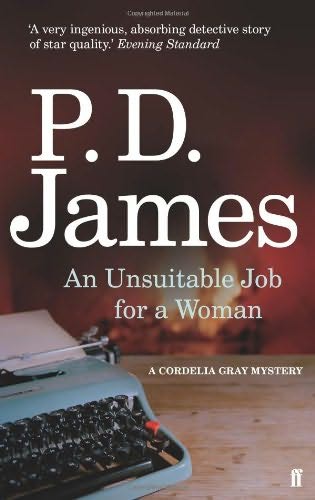
An Unsuitable Job for a Woman: A Cordelia Gray Mystery by P.D. James, 2001, Scribner Books, originally published 1972 (Mystery)


It took awhile for women to enter the private eye profession without serving as secretaries or seductresses. When they did, the ladies proved to be every bit as tough, efficient, and intuitive as their male predecessors. In 1972, author P.D. James introduced Cordelia Gray, a young woman who inherits a London detective agency. Of course, it’s an awfully run-down detective agency, and Cordelia only gets it when her she finds her mentor Bernie Pryde, a cancer-ridden ex-cop, dead in the office. Bernie committed suicide but left his beloved P.I. firm in the capable hands of his youthful assistant. Cordelia bites the bullet, defies convention, and makes the business her own. Luck is on her side when her first case is a high profile investigation into the supposed suicide of a prominent scientist’s son. The son is Mark Callender, an intelligent Cambridge student who suddenly left school, became a gardener for a wealthy family, lived in a cozy little cottage, and then hung himself. To Cordelia, questioning Mark’s uncooperative friends and investigating the puzzling crime scene, the pieces don’t fit. Digging deep into Callender family secrets, Cordelia uncovers a web of mysterious circumstances that someone doesn’t want brought to light. Now Cordelia herself is a target, but no good private investigator lets something as trivial as danger stand in the way. Cordelia, despite her youth and inexperience, is determined to be a damn good P.I. Author P.D. James (born in 1920 and publishing since 1962) is as experienced a mystery writer as they come. Tight plotting, attention to detail, and compelling characters mean that Cordelia Gray is a detective to be reckoned with—and she appears in one more mystery, 1983’s The Skull Beneath the Skin.

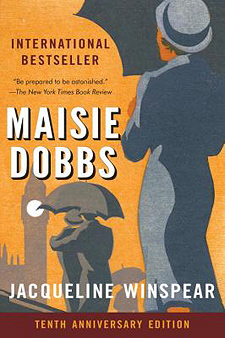
Maisie Dobbs by Jacqueline Winspear, 2003, Soho Press (Historical Fiction/ Mystery)


Written years after Cordelia Gray hit the P.I. scene but set decades earlier, Maisie Dobbs is another young woman with a keen eye who defies stereotype and hangs her shingle as a private detective. The year is 1929 and England is still recovering from the devastating effects of World War I. But Maisie Dobbs, ex-maidservant, student of master-detective Maurice Blanche, former front-line nurse, is turning a new page and opening her own private investigations agency in London. Her allies include her previous employer Lady Rowan (who discovered her maid reading philosophy in the library one night, correctly gauged this unusual servant’s intellect, and sent her straight off to University) and neighborhood handy-man Billy Beale (sharp, street-wise, an investigative-assistant in the making). Maisie herself is an acute observer of human nature, intuitive and sensitive and able to relate to people of all classes and backgrounds, but she’s also nursing her own war wounds. Still, she’s ready to put all that behind her when her first case comes along. It begins as a tedious investigation into the whereabouts of a seemingly unfaithful wife, but before long the trail leads to a secluded convalescent home for soldiers damaged in mind and body—from which very few men ever emerge alive. Now Maisie is face to face with the tragedies of the Great War that she’s tried so hard to forget, and with a complex mystery on her hands to boot. Author Jacqueline Winspear’s portrait of post-World War I England is pitch-perfect and her heroine is remarkably strong and well-drawn. Maisie Dobbs is a fine example of romance, mystery, and historical fiction all rolled into a suspenseful, moving story.

Maisie Dobbs Mysteries by Jacqueline Winspear
1. Maisie Dobbs
2. Birds of a Feather
3. Pardonable Lies
4. Messenger of Truth
5. An Incomplete Revenge
6. Among the Mad
7. The Mapping of Love and Death

The No. 1 Ladies’ Detective Agency by Alexander McCall Smith, 2009, Anchor Books, originally published 1998 (Mystery)


There are not many detective agencies in Botswana. There are even fewer ladies’ detective agencies in Botswana. In fact, there are none—until now. Using the funds from the sale of her beloved father’s cattle, middle-aged Mma Precious Ramotswe sets up the No. 1 Ladies’ Detective Agency in her small hometown of Gaborone. As the country’s only female private investigator, Mma Ramotswe is not entirely certain that her gamble will pay off. But sure enough, the clients come. Women want to know where their cheating husbands have strayed. Fathers want to know which boys their young daughters are dating. And there are more sinister crimes afoot too, as in the case of a missing little boy. But Mma Ramotswe handles them all in her own fashion. Armed with only a detecting manual, the example of mystery writer Agatha Christie, and her own more-than-competent intuition and understanding of her fellows, Mma Ramostwe tackles every case with humor and wisdom. Told in a series of vignettes that trace Mma Ramotswe’s history as well as her present casework, author Alexander McCall Smith paints a vivid portrait of Africa and the people who love to call it home. Cozy, gentle, and brimming over with true glimpses into the myriad workings of human nature, Mma Ramotswe and her little detective agency are a welcome addition to the otherwise hard-edged world of private eye fiction—and so popular that HBO has developed a No. 1 Ladies’ Detective Agency television show.

1. The No. 1 Ladies’ Detective Agency
2. Tears of the Giraffe
3. Morality for Beautiful Girls
4. The Kalahari Typing School for Men
5. The Full Cupboard of Life
6. In the Company of Cheerful Ladies
7. Blue Shoes and Happiness
8. The Good Husband of Zebra Drive
9. The Miracle at Speedy Motors
10. Tea Time for the Traditionally Built
11. The Double Comfort Safari Club

The Case of the Missing Servant: From the Files of Vish Puri, India’s “Most Private Investigator” by Tarquin Hall, 2009, Simon and Schuster (Mystery)


Vish Puri is India’s “Most Private” private investigator. With a team of delightfully nicknamed employees (the driver goes by “Handbrake;” the firm’s female agent is known as “Facecream”), a network of contacts in high (and low) places, and even a few sleek new modern technologies, the plump, middle-aged gentleman is Delhi’s master of respectability, confidentiality, and discretion. But despite being the proud recipient of the Super Sleuth Award from the World Federation of Detectives for solving the Case of the Missing Polo Elephant in 1999, most of Vish Puri’s clients are mamas and papas wanting their prospective sons-and-daughters-in-law investigated. So when a lawyer comes to Puri with a tale of a missing housemaid, false accusations, and bureaucratic corruption, the dapper detective jumps at the chance to get back to some real sleuthing. But Puri faces several complications, including a baffling request from a famous war hero, a doctor’s orders to diet (and a wife eager to comply), and an overly-inquisitive mother (“Mummy-ji”) who refuses to accept that elderly ladies are simply not cut out to be detectives. Despite the challenges, it will never be said that Vish Puri, Indian’s acclaimed “Most Private Investigator,” failed to solve the case. British author Tarquin Hall has made Delhi his second home, and he does credit to modern India’s fabulously chaotic atmosphere. Lively, clever, and with a charming cast of unforgettable characters, The Case of the Missing Servant (and its 2010 sequel, The Case of the Man Who Died Laughing) is a new mystery series well worth keeping an eye on.

The Spellman Files by Lisa Lutz, 2007, Simon and Schuster Books (Fiction/ Mystery)


It’s hard growing up with a pair of private investigators for parents, a mom and pop who wield a hard line of questioning whenever anyone steps out of line—which for Izzy, middle child in the overly-inquisitive Spellman clan, is pretty often Izzy was the family rebel, with years of teenage hjinks and all-night parties under her belt. But now, at age twenty-eight, Izzy is grounded by the nuts-and-bolts of detective work as a P.I. for Spellman Investigations, which operates out of the family home in San Francisco. Her youthful misadventures make her ideally suited to telling lies, keeping secrets, and spying. True, her parents are not above tailing her on dates, but Izzy is making it work—until she meets Daniel Castillo, dentist, ordinary guy, and love of her life. Trying to keep her familial obligations and her romantic life separate is next to impossible, so Izzy quits the family business. Of course, she can’t get away that easily. The Spellmans are not accustomed to keeping out of each other’s affairs. Her parents bargain for one last case (one old, cold, missing-persons case), but things get infinitely more complicated when her fourteen-year-old kid sister Rae goes missing too, forcing the Spellmans to work together if they want to keep their family intact. Narrated in a conversational tone by wry-humored Izzy (equal parts Dirty Harry, Bridget Jones, and Nancy Drew) and sprinkled throughout with her numerous lists of misdeeds, The Spellman Files is a laugh-out-loud lesson in suspense, mystery, romance, and quirky family dysfunction.

1. The Spellman Files
2. Curse of the Spellmans
3. Revenge of the Spellmans
4. The Spellmans Strike Again

Storm Front: The Dresden Files, Book 1 by Jim Butcher, 2000, Roc Books (Fantasy/ Mystery)


Harry Dresden’s detective agency is not your average P.I. firm, and Harry is not your average P.I. Harry Dresden is a wizard. He’s even in the phone book, but there’s not a helluva lot of money in this line of work—his basement apartment’s best asset is its dank sub-basement—so Harry consultants on some of the stranger cases that fall into the lap of the Chicago P.D. When the police request his presence at the scene of a double homicide, Harry jumps at the opportunity to get ahead on next month’s rent. But the murders are bizarre, grisly, and unquestionably the result of dark art. Investigating this crime means danger of more than just the usual seedy-city-underbelly type. Harry will need to dodge sultry vampires, ticked-off faeries, and the quick-to-judge (and even quicker to punish) White Council. To make matters worse, suspicion soon falls on Harry himself—he does, after all, know magic. And nothing makes it harder to clear you name than the actual villain—a mysterious, powerful practitioner of the blackest of black magic—hot on your heels. Anything that can go wrong will go wrong, but it’ll take more than that to knock Harry Dresden off a case. Supported by Harry’s detailed back story and evolving relationships with characters human and inhuman alike, author Jim Butcher creates a gritty fantasy world that is firmly rooted in the real locations and history of the city of Chicago. Led by the likes of this wise-cracking, dry-humored, heroic young wizard-detective, Storm Front is irresistible.

The Dresden Files by Jim Butcher
1. Storm Front
2. Fool Moon
3. Grave Peril
4. Summer Knight
5. Death Masks
6. Blood Rites
7. Dead Beat
8. Proven Guilty
9. White Night
10. Small Favor
11. Turn Coat
12. Changes

The Unknown by Mark Waid, art by Minck Oosterveer, 2010, BOOM! Studios (Mystery/ Fantasy/ Comic/ Graphic Novel)


Catherine Allingham is the smartest person in the world and the world’s most famous private investigator. She’s used her superb intellect to solve infamous crimes like the Black Dahlia murder and the code of the Zodiac Killer. When the police request her help, it’s a mere minute’s work to puzzle out the crime scene and present the solution to the head-scratching cops. But now, diagnosed with a terminal illness and given just six months to live, Cat is about to tackle the greatest unsolved mystery of all: death. After hiring on a whim an unusually observant ex-bouncer named James Doyle to serve as a bodyguard and an extra pair of eyes, Cat sets out to solve an X-Files-esque burglary from a high-tech science laboratory in Europe. The object stolen might very well hold the key to the secrets of the afterlife—secrets Cat needs very much to learn, since she’s begun to hallucinate a chalky-faced specter who dogs her every step. James, open-minded and good-natured, quickly becomes more than a sidekick to impulsive Cat and the two are well on their way to a true partnership by the time the action-packed plot kicks into high gear. Author Mark Waid has Cat and James argue metaphysics in between brawls with bad guys and artist Minck Oosterveer’s darkly elegant comic panels lend an air of moody suspense to the story. Some timeless conventions of the comic book genre are honored (Cat is busty; James is brawny; the villain is a towering, glowering, hulk with minions at his beck and call), but The Unknown is first and foremost an intelligent and sophisticated piece of art. A sequel, The Unknown: The Devil Made Flesh, is scheduled for publication in April 2011.

Tuesday, August 31, 2010

Read Like an Egyptian


The Great Pyramids, the winding Nile, archeological treasures from ancient civilizations—the lure of Egypt is irresistible. Whether it is recreating the lives of ancient Egypt, solving mysteries with mummies, mixing the modern world with ancient mythologies, or exploring the nuances of the country’s long political history, stories that revolve around Egypt are destined for drama and adventure.

The Egyptologist by Arthur Phillips, 2004, Random House Books (Historical Fiction)


In the 1920s, Egyptologist Ralph M. Trilipush (secretive, arrogant, and paranoid) has pinned all his hopes on Atum-hadu. Trilipush translated and published the ancient Egyptian king’s erotic verses, but his fame in the field rests on finding the pharaoh’s tomb and accompanying riches. Trilipush is not especially well respected by his fellow scholars and he’s maddeningly jealous of Howard Carter’s recent discovery of the tomb of King Tut. But now he’s got the funding (from his opium-addicted fiancé’s wealthy father) for his own dig, and he knows that Atum-hadu is out there, under the Egyptian sun, waiting to be uncovered. If things don’t go according to plan—and with an Australian detective on his tail, investigating the disappearance of an explorer who had connections to our arrogant Egyptologist, plans might very well go awry—Ralph M. Trilipush is equipped with exactly the kind of raving megalomania to cope with the situation. Author Arthur Phillips’ tale of deceit, self-deceit, and exposure unfolds through a series of letters to and from Trilipush. With a streak of macabre humor peeking out amongst the drama and a mean twist of an ending, The Egyptologist is a strange, darkly comic creation that is sure to shock and surprise.

Crocodile on the Sandbank: Amelia Peabody Mysteries, Book 1 by Elizabeth Peters, 1988, Mysterious Press, originally published 1975 (Mystery/ Historical Fiction)


The first thing Amelia Peabody does when she gets her independence after the death of her father is to head out and explore the wonders of Egypt. Not your typical Victorian spinster, Amelia is destined for adventure. So when she collects an elegant damsel in distress, the handsome archeologist Emerson brothers, and a walking, talking (well, moaning), two-thousand-year-old mummy along the way, it should come as no surprise that the iron-willed, umbrella-wielding Englishwoman knows how to deal with supposed curses and fainting ladies. But in the hot-tempered personality of dashing Radcliffe Emerson, Amelia appears to have met her match. It is hardly spoiling the story to reveal that the comically tempestuous relationship that develops between Amelia and Emerson is the force that drives not just Crocodile on the Sandbank, but the other eighteen books in the series. The real appeal lies not so much in the mysteries (though crime does indeed abound among the ruins of the ancient pharaohs) but in author Elizabeth Peters’ dynamic cast of characters and impeccable re-creation of the sights and sounds of Victorian-era Egypt. Peters has been writing about Amelia and her unconventional family, quirky friends, and deliciously wicked enemies for nigh on thirty years. The books take place in the years 1884 to 1922 (Amelia ages gracefully but never grows an ounce less resolute) and each explores another facet in the relationships of the Peabody-Emerson clan, another archeological site in Egypt, and another chapter in the ever-evolving history of that ancient nation. Fans can also check out Amelia Peabody’s Egypt: A Compendium, a lovely big book overflowing with details about Amelia and her brood, how they thought, what they did, and what they saw in glorious Egypt.

Amelia Peabody Mysteries by Elizabeth Peters
1. Crocodile on the Sandbank
2. Curse of the Pharaohs
3. The Mummy Case
4. Lion in the Valley
5. The Deeds of the Disturber
6. The Last Camel Died at Noon
7. The Snake, the Crocodile, and the Dog
8. The Hippopotamus Pool
9. Seeing a Large Cat
10. The Ape Who Guards the Balance
11. The Falcon at the Portal
12. He Shall Thunder in the Sky
13. Lord of the Silent
14. The Golden One
15. Children of the Storm
16. Guardian of the Horizon
17. The Serpent on the Crown
18. Tomb of the Golden Bird
19. A River in the Sky

The Mamur Zapt and the Return of the Carpet: A Mamur Zapt Mystery, Book 1 by Michael Pearce, 1990, Doubleday Books (Mystery/ Historical Fiction)


The complex international politics of early 20th century Egypt provide the background for this first book in a series that stars Captain Gareth Owen, head (or “mamur zapt”) of the Cairo secret police. In 1881 Egypt’s ruler, the Khedive, nearly bankrupted the country and caused a major rebellion. Britain stepped in to “help”—and never left. Egypt is firmly under British rule in 1908 when our story takes place, with a slew of nationalist and anti-nationalist movements (some more extreme than others) striving to make their voices heard. A member of one of these factions must be responsible for the attempted assassination of politician Nuri Pash. A poor villager comes forward with a tale of revenge, but when police determine that his weapon was British army-issued, things become much more complex. This is the case Owen must solve, even as the city seethes with anticipation of the annual religious festival that celebrates the return of the Holy Carpet, the silk wrapping for the sacred stone at Mecca. Owen has many higher-ups to satisfy and many clues to navigate, but the heart of the story is the tentative friendship he forms with his Egyptian counterpart, Mahmoud el Zaki from the Ministry of Justice. The Mamur Zapt and the Return of the Carpet (and the other titles in the series) is carefully plotted, precisely paced, and character-driven. Author Michael Pearce offers an authentic perspective into the politics and society of colonial Egypt, evokes a richly detailed Cairo that is a character unto itself, and presents an intricate political thriller to boot.

Mamur Zapt Mysteries by Michael Pearce
1. The Return of the Carpet
2. The Night of the Dog
3. The Donkey-Vous
4. The Men Behind
5. The Girl in the Nile
6. The Spoils of Egypt
7. The Camel of Destruction
8. The Snake-Catcher’s Daughter
9. The Mingrelian Conspiracy
10. The Fig Tree Murder
11. The Last Cut
12. Death of an Effendi
13. A Cold Touch of Ice
14. The Face in the Cemetery
15. The Point in the Market
16. The Mark of the Pasha

Nefertiti: The Book of the Dead by Nick Drake, 2007, Harper Collins (Historical Fiction/ Mystery)


The ancient pharaoh Ahkenaten is an enigmatic figure even to Egyptologists today. Author Nick Drake re-imagines the king and all the glory of his time in Nefertiti: The Book of the Dead. Ahkenaten is power-hungry and driven, and he’s got a lot on his mind. He’s built a new capital city, created a new style of art and culture, and imposed a new religion on his people. But his vision is severely compromised when his beautiful and beloved wife Nefertiti goes missing. The pharaoh summons Rai Rehotep, chief detective of the Thebes police force, to solve the mystery in ten days—or die trying. Rehotep accepts that his life (and the lives of his family, who will also die if he fails) are in the hands of the strange king, and sets his whole mind and being to the search for the lost queen. He’s given three assistants—ruthlessly ambitious Mahu, cautious Khety, and earnest young Tjenry—and the king’s leave to poke into every nook and cranny of the palace and the city. Rehotep is surprisingly modern in his investigative techniques. He analyzes gossip, interviews suspects, collects forensic evidence, and finds himself deep in conspiracy, scandal, and a fierce battle for power. Ancient Egypt is given the royal treatment in Nefertiti. Ahkenaten is a personality to be reckoned with, the new city of Ahketaten is teeming with intrigue, and readers are completely caught up in Rehotep’s race against time. Nefertiti is the first of a planned trilogy about detective Rehotep; book two is Tutankhamun:  The Book of Shadows.

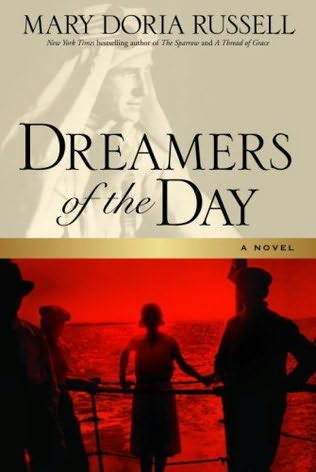
Dreamers of the Day by Mary Doria Russell, 2008, Random House Books (Literary Fiction/ Historical Fiction)


Miss Agnes Shanklin is a spinster schoolteacher in rural Ohio, the plain Jane in her family who is loved but overlooked nonetheless. She’s spent her life quietly obeying her hard-working mother and living vicariously through her sister. But when the Great War and the Great Influenza take her family away from her, Agnes is forced into the spotlight. Leaving her grief behind, Agnes takes her modest inheritance and her cheery little dachshund, Rosie, to Egypt. It’s 1921 and the world is still recovering from all those years of trench warfare, but in Cairo a peace conference is underway. Luminaries like Winston Churchill, Gertrude Bell, and Lawrence of Arabia are meeting to determine the fate of the Middle East. When Agnes wanders into their midst, her mild manner gives way to a sharp mind that serves as an ideal sounding board for their plans and ideas. Her attention is also drawn to Karl Weilbacher, an affable gentleman who showers Agnes with more kindness than she’s experienced in an entire lifetime. Karl is excessively interested in everything Agnes has to say—particularly when it relates to Churchill, Bell, Lawrence, and the plans of the European diplomats. Author Mary Doria Russell vividly portrays the real personalities who created the nations of Iraq, Syria, Lebanon, Israel, and Jordan, but it is Agnes, the fictional character who narrates this history, who readers will relate too. Inexperienced but by no means uninformed, Agnes navigates the waters of Egypt’s shifting political intrigues with a sense of wonder and wry intellect that is appealing and intimate.

The Professor’s Daughter by Joanne Sfar and Emmanuel Guibert, 2007, First Second Books (Fantasy/ Historical Fiction/ Graphic Novel)


It’s a romance for the ages, told in that most colorful of narrative forms: the graphic novel. Lillian (pert and pretty) and Imhotep (dashing and dapper) are in love, and the duo makes quite a splash as they gad about Victorian-era London. Of course, many obstacles stand in their way—Lillian is the daughter of an eminent archeology professor, and Imhotep is a bandage-wrapped mummified Prince of Ancient Egypt. Imhotep is three-thousand years old and somewhat out of touch with modern life (a single cuppa turns him into a drunken mess, insulting gentlemen and wrecking tea rooms), and Lillian’s father is unlikely to approve the match (“You are the property of the British Museum. You are dead. Stay out of this!” the Professor cries when he discovers the mummy and his daughter in each other’s arms). Imhotep’s own mummified dad, the British police force, and Queen Victoria herself get tangled up in this whimsical romantic omedy. As the sprightly forms of Lillian and Imhotep dart across the pages, readers become enchanted by the pair’s hijinks and adventures. Originally published in France in 1997, The Professor’s Daughter was translated by noted graphic novel press First Second Books in 2007. Author and artist collaborators Joann Sfar and Emmanuel Guibert are in fine form here—cheeky humor and expressive illustrations combine for a truly delightful romp.

The Red Pyramid: The Kane Chronicles, Book 1 by Rick Riordan, 2010, Hyperion Books for Children (Children’s Fiction/ Fantasy/ Adventure)


Author Rick Riordan is best known for his Percy Jackson and the Olympians books that combine the pantheon of Greek gods with a rag-tag bunch of modern kids on a heroic quest to save the world. In his new series, The Kane Chronicles, Riordan mines the equally rich Egyptian mythos for a similar but no less exciting adventure. Book one introduces Carter Kane (age 14) and Sadie Kane (age 12). Since the death of their mother six years ago, these siblings have lived separate lives. Carter roams the globe with his Egyptologist father, Julius, while Sadie lives in England with grandparents. The scattered family is reunited one Christmas Eve when Julius Kane brings his children to the British Museum. What happens there results in the destruction of the Rosetta Stone, the disappearance of Carter and Sadie’s dad, and the unleashed power of the ancient Egyptian god of chaos. This god, Set, is of course out to destroy the world and Carter and Sadie—who begin to display some unique powers of their own—are the only ones who can stop him. They are aided (and educated in Egyptian lore) by a colorful cast of magicians, gods, goddesses, and monsters. Sadie is cheeky and tenaciously curious; Carter is cautious but steadfast. The siblings’ banter (the tale is presented as a transcript of an audio recording) is as much fun as the action-packed chapters, and it’s a refreshing to have a female hero join a genre that finally features main characters with a biracial heritage (the Kane kids have a black father and a white mother). Riordan brings ancient Egypt to life and sends it crashing into the modern world. The result is non-stop, dynamic, rip-roaring adventure.

Tutankhamen: The Life and Death of the Boy-King by Christine El Mahdy, 2000, St. Martin’s Press (Nonfiction/ Ancient Egyptian History/ Pharaohs/ Biography)


Name an Egyptian pharaoh. Ten to one, the words “King Tut” came rolling out of your mouth almost automatically. When Pharaoh Tutankhamen’s untouched tomb was discovered in 1922 filled to the brim with gold and precious stones, it caused a worldwide sensation. And when several of the people involved in the excavation died of “mysterious causes” attributed to an ancient curse, Tut’s popularity went through the roof. But really, we know very little about the actual life and death of this immensely famous ancient ruler. With Tutankhamen: The Life and Death of the Boy-King, British Egyptologist Christine El Mahdy investigates the mystery that lies behind the legend. El Mahdy devoted most of her life and career to the study of Egypt’s 18th Dynasty, which ruled the country more than 3,500 years ago. She outlines the ancient geography, culture, religion, politics, and society. She relates Tutankhamen’s family tree and describes the unique period into which he was born—the pharaoh before Tut was Ahkenaten, the heretic king who turned his back on Egypt’s traditional array of gods and built a brand new city in sole honor of the sun god. She describes the riveting account of the discovery of Tut’s tomb in 1922 by Howard Carter. And she constructs a new biography of Tutankhamen, this young man who was crowned king at the age of seven, died in his tender teenage years, and was entombed with almost unimaginable wealth. Tutankhamen is accessible, intriguing, intellectual, and brimming over with the author’s unmistakable enthusiasm for her subject.