Showing posts with label nonfiction. Show all posts

Monday, April 9, 2012

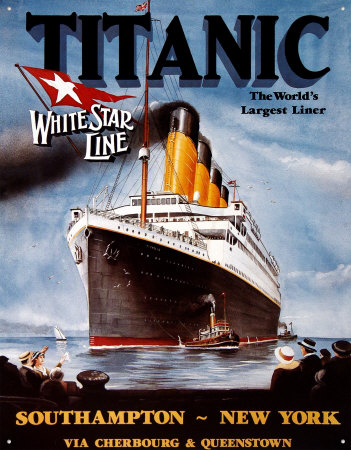
The 100th Anniversary of the Sinking of the Titanic


In the late hours of April 14th, 1912, the steamship RMS Titanic hit an iceberg. At 2:20am on the morning of the 15th, the ship sank into the depths of the Atlantic Ocean. It was the ship’s first and final voyage. Titanic was the largest and most luxurious ocean liner in the world. Some of the wealthiest and most famous people of the day were passengers. The ship was said to be “unsinkable;” over 1,500 souls went down with her that night. The disaster made headlines all around the world. One hundred years later, we’re still talking about it.

A Night to Remember by Walter Lord, 2005, Henry Holt and Co., originally published in 1955 (Nonfiction/ 20th Century History/ Maritime Disasters). 


The strict divisions between first class and third, the record-breaking size of the ocean liner, the old-fashioned heroism of “women and children first,” the ease by which the entire disaster could have been avoided, the captain going down with the ship and the band playing ‘til the very end—these details have made the sinking of the Titanic an event that is impossible to forget. In 1955, Walter Lord published the first fully researched account of the events of that fateful night. Lord supplies a wealth of information about the crew, the passengers, the construction of the ship, and all its distinct luxuries. He carefully traces the timeline that ends in tragedy. He focuses on the rigid class system that kept the steerage passengers locked below decks when the ship struck the iceberg, and on the outdated emergency standards that kept the number of lifeboats to a minimum and resulted in the deaths of more than half the people on board. Lord’s attention to detail is extraordinary—no passenger’s experience is too small to explore and record and shed light on the disaster. Nearly sixty years after its original publication, A Night to Remember is still the definitive account of the Titanic.

Building the Titanic: An Epic Tale of the Creation of History’s Most Famous Ocean Liner by Rod Green, 2005, Reader’s Digest Books (Nonfiction/ 20th Century History/ Shipbuilding). 


882 feet long, 175 feet high, weighing 46,428 tons—Titanic was the largest moving man-made object of the day. Staterooms with private promenades, squash courts, a Turkish bath, a Parisian cafĂ©—Titanic was the most luxurious ship ever built. In that respect, the White Star Line accomplished its goal of building the largest and most impressive sea-going vessel to date. Of course, the ship sinking on its maiden voyage with a loss of 1,500 people was not part of the plan. Building the Titanic is the story of the creation of the great ship. Author Rod Green explores the motives of the ship’s owners (profits and status), the lives of the men who worked in the shipyards (there were 254 recorded accidents during the building of the Titanic; eight men died), and every detail of its construction from the delivery of 45,000 table napkins to the production of a new massive dry dock to hold the ship while it was being built. Rare photographs taken by passengers during the ill-fated voyage and detailed construction plans complete this portrait of Titanic and prove that the ship was mightily impressive indeed, and well deserving of the attention she received even from her very beginning.

The Discovery of the Titanic by Robert D. Ballard, 1995, Orion Books, originally published 1987 (Nonfiction/ Deep Sea Exploration/ Science Writing). 


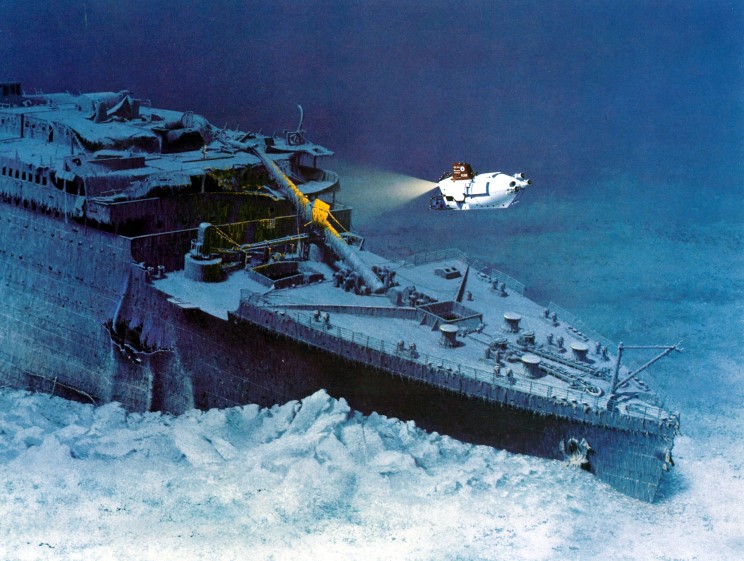
Public fascination with Titanic reached a new peak in 1985, when Dr. Robert Ballard and his American-French expedition finally found the wreck 13,000 feet below the surface of the North Atlantic. The ship lies in two pieces, bow and stern, with a scattered debris field that contains haunting signs of life and death—plates, combs, mirrors, boots—all carefully documented by Ballard’s underwater submersibles. By juxtaposing images of Titanic in all her glory with images from Titanic’s watery grave, Ballard shows how vulnerable the ship really was—and still is. In 2004 Ballard visited the wreckage again and published Return to the Titanic with all-new high-quality images and an impassioned plea for preservation of the site. A final book, 2008’s Titanic: The Last Great Images, is an attempt to document the wreck before it is gone forever, picked away by the ravages of time and even more so by scavengers who seek to get rich from Titanic’s ruin and aren’t so bothered if their submersible scrapes a railing or removes an artifact. Ballard’s case for conservation is a strong one; the long search for Titanic’s resting place is a riveting tale of perseverance and scientific ingenuity; the ghostly images of the sunken ship are mesmerizing.

The Watch That Ends the Night: Voices from the Titanic by Allen Wolf, 2011, Candlewick Press (Young Adult Fiction/ Historical Fiction/ Novels in Verse). 


Everyone knows how the story ends—with a lost ship and a few boatloads of survivors in the frigid waters of the Atlantic Ocean. But the stories of the people on the Titanic continue to fascinate and resonate. Author Allen Wolf tells two dozen of those stories in The Watch That Ends the Night, a novel-in-verse featuring the voices of millionaire John Jacob Astor, wireless operator Harold Bride, immigrant Olaus Abelseth, third-class refugee Jamila, the woman who became known as “Unsinkable Molly Brown,” the ship’s baker, the violinist, an on-board rat, and many others—including the iceberg itself. Wolf mixes fact and fiction for a work that is epic in scope, from the musings of doomed Captain Smith to the babblings of near-infant Lolo Navratil. Cementing the story is the occasional report from undertaker John Snow, who helps to harvest the bodies from the sea days after the disaster. Though mournful at times, The Watch That Ends the Night has its fair share of brave deeds and meaningful connections. With over thirty pages of biographies and resources, this is an impressive work that adds a crucial human touch to the facts and statistics that make up the Titanic’s remarkable history.

Fateful by Claudia Gray, 2011, HarperTeen Books (Young Adult Fiction/ Historical Fiction/ Fantasy). 


Fateful is a romance about werewolves on the Titanic. That’s right: werewolves on the Titanic. Preposterous? Of course. Fun? Absolutely. Tess Davies is a maid for the snobbish Lisle family, and she’s finally had enough. She’s taking this opportunity to break free: when Titanic reaches New York, Tess will strike out on her own. But a seemingly chance encounter with two men—one sinister, one handsome—has Tess looking over her shoulder as she boards the mighty ship. Sure enough, the two strangers are on board and on the prowl. Mikhail is a dangerous werewolf representing the Brotherhood, a powerful paranormal faction. Alec is also a (very wealthy and attractive first class) werewolf, but he’s clinging to his sense of humanity and desperate to do no harm. Mikhail is after Alec’s fortune but there’s something else on Titanic—something that belongs to the Lisle family—and Mikhail’s not going to let some gutsy little maidservant stand in his way. As Tess is drawn deeper in the werewolves’ affairs, the ship has its own fateful encounter with an iceberg that will foil the best-laid plans of wolf and maid. Melodramatic, with a steamy romance and plenty of action, Fateful is an entirely worthwhile guilty pleasure.

Passage by Connie Willis, 2001, Bantam Books (Science Fiction). 
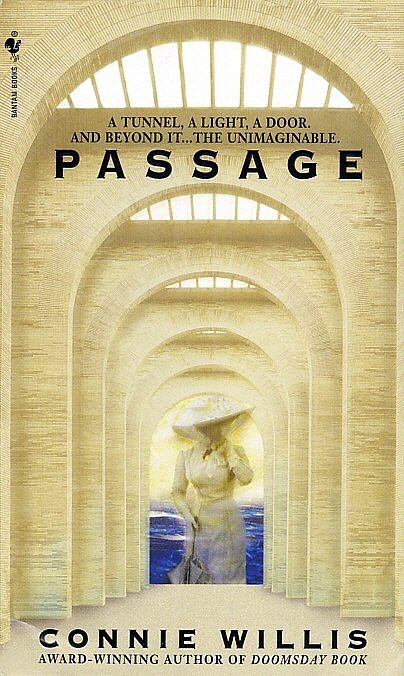


Connie Willis is an acclaimed science fiction writer who happens to love history. Her Hugo- and Nebula-winning novel Doomsday Book sends a graduate student back in time to the Dark Ages; her comic gem To Say Nothing of the Dog mixes the Victorian Era with World War II. In Passage, Dr. Joanna Lander is a psychologist researching near-death experiences (or NDEs). She’s developed a drug that can stimulate the experience and is working with neurologist Richard Wright on a theory that NDEs are actually a survival mechanism. But when Joanna goes under herself in a stimulated NDE, what she finds is completely unexpected—it’s the Titanic, and neither Joanna nor Richard have any idea what it means. But Willis drops plenty of hints, all the while distracting her protagonists with chance meetings, half-forgotten conversations, and characters as varied as a smart little girl with a severe heart condition and a swarmy fellow doctor who wants to use their research to promote his own career. As Joanna explores her strange experience farther and farther, the tension and the mystery build to a fever pitch—and then there’s the intense plot twist just before the ending. Suspenseful and powerful, reading Passage is an unforgettable experience.

Down with the Old Canoe: A Cultural History of the Titanic Disaster by Steven Biel, 2003, W.W. Norton and Co. (Nonfiction/ Social History/ Cultural History). 



Why are we so fascinated by the Titanic? Is it the hubris of its era, the excessive luxury coupled with the subpar safety measures? Is it all the “what ifs” that could have prevented the disaster, from the ignored ice warnings to the nearby ship that could have saved every soul on board had it ventured to find out what was going on? Is it the striking class differences that meant Sir Cosmo and Lady Duff Gordon set sail in a lifeboat built for forty with only two other passengers and twelve crewmen to row them, while hundreds of third class passengers were kept below decks until the last minute? Author Stephen Biel explores the cultural history of the Titanic, from its effect on the suffrage movement (the old standby of “women and children first” meant that men were made into easy heroes who stood for strength and power while the women survivors were weaklings who needed protection) to the commercialization of the disaster in the form of books (including his own), movies, and exhibitions. He touches on all of Titanic’s roles throughout history:  status symbol, news sensation, metaphor, commodity, and entertainment. Regardless of how much time goes by, Titanic will always give us something to talk about.

The Night Lives On by Walter Lord, 1987, Avon Books (Nonfiction/ 20th Century History Shipwrecks).


Walter Lord remained devoted to the story of the Titanic after writing his groundbreaking account of the disaster A Night to Remember in 1955. When the wreckage was discovered in 1985, Lord couldn’t resist another rumination on the great ship’s lasting legacy. In The Night Lives On, Lord delves deeper into mysteries and myths that have accumulated over the decades. He sheds light on the rumor that a crewman shot into a crowd of passengers swarming around the last of the lifeboats. He ponders the pride and arrogance of the Edwardian age that is so frustrating to modern minds in the light of all the “what ifs” that could have changed the course of Titanic’s history. He pours over the records for eyewitness accounts of the ship splitting in two and the band playing ‘til the end. He contrasts the reactions of the ships Carpathia and Californian—the former rushed to Titanic’s aid but was over fifty miles away; the later passively puzzled over strange lights and rockets in the night from a distance of just fifteen miles or so. As it asks new questions, rights wrongs, and sets the record straight, The Night Lives On is another detailed, engrossing account of all things Titanic.

Tuesday, September 27, 2011

The Assassination of Abraham Lincoln


It’s been 146 years since John Wilkes Booth walked into a theater and shot Abraham Lincoln in the head. But our collective interest in that event has not dimmed. Consider a few details from that fateful night—Booth had only a few hours to plan the assassination; Lincoln had recurring dreams and premonitions about his death; Booth knew the play so well that he could anticipate the crowds’ laughter to cover the sound of the shot. And then there’s the remarkable cast of supporting characters—Mary Surratt (the first woman in American history to be executed by the federal government), Secretary of State William Seward (who survived a near-fatal assault by another assassin at the exact moment Booth was killing Lincoln), and Robert Lincoln (Abe’s son who would be at hand to witness two more presidential shootings). It’s no wonder we’re still fascinated by the assassination of Abraham Lincoln.


Lincoln Shot: A President Remembered by Barry Denenberg, illustrated by Christopher H. Bing, 2008, Feiwel and Friends Books (Nonfiction/ Children’s Picture Book/ Biography).


Purporting to be a commemorative edition of the (fictional) 1866 National News, published on the one-year anniversary of Abraham Lincoln’s death, this striking (and large—it’s nearly two feet tall) picture book combines history with the art of book design to present an object that is both a pleasure to read and a wealth of information. Faux-contemporary articles narrate the events at Ford’s Theater; cover the hunt for Booth and the conspirators’ trial; and provide biographies of Lincoln, his family, and his generals. Photographs, posters, maps, and original artwork by Christopher H. Bing—combined with yellowed pages, old-fashioned type, and advertisements from the era—complete the illusion that we’re reading an antique 19th century newspaper documenting the crime that changed the nation. And it’s an illusion readers are more than willing to buy into, given that its creators have gone to such lengths to make it so authentic and so engrossing.


Lincoln’s Assassins: Their Trial and Execution—An Illustrated History by James L. Swanson and Daniel R. Weinberg, 2006, William Morrow Books (Nonfiction/ Civil War History).


The assassination is not just the story of John Wilkes Booth and Abraham Lincoln. Sure, we know dramatic details like Booth’s theatrical leap to the stage after the shooting, but this illustrated history gathers all the lesser-known but no less compelling facts of the case—Booth’s numerous schemes and failed plans before his final successful murder attempt, the extensive network of Confederate spies and sympathizers that Booth relied on, Booth’s dramatic escape and capture, and the trial and execution of the men (and woman) who aided him. The story is conveyed through detailed summaries written by two men who are assassination experts. Reproductions of newspapers articles and illustrations cover nearly every page, and the haunting faces of Booth’s accomplices stare out from their post-capture portraits. It’s a bit morbidly fascinating, but this astonishing collection of images provides one of the most accurate, intelligent, and comprehensive looks at the Lincoln assassination.


Manhunt: The 12-Day Chase for Lincoln’s Killer by James L. Swanson, 2006, William Morrow Books (Nonfiction/ Civil War History).


James L. Swanson, co-author of Lincoln’s Assassins, here focuses on the events immediately after Lincoln’s murder. An angry, bitter, South-sympathizing Booth stumbles across an unforeseen opportunity, acts on it, and flees into the night. The next twelve days will shock a nation still reeling from the barely-ended Civil War. Manhunt becomes a gripping page-turner as Booth literally breaks a leg during his dramatic leap to the stage, cons his way across the bridge to Maryland, hides in the woods for days with his naĂŻve accomplice David Herold, and makes a desperate bid for safety in the Deep South. Booth’s obsessions and hatreds, his deep-seated desire for fame and notoriety, his immense ego—not to mention his ill-luck and miserable mistakes—take center stage here, and the results are compelling. Swanson picks up where Manhunt leaves off with Bloody Crimes: The Chase for Jefferson Davis and the Death Pageant for Lincoln’s Corpse.


The Assassin’s Accomplice: Mary Surratt and the Plot to Kill Abraham Lincoln by Kate Clifford Larson, 2008, Basic Books (Nonfiction/ Biography/ Civil War History).


One of the most compelling characters in the story of the Lincoln assassination is Mary Surratt, the only female conspirator and the first woman executed by the federal government. Mary was the mother of John Surratt, one of Booth’s most infamous accomplices. Booth was a constant visitor at the Surratt boarding house in Washington, D.C.—he even visited Mary the day of the murder. In short, the Surratt home was the center of operations for the assassination conspiracy. When Mary was inevitably arrested (her Southern sympathies were no secret), the public was shocked that a gentlewoman could be involved so directly in such a deplorable plot. When Mary was sentenced to death, the nation was outraged that their government could be so harsh to a mere woman. The Assassin’s Accomplice reveals Mary Surratt as a strong-willed woman who made no qualms about what she believed—and who paid for those beliefs with her life.


The Murder of Abraham Lincoln: A Chronicle of 62 Days in the Life of the American Republic, March 4-May 4, 1865 written and illustrated by Rick Geary, 2005, NBM ComicsLit (Comics/ Nonfiction Graphic Novel).


What better way to learn about the assassination of Abraham Lincoln than through the artistic stylings of a comic book from a series called A Treasury of Victorian Murder? Author and illustrator Rick Geary begins on March 4th, 1865 (the date of Lincoln’s second inauguration) and doesn’t let up until the President’s body is laid to rest on May 4th. Geary’s dialogue adds flare to the already-inherent drama of the events, his maps of places and buildings are immensely helpful in getting a sense of the action, and the particulars of the time period are rendered with a carefulness that speaks of thorough research and attention to detail. The story unfolds seamlessly as page after page of Geary’s rich black-and-white illustrations (reminiscent of 19th century newspaper engravings) flow by. Plus it’s just fun to see Honest Abe and the villainous Booth done up as cartoons, complete with stovepipe hat and twirling mustache.


Assassination Vacation by Sarah Vowell, 2005, Simon and Schuster Books (History Writing/ Travel Writing).


Sarah Vowell loves a good assassination—so much so that she goes on a cross-country vacation to visit the sights associated with three presidential murders: James A. Garfield, shot by deluded Charles Guiteau in 1881; William McKinley, shot by anarchist Leon Czolgosz in 1901; and of course good old honest Abe Lincoln, shot by John Wilkes Booth back in 1865. Vowell’s obsession with the Lincoln assassination takes up quite a bit of this delightfully oddball book. It is here that we find out about Robert Lincoln (aka “Jinxy McDeath”) and his penchant for being nearby when presidents were killed. We also learn where Lincoln’s brain ended up and that Vowel has a crush on the actor who played John Wilkes Booth in the off-Broadway musical Assassins. Quirky, witty, and endlessly enjoyable, Assassination Vacation supplies everything you ever wanted to know about the Lincoln assassination but didn’t even know you wanted to ask.

Saturday, July 16, 2011

ARCs @ ALA


There’s nothing like a half-mile long convention center exhibit hall full of publishers throwing books at you to get you back in the mood for book-blogging. The American Library Association (ALA) Annual Conference was in New Orleans last month, and the exhibit hall was a librarian’s heaven on earth. You’d walk past a table and a book would appear in your hands—an ARC, or Advanced Reading Copy. Many of those ARCs were new graphic novels and illustrated books that represent an especially exciting trend in publishing right now. Here are some new and up-coming titles, fresh from the forty-pound bag of books that this librarian lugged across that exhibit hall, through the convention center, and down the streets of New Orleans.

Wonderstruck by Brian Selznick, Sep. 11, 2011, Scholastic Books (Children’s Illustrated Novel)


Brian Selznick’s debut novel, The Invention of Hugo Cabret, won the Caldecott Medal. Selznick’s second book, Wonderstruck, continues to push the boundaries of the illustrated novel format. Just as Hugo Cabret told a good portion of its story through full-page black-and-white drawings, Wonderstruck is also full of Selznick’s trademark illustrations. But this time, half the novel is told through pictures alone—the story of Rose, a girl in the 1920s who becomes enchanted with a beautiful actress. Ben’s story, set in 1977 as he runs away from home, is told in words. Combined, the stories of Rose and Ben offer tales of mystery and intrigue that wind and weld through a union of art and prose. Selznick has become an expert at mixing elements of the novel, graphic novel, picture book, and film, and Wonderstruck continues to cement his reputation as a visionary in his field.

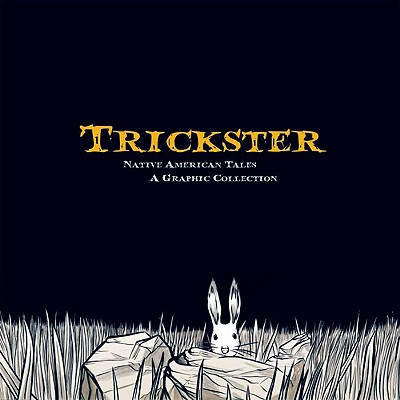
Trickster: Native American Tales—A Graphic Collection edited by Matt Dembicki, 2010, Fulcrum Books (Graphic Novel Anthology)


Native American stories are often overlooked in literature; even more so in the graphic novel boom that has swept book publishing the last few years. But Trickster: Native American Tales remedies all that—and does so in an intelligent, artistic, and truly delightful way. Collecting various interpretations of the Trickster character and myth just as it collects different artists and authors to tell the tales, Trickster is a unique and authentic anthology. The artwork ranges in style from bubbly cartoon rabbits to realistic raccoons to black-and-white inked coyotes and ravens; the tales are drawn from many cultures to emphasis the distinct differences between North America’s tribal groups. But it’s not only educational information about a too-often-ignored history; Trickster is as genuinely funny as it is thought-provoking. Whether he’s a coyote creating stars in the sky or a rabbit out-witting bison, there’s something for everyone in the tales of the Trickster.

Around the World: Three Remarkable Journeys by Matt Phelan, Oct. 11, 2011, Candlewick Press (Children’s Graphic Nonfiction)


Picture book illustrator Matt Phelan won critical acclaim for his 2009 historical graphic novel The Storm in the Barn, a Depression-era story tinged with fantasy. His new book, Around the World, is no less enchanting for being based on fact. In 1873, Jules Verne published Around the World in Eighty Days, his famous adventure story about a high-stakes race around the world. The novel captured the public imagination, and a few intrepid real-life adventures determined to embark on their own worldwide round-trips. Phelan’s beautifully illustrated book follows ex-miner Thomas Stevens on his bicycle (the old-fashioned kind with the giant front wheel), sea captain Joshua Slocum all alone on his thirty-six-foot ship, and sassy reporter Nellie Bly as she charges around the globe to beat Jules Verne’s fictional eighty-day challenge. The adventures are thrilling enough in black and white; the final book will be published in glorious full color.

The Wikkeling by Steve Arntson, illustrated by Daniela Jaglenka Terrazinni, 2011, Running Press Kids Books (Children’s Illustrated Novel)


Henrietta’s life is controlled by rigid rules that “protect” her from deadly things like house cats (dangerous wild animals) and old books (which can make you sick). But one night Henrietta finds an injured cat in a secret attic. From the tip-top windows, she can see her neighborhood the way it used to look in the idyllic way-back-when days. Good things rarely last, however, and soon a mysterious, long-fingered yellow creature called the Wikkeling is haunting Henrietta. Its mere touch can give you a headache, and it wants to know where you’ve been and what you’ve seen. As Henrietta investigates this menacing apparition and the world she lives in, readers are delightfully creeped out by illustrator Daniela J. Terrazinni’s stark and wild drawings. The dystopian world of The Wikkeling is eerily similar to our own, and that is of course where its real appeal lies.

The Chronicles of Harris Burdick: Fourteen Amazing Authors Tell the Tales by Chris Van Allsburg, Sherman Alexie, M.T. Anderson, Kate DiCamillo, Cory Doctorow, Jules Feiffer, Stephen King, Tabitha King, Lois Lowry, Gregory Maguire, Walter Dean Myers, Linda Sue Park, Louis Sachar, and Jon Scieszka with an introduction by Lemony Snicket, Oct. 25, 2011, Houghton Mifflin Books (Children’s Picture Book/ Short Story Collection)


Since it was first published in 1984, The Mysteries of Harris Burdick by Chris Van Allsburg has been inspiring people to write stories. The original introduction tells of Harris Burdick, a man who left his artwork with a publisher and walked out the door—never to return again. The fourteen fascinating illustrations and their even-more fascinating captions remain to motivate writers all around the world. Now, twenty-seven years later, the best and brightest of children’s and young adult literature contribute their stories to the Harris Burdick oeuvre. In October, readers young and old can experience Lois Lowry’s story about the nun flying through the cathedral whilst seated primly in a wooden chair, Stephen King’s tale about the blast-off house, and Chris Van Allsburg’s own version of the girl and her caterpillars. By turns creepy, cute, and comical, this new batch of stories will inspire Harris Burdick fans all over again.

Moby-Dick in Pictures: One Drawing for Every Page by Matt Kish, Oct. 11, 2011, Tin House Books (Illustrated Novel)


One day in 2009, Matt Kish, a librarian and artist in Ohio, was inspired by his “undying love” for a big book about a man and a whale. Kish decided to draw an illustration for every page of the Signet Classics edition of—you guessed it—Herman Melville’s Moby-Dick. Two years and 552 pages later, Kish’s project is complete. Using common materials and found pages, Kish deliberately employed a low-tech style in response to the increasing amount of digitally produced book art. A quote or passage from each page of Moby-Dick is Kish’s inspiration, and the result—seen in a few promotional postcards and a simple BLAD (Book Layout and Design, a sort of six-to-twelve-page mini-ARC)—is beautiful, fun, and inspiring. Kish began his Moby-Dick drawings as an art project for his modest blog; in a few months his artistic interpretation of Melville’s masterpiece will be available to one and all.

Tuesday, March 29, 2011

Why We Love Jane


Jane Austen (1775-1817) is more popular today than she ever was in her all-too brief life. Arguably the best-known female writer in literary history, Jane wrote only six books—Sense and Sensibility, Pride and Prejudice, Emma, Mansfield Park, Northanger Abbey, and Persuasion—before she died at the age of forty-two. Some think of her as the ultimate romantic, the founding mother of the chick lit genre. Some admire her keen wit and observant eye, seeing in Jane an uncanny ability to critique society. Not merely content to read Jane’s books, we’ve created an entire industry around her legacy—sequels, prequels, spin-offs, modern adaptations, and a unique body of work that analyzes why exactly we’re so fond of dear old Jane.

Jane Austen: A Life by Claire Tomalin, 1997, Alfred A. Knopf Books (Biography/ 19th Century English Novelists) 


The first biography of Jane Austen was published a few years after her death by a nephew; it was meant to be the final word on “Aunt Jane” and her quiet, humble existence. To her later biographers, Jane proved exceptionally elusive—despite leading such a supposedly ordinary existence, there are very few records, notes, letters, or other papers that reveal what Jane was really like. Guesswork is a must for an Austen biographer, especially since sister Cassandra destroyed many of Jane’s letters, which hints at a private life that was more dramatic than historical fact leads us to believe. Jane Austen: A Life, the 1997 biography by Claire Tomalin, is one of the best. Tomalin reveals details about the lives of family and friends to throw light on how Jane lived and worked and thought and felt; Jane’s life is placed firmly in its context of 18th and 19th century religion, politics, and war. Most importantly, the evolution of Jane’s writing is thoughtfully traced. The reader is left with a vivid sense of Jane, her work, and her life. And that, given the difficulty of truly explaining Jane, is the best Austen fans can wish for.

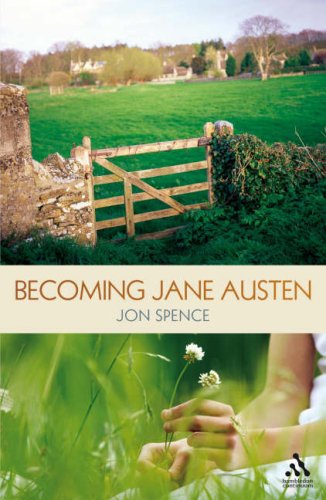
Becoming Jane Austen: A Life by Jon Spence, 2007, Hambledon Continuum Books (Biography/ 19th Century English Novelists)


The only other writing Jane left behind (besides her novels, a few half-finished works-in-progress, and a handful of childhood scribblings) is her letters. Jane’s elegant literary style is not on show in these missives; these are everyday thoughts put down on the spur of the moment, gossip, news, and family jokes. But there is one tantalizing incident—a flirtation with one “Tom Lefroy.” Tom and Jane met, danced, chatted, and parted forever. Schoolgirl crush or doomed love affair? We’ll never know, but that doesn’t stop biographer Jon Spence from speculating that this relationship was a turning point in Jane’s life that directly inspired the love stories she later wrote. Spence also highlights the possible influence of Jane’s fashionable, glamorous cousin Eliza de Feuillide, whose first husband was guillotined during the French Revolution. By making connections between historical fact and literary fiction, Spence infuses Jane’s life with the romance and drama that Austen fans long to know she experienced. Becoming Jane Austen was the inspiration for the 2007 Hollywood movie Becoming Jane, which firmly casts Jane Austen as the heroine in her very own romantic comedy.


“The Janeites” in Collected Stories by Rudyard Kipling, 1999, Everyman’s Library/ Alfred A. Knopf Books, originally published 1922 (Fiction/ Short Story Collections)


Rudyard Kipling’s 1922 “The Janeites” is one of the first stories to mention Jane Austen as a member of the literary canon, as an author one is expected to know and love. In the story, a simple-minded ex-soldier recounts how, thanks to Jane, he survived World War I. Humberstall is wounded and reassigned to the position of assistant mess waiter. While he’s working, he notices the senior mess waiter conversing on equal terms with military officers. The subject, of course, is Jane Austen. Humberstall has never heard of this “Jane woman,” but he can tell that a passion for her is something akin to being a member of a secret society. Soon Humberstall is escaping the horrors of war by learning the meaning of “Tilney,” learning how to spell “Catherine De Bugg,” naming artillery after other characters, and gossiping about whether Jane ever got married. Humberstall tells his own story so Kipling writes in a lower-class British dialect; it’s charming (once you get used to it) and Austen fans will get a kick out of Humberstall’s crash-course in all things Austen.

“Jane Austen Faints” in Virginia Woolf’s Nose: Essays on Biography by Hermione Lee, 2005, Princeton University Press (Nonfiction/ Literary History and Analysis/ Biography)


How does a biographer handle the ambiguities, contradictions, missing years, mythmaking, facts, and fictions? When British writer Hermione Lee gets to the case of Jane Austen, she has plenty to talk about. Given the piddling amount of factual information that exists from Jane’s forty-two years on earth, Austen is a notoriously tough subject. Any incident that is known—no matter how trivial—is ripe for debate. Once, according to family legend, Jane Austen fainted. The cause was the unexpected news that Mr. Austen had decided to move the family to Bath; the result has been intense biographical speculation. This is Jane exhibiting extreme emotion; it must be important. Lee examines various Austen bios see what different writers have made of the incident. Is Jane shocked by how sudden the news is? Terrified of city life, away from the familiar green countryside? Afraid a secret love affair has been uncovered and she is being forcibly separated from her suitor? The real cause is unknown, and so every biographer’s point of view colors our vision of Austen—and forces us to question whether we can ever really know Jane as well as we think we do.

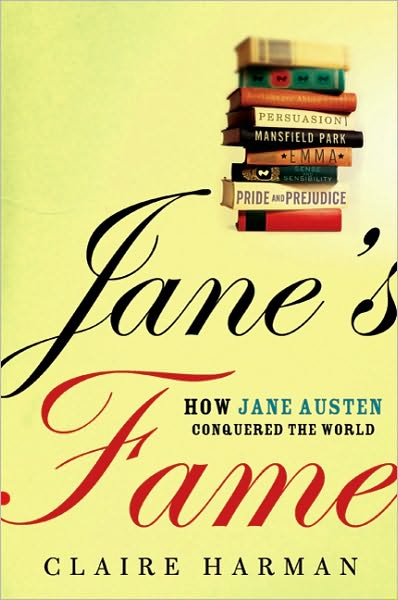
Jane’s Fame: How Jane Austen Conquered the World by Claire Harman, 2009, Henry Holt and Co. (Nonfiction/ Literary History and Analysis/ 19th Century English Novelists)


Even if you’ve never read any of Austen’s books, you’re familiar with their titles and plots. Note the success of the BBC’s TV Pride and Prejudice miniseries starring Colin Firth as Mr. Darcy, or the chick lit bestseller Bridget Jones’s Diary (a modern retelling of Pride and Prejudice, complete with its own Mr. Darcy), or the Hollywood movie Clueless (a modern retelling of Emma), or the recent book mash-up Pride and Prejudice and Zombies. Today, Jane is everywhere, and author Claire Harmon shows us how she got there. This is a biography not of Jane’s life but of her fame—her quiet life followed by a few brief decades where no one knew her name, and then a century-long revival that has yet to end. Harman shows us Jane as a feminist and as an anti-feminist, Jane as a prickly old maid and Jane as a token for “girl power,” Jane as a Hollywood heroine and as a Bollywood starlet. We meet Jane’s detractors (Charlotte BrontĂ«, Mark Twain) and Jane’s fans (Rudyard Kipling, Virginia Woolf). We figure out our own personal reasons for loving Jane. However she is viewed and analyzed and adapted, one thing becomes very clear in this fascinating exploration—Jane Austen is here to stay.

Sanditon and Other Stories by Jane Austen, 1996, Everyman’s Library, originally published 1870-1871 (Fiction Classics)


Forget all the sequels, prequels, and spin-offs. Never mind the sexual innuendos in Mr. Darcy Takes a Wife and the cartoon violence in Sense and Sensibility and Sea Monsters. Throw out the mystery series starring Mr. and Mrs. Darcy (by Carrie Bebris) and the mystery series starring Jane herself (by Stephanie Barron). You don’t need the next best thing; there IS more Jane. When she died, Jane left several unpublished works. Two of these we know as Northanger Abbey and Persuasion, but the fragmentary Sanditon, the few chapters of The Watsons, and the novella Lady Susan showcase Jane at her finest. Sanditon begins with an overturned carriage, several gossipy chapters about the characters’ lives, and ends just when the heroine becomes entangled in a romantic mystery. The Watsons features a young lady brought up by wealthy relations and shipped back to her poor family in the country—rather the opposite of Mansfield Park’s Fanny Price. Lady Susan is a sassy little tale about a man-hunting widow who wants her daughter to marry well—and herself to remarry even better. These fragments, believe it or not, are every bit as good as the real thing.