Showing posts with label novels in verse. Show all posts

Monday, April 9, 2012

The 100th Anniversary of the Sinking of the Titanic


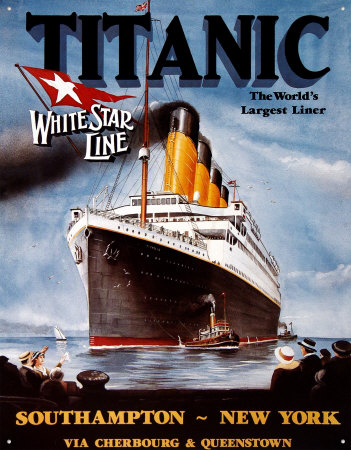
In the late hours of April 14th, 1912, the steamship RMS Titanic hit an iceberg. At 2:20am on the morning of the 15th, the ship sank into the depths of the Atlantic Ocean. It was the ship’s first and final voyage. Titanic was the largest and most luxurious ocean liner in the world. Some of the wealthiest and most famous people of the day were passengers. The ship was said to be “unsinkable;” over 1,500 souls went down with her that night. The disaster made headlines all around the world. One hundred years later, we’re still talking about it.

A Night to Remember by Walter Lord, 2005, Henry Holt and Co., originally published in 1955 (Nonfiction/ 20th Century History/ Maritime Disasters). 


The strict divisions between first class and third, the record-breaking size of the ocean liner, the old-fashioned heroism of “women and children first,” the ease by which the entire disaster could have been avoided, the captain going down with the ship and the band playing ‘til the very end—these details have made the sinking of the Titanic an event that is impossible to forget. In 1955, Walter Lord published the first fully researched account of the events of that fateful night. Lord supplies a wealth of information about the crew, the passengers, the construction of the ship, and all its distinct luxuries. He carefully traces the timeline that ends in tragedy. He focuses on the rigid class system that kept the steerage passengers locked below decks when the ship struck the iceberg, and on the outdated emergency standards that kept the number of lifeboats to a minimum and resulted in the deaths of more than half the people on board. Lord’s attention to detail is extraordinary—no passenger’s experience is too small to explore and record and shed light on the disaster. Nearly sixty years after its original publication, A Night to Remember is still the definitive account of the Titanic.

Building the Titanic: An Epic Tale of the Creation of History’s Most Famous Ocean Liner by Rod Green, 2005, Reader’s Digest Books (Nonfiction/ 20th Century History/ Shipbuilding). 


882 feet long, 175 feet high, weighing 46,428 tons—Titanic was the largest moving man-made object of the day. Staterooms with private promenades, squash courts, a Turkish bath, a Parisian café—Titanic was the most luxurious ship ever built. In that respect, the White Star Line accomplished its goal of building the largest and most impressive sea-going vessel to date. Of course, the ship sinking on its maiden voyage with a loss of 1,500 people was not part of the plan. Building the Titanic is the story of the creation of the great ship. Author Rod Green explores the motives of the ship’s owners (profits and status), the lives of the men who worked in the shipyards (there were 254 recorded accidents during the building of the Titanic; eight men died), and every detail of its construction from the delivery of 45,000 table napkins to the production of a new massive dry dock to hold the ship while it was being built. Rare photographs taken by passengers during the ill-fated voyage and detailed construction plans complete this portrait of Titanic and prove that the ship was mightily impressive indeed, and well deserving of the attention she received even from her very beginning.

The Discovery of the Titanic by Robert D. Ballard, 1995, Orion Books, originally published 1987 (Nonfiction/ Deep Sea Exploration/ Science Writing). 


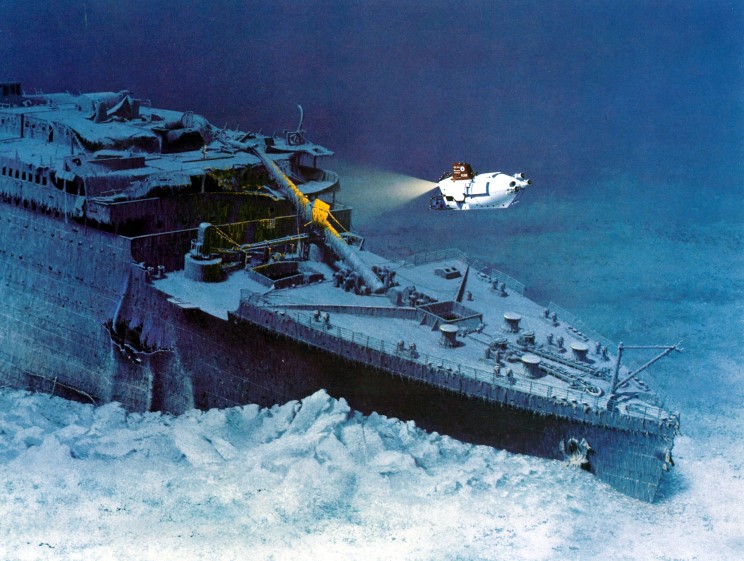
Public fascination with Titanic reached a new peak in 1985, when Dr. Robert Ballard and his American-French expedition finally found the wreck 13,000 feet below the surface of the North Atlantic. The ship lies in two pieces, bow and stern, with a scattered debris field that contains haunting signs of life and death—plates, combs, mirrors, boots—all carefully documented by Ballard’s underwater submersibles. By juxtaposing images of Titanic in all her glory with images from Titanic’s watery grave, Ballard shows how vulnerable the ship really was—and still is. In 2004 Ballard visited the wreckage again and published Return to the Titanic with all-new high-quality images and an impassioned plea for preservation of the site. A final book, 2008’s Titanic: The Last Great Images, is an attempt to document the wreck before it is gone forever, picked away by the ravages of time and even more so by scavengers who seek to get rich from Titanic’s ruin and aren’t so bothered if their submersible scrapes a railing or removes an artifact. Ballard’s case for conservation is a strong one; the long search for Titanic’s resting place is a riveting tale of perseverance and scientific ingenuity; the ghostly images of the sunken ship are mesmerizing.

The Watch That Ends the Night: Voices from the Titanic by Allen Wolf, 2011, Candlewick Press (Young Adult Fiction/ Historical Fiction/ Novels in Verse). 


Everyone knows how the story ends—with a lost ship and a few boatloads of survivors in the frigid waters of the Atlantic Ocean. But the stories of the people on the Titanic continue to fascinate and resonate. Author Allen Wolf tells two dozen of those stories in The Watch That Ends the Night, a novel-in-verse featuring the voices of millionaire John Jacob Astor, wireless operator Harold Bride, immigrant Olaus Abelseth, third-class refugee Jamila, the woman who became known as “Unsinkable Molly Brown,” the ship’s baker, the violinist, an on-board rat, and many others—including the iceberg itself. Wolf mixes fact and fiction for a work that is epic in scope, from the musings of doomed Captain Smith to the babblings of near-infant Lolo Navratil. Cementing the story is the occasional report from undertaker John Snow, who helps to harvest the bodies from the sea days after the disaster. Though mournful at times, The Watch That Ends the Night has its fair share of brave deeds and meaningful connections. With over thirty pages of biographies and resources, this is an impressive work that adds a crucial human touch to the facts and statistics that make up the Titanic’s remarkable history.

Fateful by Claudia Gray, 2011, HarperTeen Books (Young Adult Fiction/ Historical Fiction/ Fantasy). 


Fateful is a romance about werewolves on the Titanic. That’s right: werewolves on the Titanic. Preposterous? Of course. Fun? Absolutely. Tess Davies is a maid for the snobbish Lisle family, and she’s finally had enough. She’s taking this opportunity to break free: when Titanic reaches New York, Tess will strike out on her own. But a seemingly chance encounter with two men—one sinister, one handsome—has Tess looking over her shoulder as she boards the mighty ship. Sure enough, the two strangers are on board and on the prowl. Mikhail is a dangerous werewolf representing the Brotherhood, a powerful paranormal faction. Alec is also a (very wealthy and attractive first class) werewolf, but he’s clinging to his sense of humanity and desperate to do no harm. Mikhail is after Alec’s fortune but there’s something else on Titanic—something that belongs to the Lisle family—and Mikhail’s not going to let some gutsy little maidservant stand in his way. As Tess is drawn deeper in the werewolves’ affairs, the ship has its own fateful encounter with an iceberg that will foil the best-laid plans of wolf and maid. Melodramatic, with a steamy romance and plenty of action, Fateful is an entirely worthwhile guilty pleasure.

Passage by Connie Willis, 2001, Bantam Books (Science Fiction). 
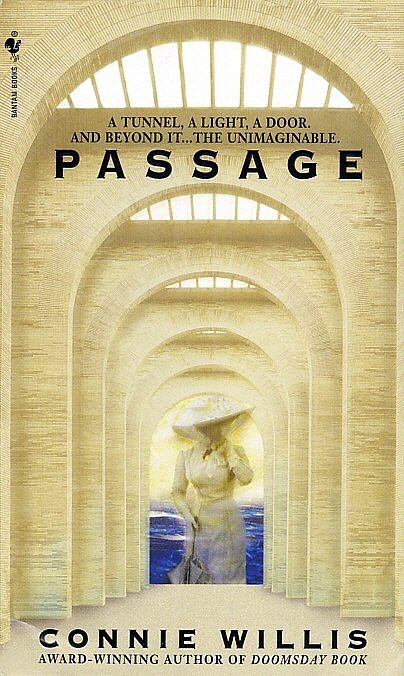


Connie Willis is an acclaimed science fiction writer who happens to love history. Her Hugo- and Nebula-winning novel Doomsday Book sends a graduate student back in time to the Dark Ages; her comic gem To Say Nothing of the Dog mixes the Victorian Era with World War II. In Passage, Dr. Joanna Lander is a psychologist researching near-death experiences (or NDEs). She’s developed a drug that can stimulate the experience and is working with neurologist Richard Wright on a theory that NDEs are actually a survival mechanism. But when Joanna goes under herself in a stimulated NDE, what she finds is completely unexpected—it’s the Titanic, and neither Joanna nor Richard have any idea what it means. But Willis drops plenty of hints, all the while distracting her protagonists with chance meetings, half-forgotten conversations, and characters as varied as a smart little girl with a severe heart condition and a swarmy fellow doctor who wants to use their research to promote his own career. As Joanna explores her strange experience farther and farther, the tension and the mystery build to a fever pitch—and then there’s the intense plot twist just before the ending. Suspenseful and powerful, reading Passage is an unforgettable experience.

Down with the Old Canoe: A Cultural History of the Titanic Disaster by Steven Biel, 2003, W.W. Norton and Co. (Nonfiction/ Social History/ Cultural History). 


Why are we so fascinated by the Titanic? Is it the hubris of its era, the excessive luxury coupled with the subpar safety measures? Is it all the “what ifs” that could have prevented the disaster, from the ignored ice warnings to the nearby ship that could have saved every soul on board had it ventured to find out what was going on? Is it the striking class differences that meant Sir Cosmo and Lady Duff Gordon set sail in a lifeboat built for forty with only two other passengers and twelve crewmen to row them, while hundreds of third class passengers were kept below decks until the last minute? Author Stephen Biel explores the cultural history of the Titanic, from its effect on the suffrage movement (the old standby of “women and children first” meant that men were made into easy heroes who stood for strength and power while the women survivors were weaklings who needed protection) to the commercialization of the disaster in the form of books (including his own), movies, and exhibitions. He touches on all of Titanic’s roles throughout history:  status symbol, news sensation, metaphor, commodity, and entertainment. Regardless of how much time goes by, Titanic will always give us something to talk about.

The Night Lives On by Walter Lord, 1987, Avon Books (Nonfiction/ 20th Century History Shipwrecks).


Walter Lord remained devoted to the story of the Titanic after writing his groundbreaking account of the disaster A Night to Remember in 1955. When the wreckage was discovered in 1985, Lord couldn’t resist another rumination on the great ship’s lasting legacy. In The Night Lives On, Lord delves deeper into mysteries and myths that have accumulated over the decades. He sheds light on the rumor that a crewman shot into a crowd of passengers swarming around the last of the lifeboats. He ponders the pride and arrogance of the Edwardian age that is so frustrating to modern minds in the light of all the “what ifs” that could have changed the course of Titanic’s history. He pours over the records for eyewitness accounts of the ship splitting in two and the band playing ‘til the end. He contrasts the reactions of the ships Carpathia and Californian—the former rushed to Titanic’s aid but was over fifty miles away; the later passively puzzled over strange lights and rockets in the night from a distance of just fifteen miles or so. As it asks new questions, rights wrongs, and sets the record straight, The Night Lives On is another detailed, engrossing account of all things Titanic.

Friday, March 19, 2010

How to Like Poetry


Poetry is hard. We know we’re supposed to like poetry and be moved by its verses, but it can be a lot of work to understand. Poetry starts out fun, with the nonsensical delights of Dr. Seuss, Shel Silverstein, and Roald Dahl. But once we’ve got the basics down, things get serious pretty fast—heavies like Langston Hughes, Emily Dickinson, and even Shakespeare get thrown into the mix, and all those metaphors and rhyming couplets and iambic pentameters get tricky. Still, poetry is among the most creative forms of expression. Rules of rhythm and rhyme are made to be broken and—believe it or not—poetry has always had a wicked sense of humor. From revisiting classic poets to illustrated poetry editions to the newest trend of novels in verse, here are some books that just might convince you to give poetry one more try.

Love That Dog by Sharon Creech, 2001, HarperCollins (Children’s Poetry/ Children’s Fiction)


Love That Dog is a poetry book about a boy who doesn’t like poetry. But his grade school class is doing a poetry unit, so the boy—young Jack—has to play along. He’s charmingly stubborn; if he has to write poems, he’s going to write poems about not liking poetry: “September 13/ I don’t want to/ because boys/ don’t write poetry./ Girls do.” Still, Jack has a knack for this, and soon he’s filling his notebook—which doubles as our slim novel—with intimate little verses about the whys and wherefores of poetry, and, eventually, his own versions of poems by famous writers (William Carlos Williams and Walter Dean Myers especially) that his gently persuasive teacher reads to the class. As the months of the school year go by, Jack’s poems get brighter and better. Soon, Jack’s own story begins to emerge from between the lines, the story of Jack and his beloved old dog, a dog named Sky with “his tongue all limp/ and his chin/ between/ his paws.” The story of a boy and his dog is hard to resist, but it’s thanks to author Sharon Creech’s wonderfully genuine voice that it’s the poetry that makes her story truly timeless.

Good Poems edited by Garrison Keillor, 2002, Viking Press (Poetry/ Anthologies) 


Garrison Keillor, nationally loved writer, has charmed millions of listeners with his daily poetry readings on public radio’s A Writer’s Almanac. Keillor’s criterion for a good poem is deliciously simple, especially for those of us who don’t really like poetry—or who don’t think we do. A good poem, says Keillor, is one that demonstrates “stickiness, memorability… You hear it and a day later some of it is still there in the brainpan.” He likes poems that tell a story or paint a vivid picture, something simple and subtle but effective nevertheless, and he has collected those poems here in a collection titled simply Good Poems. There are poems that ode to aspects of the everyday like rock and roll (in “Ooly Pop a Cow” by David Huddle), food (in “Song to Onions’ by Roy Blount, Jr. and “This is Just to Say” by William Carlos William), even poo (in “The Excrement Poem” by Maxine Kumin. There are poems that offer insight into relationships between lovers (in “Venetian Air” by Thomas Moore), families (in “I Stop Writing the Poem” by Tess Gallagher), and animals (in “Walking the Dog” by Howard Nemerov). There are poems about snow (“Lester Tells of Wanda and the Big Snow” by Paul Zimmer), poems about the color yellow (“The Yellow Slicker” by Stuart Dischell), and poems about language (“The Possessive Case” by Lisel Mueller). And through it all, through all three hundred and fifty poems, there is the good-humored spirit of bringing the poems that people can appreciate to the people who will appreciate them. Thank you, Garrison Keillor.

The Stuffed Owl: An Anthology of Bad Verse edited by D.B. Wyndham Lewis and Charles Lee, 2003, New York Review Book Classics, originally published 1930 (Poetry Classics/ Anthologies)


It’s a comfort to know that even the best poets can sometimes go terribly, horribly, hilariously wrong. And that’s a thought that has been comforting readers for seventy years, ever since two gentlemen named D.B Wyndham Lewis and Charles Lee collected a bunch of poems they deemed bad in an anthology bearing the name The Stuffed Owl. An attempt to write a poem, it seems, becomes the great equalizer. When Lord Byron mucks his way through an overly sentimental poem about the shedding of tears on graves, or when William Wordsworth tries to get away with a rhyme like “That is a work of waste and ruin:/ Consider, Charles, what you are doing,” we simply cannot help shaking our heads in disbelief, rolling our eyes in mock despair, and turning the page for more. The Stuffed Owl’s subject index another is a magnificent work of folly: The reader, merely by consulting the index and flipping back through the pages, may be exposed to topics as varied as “Bagpipes, their silence regretted” (page 5), “Hats, unfashionable in heaven” (page 216), and “Oysters, reason why they cannot be crossed in love” (page 108). The tongue-in-cheek tone, the mischievous delight in the missteps of others, and the playful spirit in which these poems are presented does indeed prove that as moving as it is when verse goes right, there is much amusement to be gained when poetry goes gleefully wrong.

Zombie Haiku: Good Poetry for Your… Brains by Ryan Mecum, 2008, How Books (Poetry/ Horror/ Humor/ Illustrated Novels)


You wouldn’t guess that poetry would be able to jump on the trendy zombie literarature bandwagon, but sure enough, you can read The Zombie Survival Guide, Pride and Prejudice and Zombies, and Zombie Haiku too. This blood-splattered volume of verse is even more notable for adopting the highly treasured haiku structure consisting of three lines of five, seven, and five syllables. This is actually a journal of poems found during the early days of the zombie plague. Not much is known about the author, except that he once was a poet, and now he’s eating brains. Yet he managed to chronicle his change from artist to icky after being attacked by an undead mob and taking shelter in an airport restroom—until he got hungry for, well, brains. Now, as zombies roam the streets moaning and groaning, our infected poet records thoughts like “Reanimation/ Would be much more difficult/ Inside a coffin” and “My dad used to say/ ‘Always finish what you start’/ So I eat her hair.” It gets a little gory, especially when combined with realistic zombie photos taped to the torn and bloodied pages, but author Ryan Mecum always keeps his quirky premise wickedly funny and bitingly smart. Mecum’s website at www.zombiehaiku.com goes a step further to feature zombified verses by famous poets; Shakespeare, for example, writes: “To bite through the skull/ Or bang it against the wall?/ That is the question.” Who knew the walking dead could be so poetic?

Sharp Teeth by Toby Barlow, 2008, Harper Books (Poetry/ Fiction/ Fantasy) 


Novels in verse: A reader gets all the drama, suspense, mystery and humor of a prose book, but it’s told in free verse poetry. Free verse is a poetic style that avoids any strict repeating rhymes or patterns and concentrates instead on a natural rhythm. It’s still poetry—pay attention to the line breaks and flow of the words—but its fluid structure makes it ideal for telling a longer narrative story. And, in the case of Sharp Teeth, what a story it is. Anthony Silvo is a lonely, luckless dogcatcher in Los Angeles. The packs of dogs that roam the streets are actually rival gangs of werewolves. Lark, a shark-like lawyer when in human form, is a pack leader with a revenge plan against a traitor to the pack. A strange small man with a very large partner is involved in the drug trade and bridge tournaments. Detective Peabody is on the trail of a series of lycanthrope-related murders. And a beautiful, mysterious, nameless werewolf-woman is sweeping hapless Anthony the dogcatcher deeper into the whole mess. The lives of these men, women, and beasts are filled with violence, abuse, and betrayal. That means that rare moments of truth, trust, and romance are all the more heartbreaking—but make no mistake, they still have a wicked bite to them. Told in an epic poetic voice that is bloody and beautiful, author Toby Barlow’s debut novel is an intricate, intriguing look at the supernaturally seedy side of city life.

New Found Land: Lewis and Clark’s Voyage of Discovery by Allan Wolf, 2004, Candlewick Press (Teen Poetry/ Historical Fiction) 


Poetry, especially in its novel-in-verse form, is surprisingly well-suited to historical fiction. Poetry has a distinctive voice, and history is best told from the points of view of many. In New Found Land: Lewis and Clark’s Voyage of Discovery, fourteen characters tell the tale of the cross-country journey undertaken by Captains Lewis and Clark in 1804. The goal was to follow the rivers from the east to west, to find the legendary Northwest Passage that would lead from coast to coast, and to map the lands in between. The fourteen unique voices in New Found Land include the members of the Corps of Discovery—the poetic name given to the expedition team—and other historical figures: Sacajawea, the Native American guide; President Thomas Jefferson; Clark’s slave, York; sundry adventurers, alcoholics, hunters, guides, and gentlemen; and even a Newfoundland dog owned by Captain Lewis who is named Seaman but calls himself Oolum. Diverse personalities, motives, notions of freedom, goals, triumphs, and tragedies merge seamlessly with historical fact as each character narrates an episode, experience, or thought in insightful free verse entries. Chatty teenager George Shannon adds humor on one page, Sacajawea’s longing comes pouring across the next, and through it all author Allan Wolf conveys the immense scope of this mammoth undertaking and how it changed the lives of all involved. It will come close to doing the same for its readers, who are destined to be swept away by the drama, history, and yes, the poetry, of New Found Land.

Visions in Poetry series edited by Tara Walker, published by KCP Press, 2004-2008 (Poetry Classics/ Illustrated Books)

 
  • Jabberwocky by Lewis Carroll, illustrated by Stèphane Jorisch, 2004
  • The Highwayman by Alfred Noyes, illustrated by Murray Kimber, 2005
  • The Lady of Shalott by Alfred, Lord Tennyson, illustrated by Geneviève Côté, 2005
  • Casey at the Bat by Ernest L. Thayer, illustrated by Joe Morse, 2006
  • The Raven by Edgar Allan Poe, illustrated by Ryan Pierce, 2006
  • The Owl and the Pussycat by Edward Lear, illustrated by Stèphane Jorisch, 2007
  • My Letter to the World by Emily Dickinson, illustrated by Isabelle Arsenault, 2008
The Visions in Poetry series is, quite simply, delightful. With seven trim little books, the team at KCP Press has created one of the loveliest collections of poetry that you’re likely to find on bookshelves anywhere. Each volume is a single poem, a famous, beloved, classic poem illustrated by a noted artist in a fresh, original style. The Highwayman, a romantic early 20th-century poem about a dashing robber and the landlord’s “black-eyed daughter,” is re-imagined as a stylized motorcycle adventure through the charcoal-black streets of New York City. The charmingly nonsensical tale about the union of The Owl and the Pussycat is given a surreal, dreamy quality by pages of delicately inked pencil and watercolor illustrations; artist Stèphane Jorisch ups the ante on the irresistibly weird “borogroves” and “mome raths” of the Jabberwocky as well. Mighty Casey is every inch the tragic hero when he takes up that baseball bat in the dusky sandlot of Ernest L. Thayer’s ode to baseball bravery Casey at the Bat. And when the likes of Emily Dickinson, Geneviève Côté, Edgar Allan Poe, and other friends join the club, it becomes almost impossible to imagine simply reading these poems as black words on a white page ever again. The matching of artist to poet is spot-on and the result is a stunning little collection of the prettiest poetry you’ve ever read.