Tuesday, July 20, 2010

The Real Lives of Curious George, the Cat in the Hat, and Other Old Friends


Curious George, the BFG, Mike Mulligan and his Steam Shovel. Could anyone ask for better friends than these? Well, sure: their authors. Beatrix Potter and Dr. Seuss are every bit as well known as their fictional counterparts, and you can bet that their stories are just as interesting. The biography or autobiography of a children’s author is guaranteed to be one of color and creativity, and just as hard to put down as that original book that captured your childish heart all those years ago.

Beatrix Potter’s Journal by Beatrix Potter, edited by Frederick Warne Publishers, 2006, Warne Books (Biography/ Picture Book)


Beatrix Potter (1866-1943) was drawing backyard creatures, pet rabbits, and guinea pigs from her earliest years. A dreamy and creative child who loved art and nature and animals, it’s no surprise that her creations Peter Rabbit, Jemima Puddle-Duck, and Mrs. Tiggy-Winkle became very real and dear to her. This illustrated biography, in the form of a fictional journal based on real diaries and letters, is a true gem. Flaps lift to show beautiful reproductions of artwork, envelopes open, letters unfold (the letter from Beatrix’s brother about getting the exact measurements of a pet bat is a particular delight), and sketches and other documents from Beatrix’s life are scattered throughout her handwritten journal entries. From her drawings of fungi to her relationship with her publisher Norman Warne to her purchase of her own Hill Top Farm in England’s Lake District, Beatrix Potter’s life is one filled with old-fashioned romance, understated humor, and the charming little animal critters that have been loved by readers for over one hundred years.

The Journey That Saved Curious George: The True Wartime Escape of Margret and H.A. Rey by Louise Borden, illustrated by Allan Drummond, 2005, Houghton Mifflin Books (Biography/ Picture Book)


Curious George and his friend the Man with the Yellow Hat currently reside in picture books, television sets, and movie screens. But they got their start in a humble flat in Paris, where their creators H.A. and Margret Rey came to honeymoon and stayed to live and work. Both H.A. (Hans Alberto; 1898-1977) and Margret (1906-1996) were Jews born in Hamburg, Germany; when Hitler’s forces invaded France in 1940, the couple knew it was time to leave. Joining millions of people who fled the city and crowded the trains, the Reys made their escape on a pair of rickety bicycles—with the manuscript that would become Curious George (his original name was Fifi) strapped to Hans’ back. The book that tells of this amazing journey through France, across the Atlantic, and to New York City is a lovely work of art all by itself. Author Louise Borden conveys the Reys’ story in poetic style. Allan Drummond’s illustrations are charming and energetic, whether they show the romance of the Reys’ pre-war years or the more desperate rush to stay one step ahead of the Nazis. Photographs, letters, passport stamps, and intimate details lend authenticity to this story that has become a real legend in the history of children’s literature.

Boy and Going Solo by Roald Dahl, 2009, Puffin Books, originally published 1984 and 1986 (Autobiography/ Memoir) 


Roald Dahl (1916-1990) is the quintessential children’s author. From Charlie and the Chocolate Factory to The BFG to James and the Giant Peach, this perpetually popular author has the unique ability to tell a fantastic story. The man clearly had a wildly creative imagination, but he also lived a wildly creative life. He relates that life in two volumes: Boy and Going Solo. Boy is chock-full of antics and escapades from Dahl’s childhood—his vacations in Norway, his schoolboy pranks (including “The Great and Daring Mouse Plot”), and his eccentric family members. Savvy readers will spot not a few larks that clearly inspired his later fiction. Going Solo chronicles Dahl’s adult life, specifically his adventures in Africa working for the Shell Oil Company and his acts of derring-do as a RAF pilot during World War II. The real joy of his memoirs comes from Dahl’s distinct narrative voice—wry and tongue-in-cheek, full of dark humor and gleeful irony. Family photographs and documents dot the pages of both volumes, and the most recent edition collects the two memoirs in a single book and features lively cover art by Quentin Blake, whose illustrative style is practically synonymous with Roald Dahl’s most beloved books.

When Everybody Wore a Hat by William Steig, 2003, Joanna Cotler Books (Autobiography/ Picture Book)


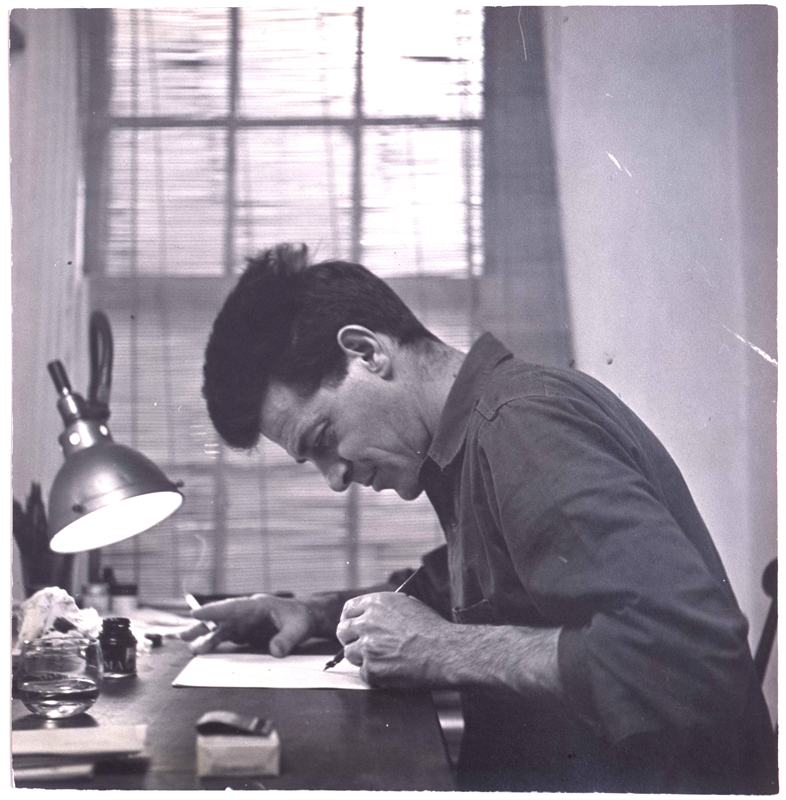
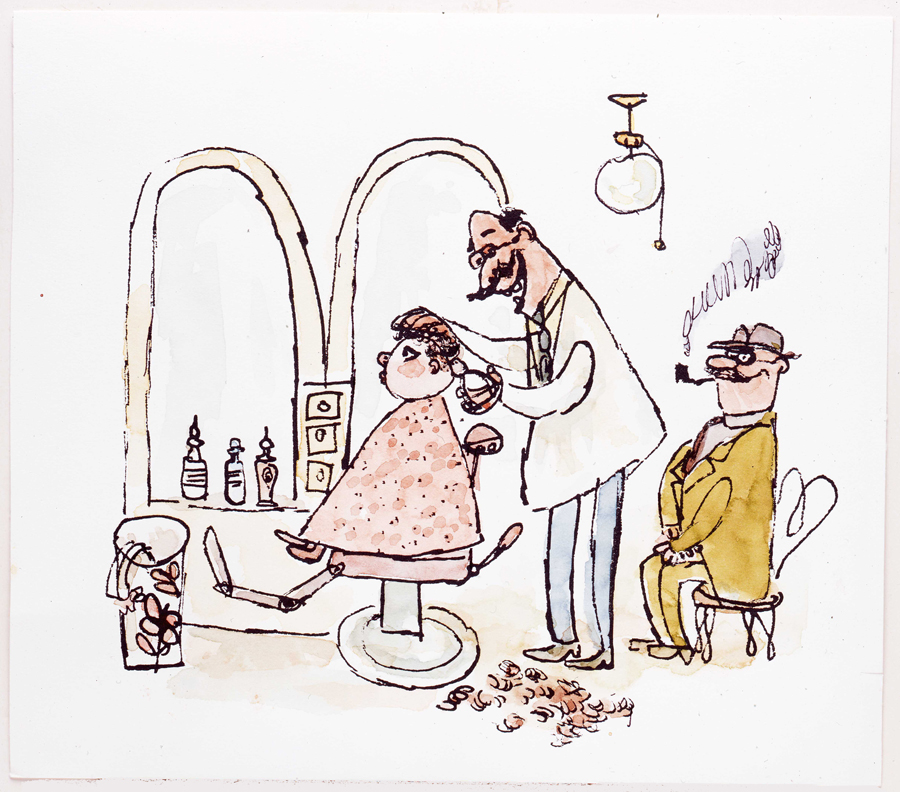
William’s Steig’s autobiography is a story for children. But anyone who knows William Steig—author of the original ugly-loving Shrek!; creator of Sylvester and the Magic Pebble, in which the main character spends most of the book as a rock—will understand that anything by this author will feature his trademark matter-of-fact tone and understated charm. When Everybody Wore a Hat is about Steig’s childhood in the Bronx, way back when you could see a movie for a nickel and a hat was as essential as shoes and a shirt. Through bright, childishly expressive illustrations, Steig (1907-2003) shows us life through his own eight-year-old eyes: an outing on the river with Mama and Papa decked out in stripes and polka-dots; neighborhood characters like elegant Mrs. Kingman who was “looked on by the women in admiration”; Steig’s first haircut at Ditchick’s Barbershop. There’s a healthy dose of realism as well, conveyed with a child’s simple directness: Papa yelling at the radiator when there isn’t enough heat, Mama’s tears when she receives sad news from the Old Country, and the bombs and blood of World War I. Deceptively simple but instantly engrossing, this slim little autobiography offers a slice of old-fashioned life and a look at the formative years of an inventive and irreverent author.

Bill Peet : An Autobiography by Bill Peet, 1989, Houghton Mifflin (Autobiography/ Illustrated Memoir)


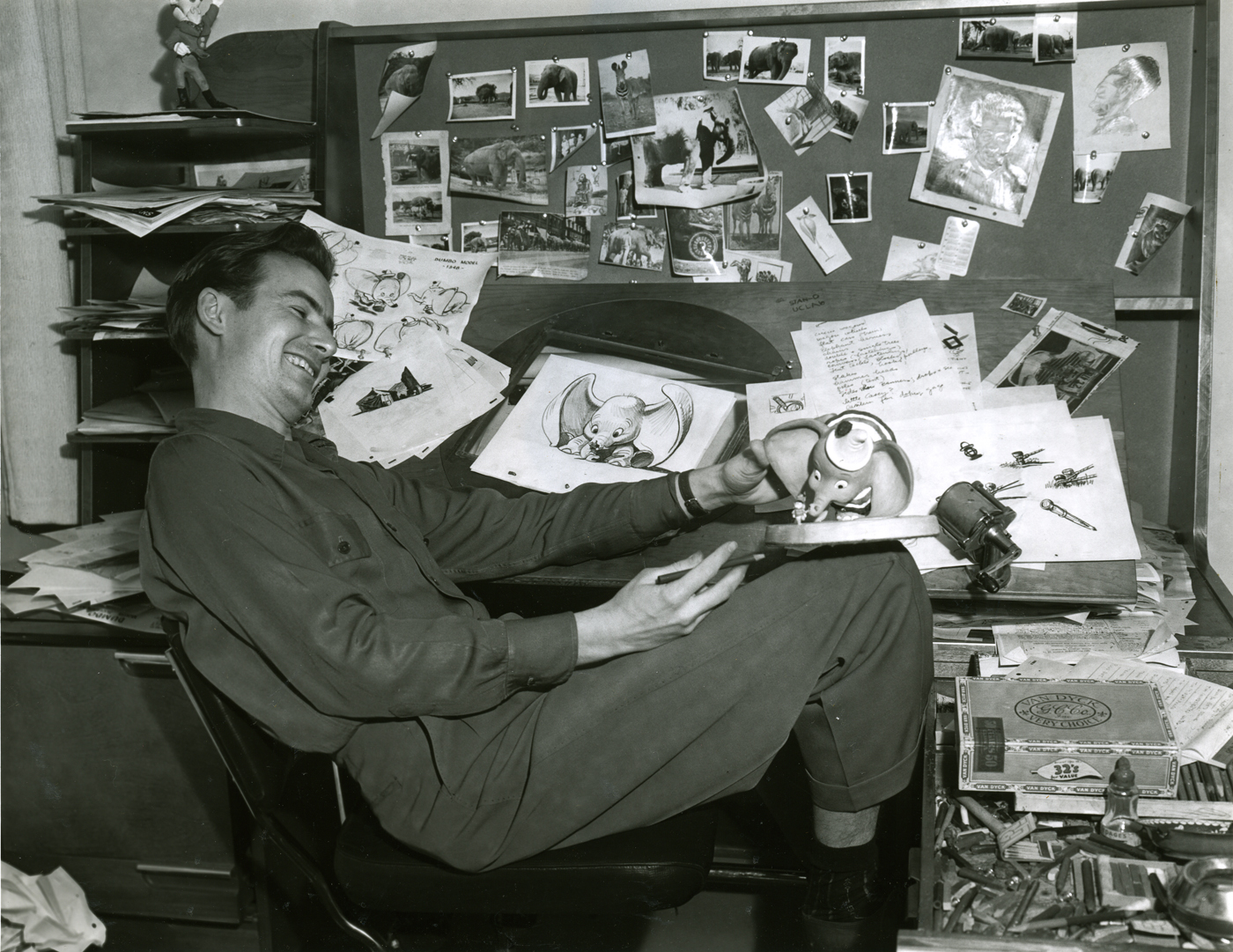
In 1937, a young storyboard artist at Disney Studios got sick and tired of drawing Donald Duck over and over and stormed out, hollering “NO MORE DUCKS! NO MORE LOUSY DUCKS!” That artist was Bill Peet (1915-2002), beloved children’s author of The Gnats of Knotty Pine, Chester the Worldly Pig, and Buford the Little Bighorn (to mention just a few), and that anecdote is one of many that he relates in his self-titled autobiography. Peet got his start at Disney, becoming a lead story man for classic films like Dumbo, Cinderella, The Sword in the Stone, and 101 Dalmatians before his own career as a children’s book author finally brought him, fame, fortune, and artistic freedom. Peet tells his life story in pictures and words—his artistic creations dance across every page as he chronicles his childhood during the Great Depression, his storyboard presentations for the great Walt Disney, and his own studio where he wrote and illustrated his books. The insight into the workings of Disney productions is revealing and entertaining and Peet always has a sense of humor about whatever life throws his way. As engaging as one of the author’s own storybooks, Bill Peet: An Autobiography is a delightful portrait of an artist at work

Ezra Jack Keats: A Biography with Illustrations by Dean Engel and Florence B. Freedman, 1995, Silver Moon Press (Biography/ Picture Book)


He was born Jack Ezra Katz, but you know and love him as Ezra Jack Keats (1916-1983), author of The Snowy Day, Whistle for Willie, Goggles!, and many others. From his penny-pinching childhood in the Great Depression to his years inking comics for Five-Star Comics (creators of Captain Marvel) to his experiments with fabric and collage, art was a crucial comfort for Keats. In this biography, the events of Keats’ life are illustrated by his own artwork. When little boy Ezra gets picked on by bullies in his Brooklyn neighborhood, we see an illustration of a similar scene from Goggles!. When Ezra explores the city of Paris as a struggling young artist, we see a self-portrait on a colorful Parisian street. And when Ezra realizes that there are very few black children in picture books and creates his hero Peter, we see that iconic image from The Snowy Day of little Peter in his red hood looking at his footprints in the snow. Ezra’s life is reconstructed in a simple, straightforward narrative that rolls along like a storybook. It’s a heartfelt, poignant tribute to an award-winning artist, written by people who knew (Florence B. Freedman was his high school teacher!) and loved him.

Virginia Lee Burton: A Life in Art by Barbara Elleman, 2002, Houghton Mifflin (Biography)

If you have a lasting fascination with steam shovels, snow plows, and construction sites, you probably know Virginia Lee Burton—or at least her storybook creations Mike Mulligan and His Steam Shovel, The Little House, and Katy and the Big Snow. There’s also Burton herself, and she takes center stage in this elegant biography. From her student years in the early 1920s studying dance and design to the deliberate research methods she incorporated to write and illustrate her books, Burton (1909-1968) was a woman ahead of her time. She had an active career in an era when most women were housewives. She was an environmentalist before the term existed, a nature-lover who relished country living. She was an innovator in book design (Katy plows right through the text on the page in Katy and the Big Snow). She was an artist of many mediums—there’s an entire chapter dedicated to the folksy textiles created by her Folly Cove Designers. Author Barbara Elleman fills the pages of her biography with photographs, sketches, and images from the children’s books that made Virginia Lee Burton famous. The tone is highly celebratory (any trials and tribulations are very much glossed over) but the final product is a loving tribute to a talented and cherished storyteller.

The Seuss, the Whole Seuss, and Nothing But the Seuss: A Visual Biography of Theodor Seuss Geisel by Charles D. Cohen, 2004, Random House Books (Biography)


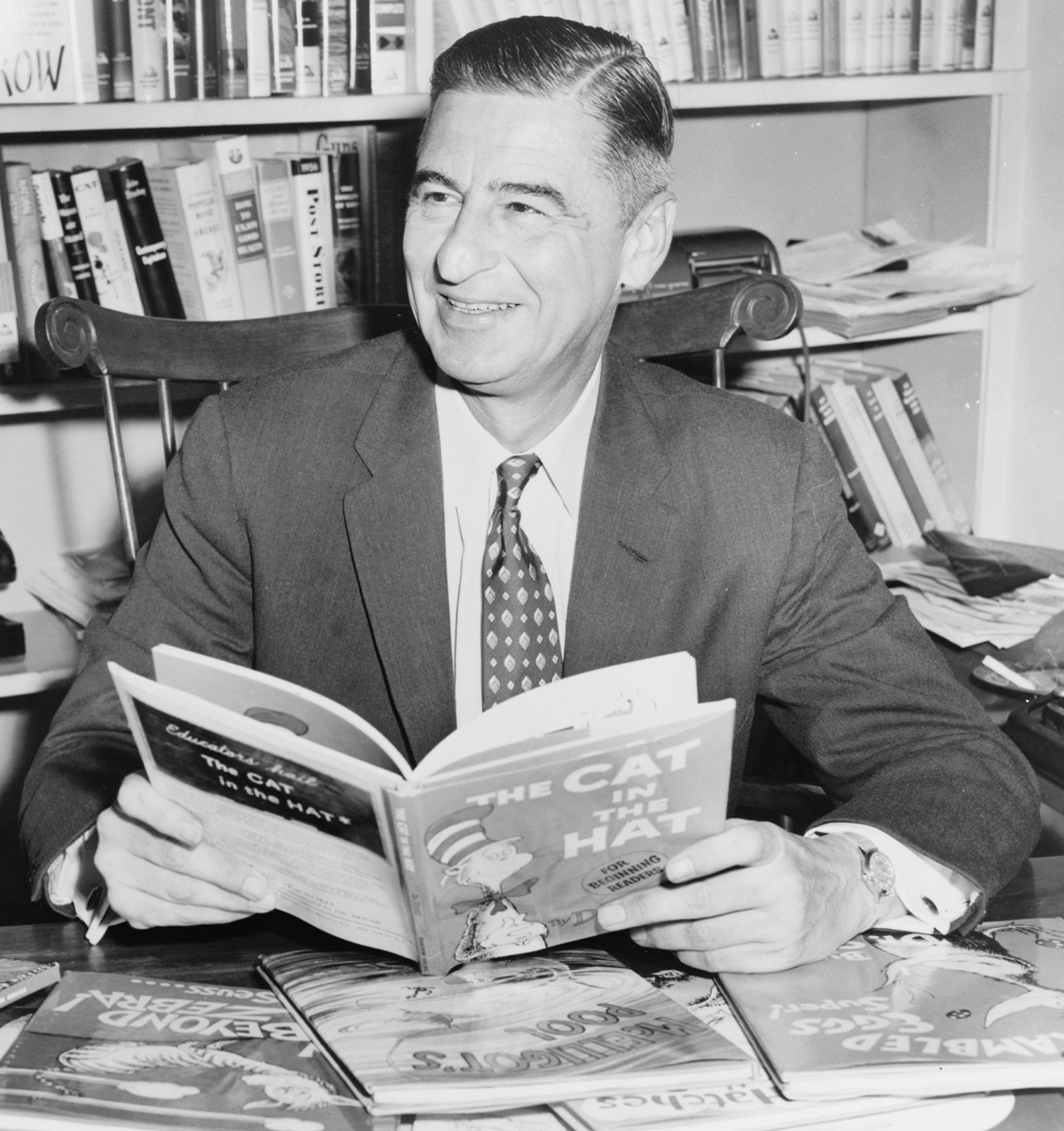
Dr. Seuss is a household name. We all know that Horton heard a Who and that the Grinch stole Christmas. But did we know that Theodor Seuss Geisel (1904-1991) first penned cartoons for Dartmouth College’s literary magazines in the early 1920s? Are we familiar with Geisel’s advertisements for Flit bug spray? Thanks to Charles D. Cohen’s extensive biography, we are now. The Seuss, the Whole Seuss, and Nothing But the Seuss offers a retrospective of Geisel’s life and art with a particular emphasis on his pre-children’s book days. Here we meet Geisel way back when he was a boy in rural Massachusetts, back when he was an ad man for Standard Oil and General Electric, back when he was a political cartoonist during World War II, back before he was Dr. Seuss. His whimsical animal-esque characters are present from day one, even if they are occasionally tempered by the commercial nature of his early work. And when the limits are lifted, watch out—richly reproduced examples of Geisel’s art cover the pages of this “visual biography.” Cohen lets Geisel speak for himself as much as possible and excerpts from letters, interviews, and articles tell much of the artist’s story. What ultimately comes across, in all its absurd Seusssian glory, is the very real sense of a man whose creativity knew no bounds.

Tuesday, July 6, 2010

Fall in Love with the Governess


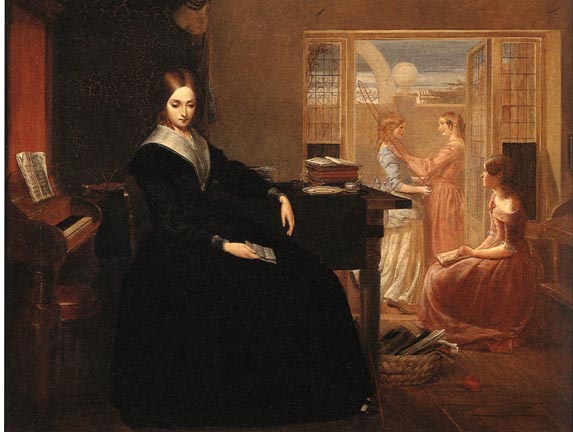
A dignified manor house. Children peering through the windows of the upstairs nursery. The lord and his lady entertaining the cream of society. Servants scurrying about their duties. And somewhere in between, neither mistress nor maid, is the governess. In the Victorian era it was often the only profession available to a genteel woman of impoverished means, and if she conveniently fell in love with the handsome tutor or the even more dashing master of the house, can you blame her? Whatever her role in the household, the presence of a governess means one thing when it comes to fiction: There’s a mystery afoot, and probably lots of swooning romance too. This list of books feature governesses in the prime role; turn the pages and let these clever young ladies teach you a lesson.

Jane Eyre by Charlotte Brontë, 2009, Vintage Classics, originally published 1847 (Fiction Classics)


Orphaned, unloved, poor as a church mouse, plain of face but with an indomitable spirit, Jane Eyre and the novel that bears her name has stood the test of time and become one of the great titles of Western literature. For all that, it’s still a rousing, dramatic soap opera of a story. Jane narrators in her own unmistakable and unforgettable intimate voice; she tells the reader about her neglected childhood, painful boarding school years, and finally, about accepting a governess position at magnificently gloomy Thornfield Hall. Her new charge is a sprightly little French ward; her new master is the enigmatic and charismatic Mr. Rochester. To everyone around them, Jane and Rochester are an unlikely—if not impossible—match. But the master of the house and demure plain Jane are kindred spirits with keen intellects and complex desires. Of course there is an obstacle greater than discrepancies in social standing, age, experience, and wealth standing in the way of Jane’s happiness—a terrible secret haunts Mr. Rochester’s past and may very well have infiltrated the halls of Thornfield. Author Charlotte Brontë’s masterpiece is an atmospheric Gothic romance that was considered far too passionate and scandalous when it was first published in 1847. That emotion still comes roaring across the page today—especially Jane’s determined longing for a free and equal life, something so regularly denied to a woman like herself in her day. A love story for the ages, Jane Eyre is the governess by which all other governesses are judged.

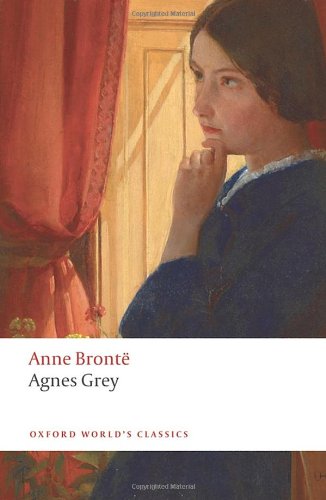
Agnes Grey by Anne Brontë, 2010, Oxford World Classics, originally published 1847 (Fiction Classics)


Her sister’s novel about the life of a governess hit bookshelves only a few months before her own, but Anne Brontë put pen to paper on Agnes Grey long before Charlotte wrote Jane Eyre. Timing and the whims of the critics dictated that Jane was better remembered than Agnes and Charlotte better remembered than Anne (though it didn’t help that Anne died at the tender age of twenty-nine). But Agnes Grey has never been allowed to fade completely into the background. The heroine is a sheltered young woman in the bosom of a poor but loving family. To help with the finances and assert her own independence, she becomes governess for the Bloomfields. Agnes has hopes of a kind, motherly mistress and sweet, obedient charges. What she gets is the precise opposite—and she is completely unprepared for the unruly, obstinate, and even violent behavior of the children. Fed up, Agnes moves on to the upper-class Murray family. The children are older and better behaved, but their governess is more a thing than a person to them, and sixteen-year-old Miss Murray’s coquettish flirting with any and every man in sight is especially distressing. Anyone who has ever had the care of children (even well-behaved children) will instantly sympathize with Miss Grey, become completely invested in Agnes’ struggles, and hope desperately for her rescue. Anne Brontë’s aim in writing Agnes Grey was to expose the plight of the governess of her day. It was a goal she accomplished with depth and purpose and the novel still serves as an important portrait its times—not to mention a fine and elegant story.

The Turn of the Screw by Henry James, 2001, Modern Library Classics, originally published 1898 (Fiction Classics)


A young gentlewoman begins her career as a governess when a handsome bachelor hires her to care for his little niece and nephew. She is sent to Bly, the country manor where the children are tucked away n the care of a motherly housekeeper. Little Flora and her brother Miles are so adorable and angelic as to be called exquisite; the governess is instantly enamored of their childish charms. But before she can become a slave to their every delightful little whim, the governess sees—something. A pale face pressed against the window and a dark figure on the other side of the lake, staring with devious intent at little Flora and Miles. When she describes these mysterious watchers to the housekeeper, they are identified as Peter Quint and Miss Jessel—and the horror immediately grows, because not only are Quint and Miss Jessel bad, immoral people, but they are dead. Convinced that the children’s young souls have been corrupted, our nerve-wracked governess fights to save some remnant of goodness in the preternaturally perfect little darlings—even while the ghostly fiends strive to possess them. Author Henry James weaves a masterful web of intense suspense that still penetrates more than a hundred years later. A uniquely layered structure (an unnamed narrator is listening to a manuscript read by a fellow houseguest; the manuscript is told in first-person by the hapless governess) completes the casting of the spell; a reader can never be sure what (if anything) is real and what (if anything) is imagined. One thing is certain: The Turn of the Screw will keep you biting your nails, jumping at every noise, and absolutely glued to the page.

Set in Stone by Linda Newbery, 2006, Knopf (Historical Fiction/ Teen Fiction)


When art tutor Samuel Godwin takes up his new position at Fourwinds Manor in 1898, he finds three mysteries in the form of three attractive young women: governess Charlotte Agnew and the young ladies of the house, Juliana and Marianne. Charlotte is completely immersed in her role as genteel companion and governess and refuses to speak about her past. Juliana, fragile and pretty, seems permanently downhearted. And Marianne, with her wild beauty and high spirits, is occasionally found wandering the grounds in a strange, dream-like state of near-hysteria. The three women are captivating and charming personalities, and Samuel is irresistibly drawn to them. Charlotte is wary of the new tutor but welcomes the chance to interact with someone who, like herself, occupies a tenuous place in the household between family member and servant. As they take turns narrating alternate chapters in author Linda Newbery’s tribute to the gothic novel of the Victorian era, Samuel and Charlotte begin to uncover the web of lies, deceit, and scandal that plagues Fourwinds and its inhabitants. The first few pages alone contains enough sensational elements for an entire book, much less a single chapter: a long walk in the moonlight, mysterious rustlings in the forest, a scream in the night, and a damsel in distress who throws herself at the hero. Readers will find themselves in a frenzy of page-turning as governess and tutor slowly unveil secret after fascinating secret.

Nine Coaches Waiting by Mary Stewart, 2006, Chicago Review Press, originally published 1959 (Mystery/ Romance)


The de Valmys want an English governess. Lovely but alone-in-the-world Linda Martin is indeed English—but she’s also half-French. Still, she needs a job, and what harm can it do to pretend ignorance when the French language is spoken? Plenty. Linda’s new charge is Philippe de Valmy—Comte (or Count) Philippe de Valmy, inheritor of a grand title, manor, and fortune at the tender age of nine years old. He lives at the magnificent Chateau de Valmy with his stylish and chic Uncle Leon and Aunt Heloise, who are overseeing the extensive estate until Philippe comes up of age. Philippe is a charming boy, and if the de Valmys are a bit standoffish, the beauty of Linda’s new home more than compensates—especially when Raoul, Philippe’s devastatingly handsome older cousin, takes a decided interest in the pretty new governess. But when one too many “accident” threatens Philippe’s safety, Linda doesn’t know who to trust—and it’ll take more than faking not knowing French to secure her young charge’s life. Author Mary Stewart wrote Nine Coaches Waiting in 1958, but she draws from the literary tradition of the gothic romance and the story is still fraught with suspense. The gorgeous French landscape is evoked in all its beauty and the sense of secrets lurking just below the surface is detectable from the first page. Resist the charm of this romantic little thriller if you can.

Miss Pettigrew Lives for a Day by Winifred Watson, 2008, Persephone Books, originally published 1938 (Fiction Classics)


Miss Pettigrew is not a very good governess. Frequently fired or quitting in a huff, her agency has given the middle-aged, out-of-touch spinster one last chance. So when Miss Pettigrew stumbles into the stylish flat of the even more stylish Delysia La Fosse, she’s determined not to blow it—even when it becomes painfully clear that the “boy” in the bedroom is no child, but instead a fully-grown fling of Delysia’s who needs to be rushed out the door before her more permanent lover gets home. Dismayed by the loss of a much-needed job, slightly scandalized, but still game, Miss Pettigrew lends a hand—she does, after all, know how to get a late sleeper out of bed, even if she’s more used to dealing with schoolboys than playboys. Delighted by the governess’ success, fetching but flighty Delysia decides that she simply cannot live without Miss Pettigrew by her side. It’s the eve of World War II and Delysia, a nightclub singer with a string of too many fellows at her beck and call, really knows how to live it up. As Miss Pettigrew encounters the glamorous speakeasys and deliciously wicked inhabitants of Delysia’s world, she finds herself in the midst of the most exhilarating day of her life—and dreading the prospect of returning to her own hum-drum existence. Back in print after a film version was released in 2008, author Winifred Watson’s 1938 novel is a joy to read. Fresh, funny, and flirty, this single day in the life of one Miss Pettigrew is utterly captivating.

The Nonesuch by Georgette Heyer, 2009, Sourcebooks, originally published 1962 (Romance/ Historical Fiction)


Sir Waldo “the Nonesuch” Hawkridge is a rich, handsome, athletic figure of a man. He got his nickname because it is generally agreed that there is no such other man as he. You’d think a fellow with a reputation like that would be conceited to the gills, but Sir Waldo is a gentleman in manner as well as name: He spends his money building orphanages to shelter and educate London’s street boys. When Sir Waldo inherits Broom Hall and comes to Yorkshire to examine his new acquisition, it is entirely too much to expect the ladies of the neighborhood to ignore this paradigm of manhood. Miss Ancilla Trent is one of those ladies, but as the twenty-eight-year-old governess and chaperone to the beautiful and tempestuous Tiffany Wield, Ancilla considers herself “on the shelf” and is able to meet Sir Waldo with a measure of composure and intelligence that impresses that gentleman very favorably. Not so Miss Tiffany. She has her eyes on both Sir Waldo and the handsome cousin who accompanies him. When her wiles inexplicably fail to attract either man, Tiffany does more than put on a pout—she hightails it out of Yorkshire and makes for the big city of London. Desperate to find her wayward charge and avoid scandal, Ancilla is hot on Tiffany’s tail—and who should come to the governess’ assistance but the Nonesuch himself? Bursting with Regency flavor in the grand tradition of Jane Austen, The Nonesuch displays all of author Georgette Heyer’s considerable charms. Witty banter, impeccable historical detail, a colorful supporting cast, and a slow-burning romance make for a delightful package that will bring smiles to the lips of any reader.

The Incorrigible Children of Ashton Place, Book 1: The Mysterious Howling by Maryrose Wood, 2010, Blazer and Bray (Children’s Fiction)


Miss Penelope Lumley, smart, sensitive, resourceful, recent graduate of the Swanburne Academy for Poor Bright Ladies and just fifteen-years-old, is hired on the spot to serve as governess at luxurious Ashton Place. Only then is she allowed to meet her charges—three children who, due to their tendency to gnaw, nip, and growl, appear to have been raised by wolves. Lord Fredrick caught them on his estate when he was out hunting and as he says, “Finders keepers.” Penelope is not daunted by her task. She gets on swimmingly with Alexander, Beowulf, and Cassiopeia Incorrigible, as Lord Fredrick names them (or Alawooooo, Beowooooo, and Cassawoof, as they call themselves). The children respond to poetry and games of fetch, and Penelope feels sure that French, Latin, and literature cannot be far behind. But then Lady Constance drops a bombshell. The children are expected to appear at the mansion’s elegant Christmas ball. This means table manners, fancy dress, and the ability to stand still when a squirrel is spotted. As Penelope and the kiddies rise to the challenge, they begin to discover that there are many dangerous secrets at Ashton Place. There are also many nods and winks to the reader, including Lemony Snicket-esque asides from the witty narrator. But author Maryrose Wood makes her tale all her own with plenty of amusing details—her heroine’s overactive imagination, the children’s endearing mischief-making, and a tone that is droll and cheeky and thoroughly giggle-inducing. By the time the last page is turned, readers will be howling for a sequel.

Governess: The Life and Times of the Real Jane Eyres by Ruth Brandon, 2008, Walker and Co. (Nonfiction/ 18th and 19th Century British History/ Women’s History)


In the 18th and19th centuries, a woman was a spinster if she wasn’t married by her mid-twenties. If she lacked funds of her own as well as a husband, almost her only recourse to support herself—particularly if she was a gentlewoman of the upper classes—was to become a governess. As a governess, a woman lived in someone else’s home. She was responsible for the education of the family’s daughters and young sons. Neither family nor servant, she occupied an uneasy middle ground. In author Ruth Brandon’s study of the institution of the governess during the Victorian age, the lives of some of the more famous governesses are investigated. The Brontë sisters drew on their experiences for their vivid depictions of the profession in Jane Eyre and Agnes Grey. Anna Leonowens’ memoirs were the inspiration for The King and I. Mary Wollstonecraft so despised her time as a governess (even though she had to quite good in comparison to many) that she later became a journalist and promoted the then-radical idea of education and equality for women. The lives that Brandon examines did not all face the neglect and mistreatment that many fictional governesses have to deal with, nor did most of them fall in love with their masters, run mad, or face compelling mysteries and secrets. But no one, it seems, ever loved being a governess. Readers will come away educated, entertained, and thanking their lucky stars that the profession is a thing of the past—but very grateful that fictional governesses abound to teach us all a thing or two.

Tuesday, June 22, 2010

Picture Books for Big People


There are picture books that children love—The Berenstein Bears, Clifford the Big Red Dog—and picture books based on cartoons like Scooby Doo or Dora the Explorer. There are picture books that we lovingly recall even when we’re not children anymore—Where the Wild Things Are, Goodnight Moon, The Snowy Day. And then there are picture books that are meant for a wider audience. They tend to be overlooked, because we think of storybooks, with their big colorful pictures, as books that are meant for little children only. But a simple story can be just as heartfelt, dramatic, and exciting as any book double its size. You’ll be surprised at the wit, elegance, and sophistication that can be packed into a picture book’s brief but stunning pages.

The Enemy by Davide Cali, illustrated by Serge Bloch, 2009, Schwartz and Wade Books (Children’s Fiction) 


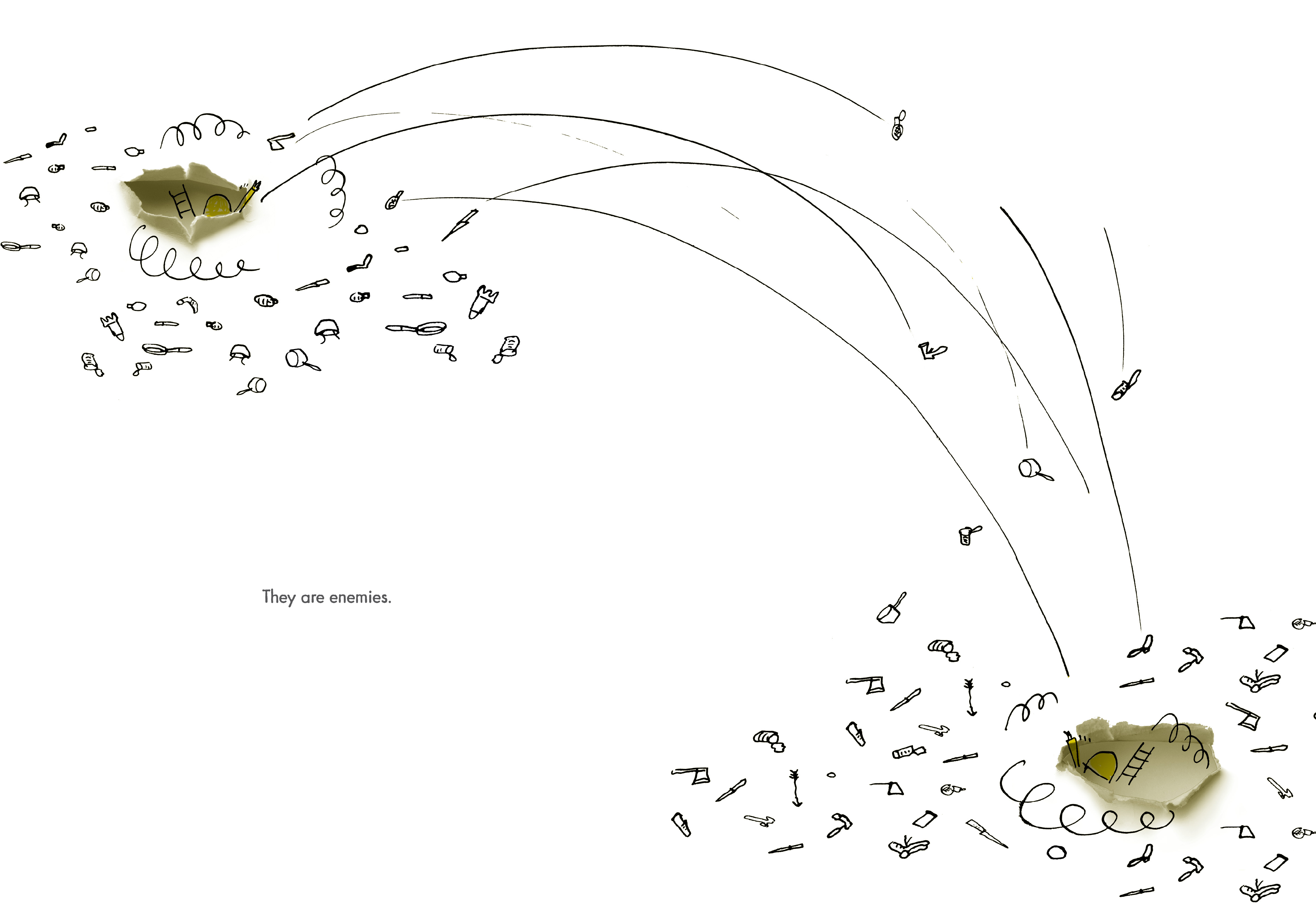
Two opposing soldiers in foxholes contemplate each other and the nature of war in this deceptively simple children’s book. At first, the soldiers think of each other only as The Enemy, a nameless, faceless, dangerous other. When it rains, the soldiers only consider their own discomfort—the thought that the enemy might be just as wet and gloomy never crosses their minds. Both soldiers consult manuals that assure them the enemy is little more than “a wild beast” whose only goal is to hurt and harm. But when the soldiers tire of their tedious duties, they end up sneaking past the other in the night and into each other’s foxholes, where they are confronted with evidence of the supposed enemy’s humanity. The choice to continue or end the war, then, becomes a great deal more complex. The two soldiers are little cartoon men existing on an otherwise blank white page; their foxholes are collaged bits of torn paper; the covers of their manuals are bright spots of red. This subtle simplicity is the work of artist Serge Bloch; the plaintive testimonies of the soldiers are penned by author Davide Cali. The result is a lesson in war and peace that we are never too old to learn.
The Rabbits by John Marsden, illustrated by Shaun Tan, 2003, Simply Read Books, originally published 1998 (Children’s Fiction)


The Rabbits is a picture book, but it is a beautiful and sophisticated picture book, the kind that can be read and reread from age eight to eighty. The story begins when a ship full of white rabbits arrives on a faraway shore, armed with black muskets and other strange technologies. The rabbits come to take rather than give, and to the marsupial-like inhabitants who have lived for generations in harmony with nature, the rabbits are terrifying indeed as they chop down trees, construct factories, and alter the land to suit their own purposes. Out of fear and anger, especially after their children are taken, the marsupials rise in rebellion against the rabbits, but by then it is too late—the rabbits are too many, the marsupials are too few, and the damage is done. Author John Marsden and illustrator Shaun Tan are from the land Down Under, and their story is an allegory for the settlement of Australia and the destruction of the aboriginal people at the hands of the self-righteous European settlers in the 19th century. It’s a mature theme indeed, highlighted by Tan’s gorgeous, highly-stylized, intricate paintings of canon-wielding rabbits marching to overcome the sand-colored marsupials armed only with their spears and their sense of right. This story book is no fairy tale, and that means its powerful message hits home with eloquence and compassion.

Woolvs in the Sitee by Margaret Wild, illustrated by Anne Spudvilas, 2005, Camberwell Press (Children’s Fantasy Fiction)


Dystopias come in all forms, even picture books. But Woolvs in the Sitee is not for little children. Told by a lonely, scared boy, this dark story features text scrawled in graffiti-like writing across the page, with words misspelled and misshapen to heighten the sense of atmospheric ruin conveyed by the bleakly elegant illustrations. Ben, a young boy who has lost his family and spends his days hiding in a dank basement, tells readers that there are “woolvs in the sitee,” but these are not forest animals, oh no, these are “shadows prowling,” hateful and dangerous beings who “will kum for me and for yoo.” Ben’s only ally is his upstairs neighbor Mrs. Radinski, who offers food and water and comfort. One night, Ben is lured outdoors by a clean blue sky (the seasons are otherwise “topsee turvee,” hinting at some devastating apocalyptic disaster). The blue sky turns out to be merely a painted wall, but Mrs. Radinski braves the dangers of the street to bring Ben home to safety. And when Mrs. Radinski disappears, Ben must decide whether or not to risk all his fears and the horrors of the city to return the favor. Australian author and illustrator team Margaret Wild and Ann Spudvilas collaborate on a gripping book with mature themes, despite its slim size. The edgy text merges with images of rusty oranges streetlights, buildings that drip with streaks of black and gray, and scratchy charcoal figures in deep shadows. A deeply evocative dystopian vision, Woolvs in the Sitee should not be overlooked.

The Miraculous Journey of Edward Tulane by Kate DiCamillo, illustrated by Bagram Ibatoulline, 2006, Candlewick Press (Children’s Fiction/ Fantasy) 


Edward Tulane is a beautiful, hand-crafted, china toy rabbit, a doll who is adored and cared for by a little girl named Abilene. Abilene loves Edward almost as much as Edward loves himself; he is, after all, a truly wonderful specimen, and as such he can’t be bothered with any emotion more serious than concern for his extensive wardrobe. But when this very vain bunny takes a tumble over the side of an ocean liner while the family is on a voyage, he embarks on a world of adventure. From the bottom of the ocean, to the net of a humble fisherman, to the backpack of a cheery hobo, to the arms of an ill little girl, Edward Tulane, rabbit extraordinaire, slowly but surely learns to love. But the lesson is painful—everyone Edward loves is eventually lost to him. As his heart (and the reader’s) breaks again and again, Edward is once again in danger of becoming a cold, distant rabbit. This elegant little fairy tale, with its shades of The Velveteen Rabbit, is an achingly beautiful story of loss and love told by master storyteller Kate DiCamillo and illustrated in sepia tones and muted color plates by Bagram Ibatoulline. Their collaboration truly brings The Miraculous Journey of Edward Tulane to life.

The Latke Who Couldn’t Stop Screaming: A Christmas Story by Lemony Snicket, illustrated by Lisa Brown, 2007, McSweeney’s Books (Children’s Fiction/ Humor) 


What’s a latke to do when Christmas lights, candy canes, and trees just don’t get it? Scream, of course, at the top of its potato pancake lungs until it gets the point across. Born of potato flakes and oil, the star of The Latke Who Couldn’t Stop Screaming leaps from his frying pan and runs shouting through the night. Confronted by ignorant, self-obsessed Christmas paraphernalia, the latke attempts to explain the meaning of Hanukkah, from the miraculous oil-burning lamp to the eight nights of gift-giving. Since this is a story by cheeky children’s author Lemony Snicket (best known for his gleefully gruesome Series of Unfortunate Events), any implied message about the holiday spirit or the meaning of the season gets turned topsy-turvy in an impish little tale that delights in the absurd and the unexpected. Artist Lisa Brown’s bright retro illustrations lend sass and spunk to Snicket’s irreverent “Christmas Story,” which is sure to tickle the funny bones of all ages and faiths, regardless of the season. Who knew latkes could be so delightfully amusing?

The Mysteries of Harris Burdick by Chris Van Allsburg, 1984, Houghton Mifflin (Children’s Fiction/ Fantasy)


This classic opens with a mysterious note from beloved children’s book author Chris Van Allsburg: The illustrations on the following pages were left at a publishing house by one Harris Burdick. Burdick delivered his portfolio for consideration, left, and was never heard of again. All that remains are fourteen illustrations for fourteen unknown stories. Each picture is accompanied by a title and a caption. In The Seven Chairs, for example, a dainty nun flies through ornate halls on a straight-backed chair while a pair of men in long robes gaze up her sedately. The caption reads, “The fifth one ended up in France.” There’s a blank spot on the dove-covered wallpaper of The Third Floor Bedroom, accompanied by the line, “It all began when someone left the window open.” Look closer, and you'll spot another dove, paper-wing lifted, about to take flight. All this mystery and fantasy is conveyed through Van Allsburg’s trademark style that can convey realism and whimsy in a single stroke. The Mysteries of Harris Burdick has been firing the imaginations of readers since its publication in 1984. A portfolio edition is now available with a new author’s introduction and one more “discovered” drawing. The interactivity of the book continues at The Mysteries of Harris Burdick website where Van Allsburg posts stories sent to him by his legions of fans, who include Stephen King (writing a solution to The House on Maple Street, where a neatly-gabled neighborhood home blasts into the sky on rocket boosters with the caption “It was a perfect lift-off”) as well as school children, amateur writers, and non-writers who couldn’t resist the lure of a good mystery. We dare you not to be inspired.

The Arrival by Shaun Tan, 2007, Arthur A. Levine (Children’s Fiction/ Fantasy/ Graphic Novel)


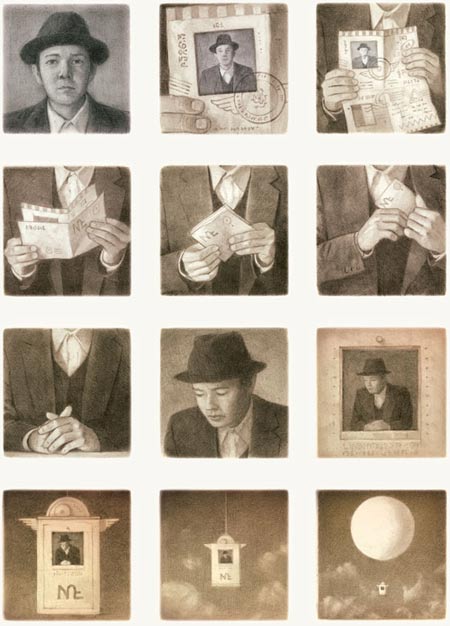
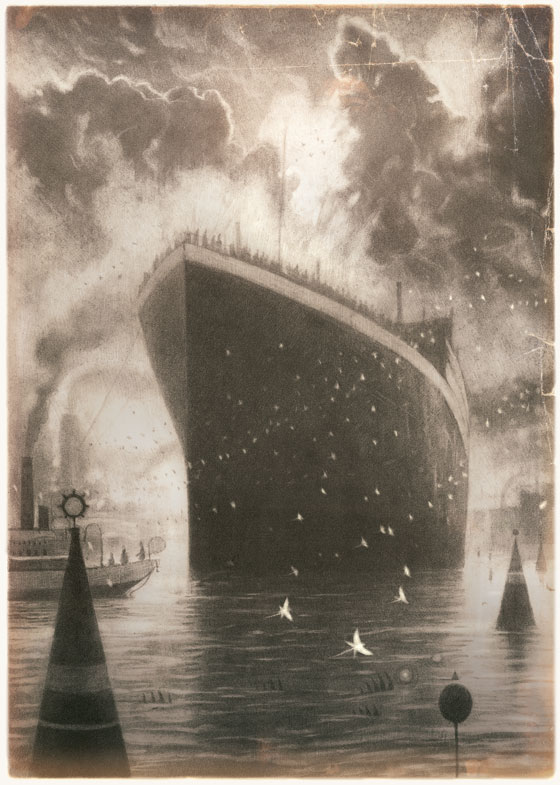
The Arrival is an elegant and haunting work of art that hovers somewhere between graphic novel, comic strip, and picture book—or maybe encompasses them all. Wordless, told entirely through sepia-toned drawings that cover the pages in comics-style panels or full-page spreads, the story of The Arrival is nonetheless clear and true and stirring. A lone immigrant leaves his homeland to embark on an unknown journey and a quest for a better life. Along the way he is confronted by the strange, the wondrous, and the terrible, because there is a healthy dose of the fantastic in this picturesque storybook. Giant dragons' tails overshadow villages, ornate cities rise from bizarre landscapes, and quirky little critters accompany the residents of the foreign country where the man finally makes a new life. At first he’s put off by the creature that adopts him—a creepy-cute round little fellow with a wide smiling mouth and a long wagging tail. But the comfort of a constant companion eventually becomes a boon, as do the histories of the friendly strangers he meets. Turn-of-the-century dress and architecture meld flawlessly with elements of science fiction that abound in The Arrival—not just the captivating little beasties, but strange methods of travel, spiraling towers, and an invented alphabet by Australian author Shaun Tan that conveys more than anything else the bewildering confusion that surrounds a refugee in a strange new land. Brimming over with visual metaphors that add layers of beauty and complexity, The Arrival is a magical tribute to the unflagging immigrant spirit.

The Invention of Hugo Cabret: A Novel in Words and Pictures by Brian Selznick, 2007, Scholastic Books (Children’s Fiction/ Illustrated Novel)


The Invention of Hugo Cabret is a 544-page picture book, and it is a fantastic, magical adventure. In 1930s Paris, twelve-year-old orphan Hugo Cabret lives a secret life behind the walls of the city’s train station. His job is to maintain the station’s many clocks, but his passion is repairing a small mechanical man that his deceased father found in a museum attic. If it ever works, the automaton’s gears will turn and it will write a message; in his grief and loneliness, Hugo believes this will somehow be a message from his father. When he is caught stealing wind-up toys for mechanical parts from the station’s toy booth, Hugo’s life changes forever. Put to work by the crotchety old toymaker and befriended by the toymaker’s inquisitive goddaughter, sensitive Hugo begins to emerge from his shell and make some intriguing connections between the toymaker’s true identity, his father’s history, and his own future. Along the way, author Brian Selznick pushes the boundaries of what the picture book can do. Subtitled A Novel in Pictures and Words, sections of the story are conveyed through silvery charcoal illustrations that zoom in and out as your turn the pages like a film on a screen. Cinema is a theme of the story, and movie stills—especially those from early French filmmaker Georges Méliès’ whimsical A Trip to the Moon—are interspersed throughout the book, as are archival photographs of the Paris of the day. More than an illustrated or graphic novel, the combination of written word and visual image is wholly unique to The Invention of Hugo Cabret, and it’s a combination that won the book the 2008 Caldecott Medal for best illustrated children’s break. Elegant, sophisticated, and charming from cover to cover, this genre-busting book is breaking new ground.

Tuesday, June 8, 2010

Past + Future = Steampunk


Steampunk: it’s one of the most entertaining sub-genres of science fiction and fantasy, and its favorite question to ask is “What if?” The past, usually the Victorian era of steam-powered trains, is re-imagined, reinvented, and recreated with all manner of futuristic technologies and fantastic creatures. The well-worn paths of history are in for some surprising twists and turns when artificially-intelligent robots and tea-sipping vampires crash into the prim and proper sitting rooms of yesteryear. The sheer inventiveness of steampunk will knock your socks off. But that’s the point, really—to blend the past and the future into stories so out of this world that they push the boundaries of what readers will believe. To try to believe is, of course, all part of the irresistible fun.

Android Karenina by Ben H. Winter and Leo Tolstoy, 2010, Quirk Books (Science Fiction/ Fantasy/ Humor)


The quirky Quirk Books ushered in a new era of literary mash-ups with the runaway success of last year’s delightful Pride and Prejudice and Zombies, which in turn spawned Sense and Sensibility and Sea Monsters. A slight shift from Regency romance to Russian classics and from monsters to robots gives us Android Karenina, a steampunked version of Anna Karenina, Leo Tolstoy’s 1877 masterpiece about love and despair set against the chilly winter backdrop of aristocratic life in Moscow and St. Petersburg. The twist comes with the titular androids. Everyone who’s anyone has one, a custom-made robot that offers comfort, support, and service with a cute nickname (the Russians love their nicknames) to boot. Cyborgs are the hot new technology trend of the moment and inter-planetary travel is a distinct possibility. The steampunk setting grows richer with anti-gravity skating rinks and dance floors, but life is not all romance, glamour, and three-dimensional waltzes. Trouble is afoot, and much of that mischief stems from the androids and the technology they wield. Against this tumult, desperate housewife Anna Karenina carries out a passionately doomed love affair with dashing Count Vronksy, and moody country boy Levin pines after pretty but pouty Kitty. In both romances the opinions and actions of the androids (Anna’s Android Karenina, Vronksy’s mechanical wolf, Levin’s hulking Socrates, and Kitty’s newly-appointed Tatiana) have as much impact as anything the human lovers do or say. How illicit love affairs and political turmoil merge is all part of the drama—and in the case of this mash-up, all part of the fun. To toy with a literary classic as heavy as Anna Karenina is a bit of a risk, but author Ben H. Winters handles his task with verve, wit, and even respect. Tolstoy’s complex portrait of 19th century life is complete and little of the story’s bulk has been trimmed (Android Karenina weighs in at 538 pages, and there are several wickedly comical illustrations). But as any fan of steampunk lit can attest to, even the classics are improved by a little extra robot mayhem.


P.S.  Tell Quirk Books where you read this review, and you may win a few quirky classics of your own!

Leviathan by Scott Westerfeld, illustrated by Keith Thompson, 2009, Simon Pulse (Science Fiction/ Fantasy/ Historical Fiction/ Teen Fiction)


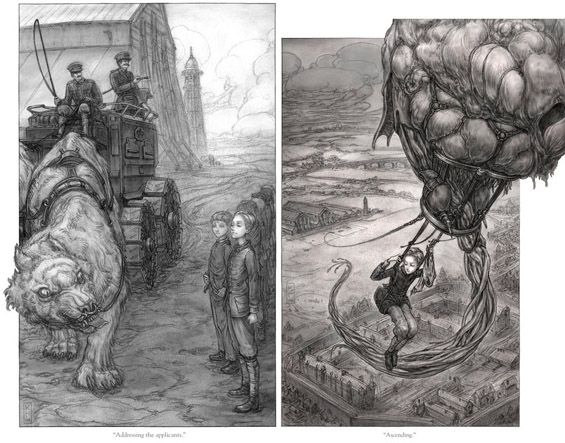
On June 28, 1914, Archduke Franz Ferdinand of Austria and his wife were assassinated, setting in motion a chain of alliances that sparks an international war. World War I, right? Well, kind of. The alliances of Leviathan’s alter-Europe are divided into the Germanic “Clankers” who build wonderfully complex and sophisticated machines, and the British “Darwinists” who genetically engineer astonishing animal crossbreeds. Prince Aleksander is a proud Austrian, but when his country turns against him after the murder of his parents, Alek is forced into exile with a small crew of loyalists and a steam-powered Stormwalker. Half a continent away, Deryn Sharp is an intelligent and skilled girl determined to make her way—disguised as a boy—as a British Air Service midshipman on board the living airship Leviathan, a massive hydrogen-breathing beastie. The fates of Clanker-born Alek and firm Darwinist Deryn seem unlikely to combine, but that’s exactly what happens when the Leviathan crashes near Alek’s Swiss mountain hideout. The only way for Alek (under the guise of a commoner) and Deryn (still dressed as a boy) to escape the approaching German army is to work together—even if that means overcoming a lifetime of suspicion about the other’s way of life and revealing their own true identities. Author Scott Westerfeld stays true to the shifting alliances that caused the Great War while inventing not one, but two, advanced new technologies. His description of the Clanker’s mechanical prowess is matched only by the complex symbiotic animal relationships that keep the Leviathan airborne. Westerfeld’s creations are visualized by illustrator Keith Thompson in inked drawings that breathe even more life into the fabulous construct that is Leviathan. The adventure continues in the upcoming sequel, Behemoth, due in October 2010.

Airborn by Kenneth Oppel, 2004, Eos Books (Science Fiction/ Fantasy/ Adventure/ Teen Fiction)


Matt Cruse was born in the air. He was born aboard a flying airship and now, fourteen years later, Matt’s a cabin boy on the luxurious passenger ship Aurora. He lives to fly; he’s devoted to his ship and is eager to pilot the Aurora himself someday. But first, Matt’s in for a very big adventure. One night while he’s on watch in the crow’s nest, Matt spots a hot air balloonist in trouble over the Pacificus Ocean. The Aurora takes the injured man on board where he dies, but not before Matt hears him whispering about mysterious winged creatures of the air. A year later the balloonist’s granddaughter, a high-spirited girl named Kate de Vries, is flying on Matt’s ship, following the trail of her grandfather’s research. Matt and Kate become friends, but before they can do more than theorize about what Kate’s grandfather saw, the ship is set upon by pirates, pushed off course into a storm, and wrecked on a tropical isle. Matt’s worried sick about the ship, but Kate brings him an interesting distraction: This is the same island where her grandfather spotted his strange bird-like animals, and Kate is confident she can find them too. But the pirates are still hot on the Aurora’s trail, ready to put the lives of passengers, crew, and winged beasts in danger. Author Kenneth Oppel reinvents the past in Airborn, setting his story in an alternate-1920s era where airships ruled the skies. Oppel draws on the stories of the Titanic and the Hindenburg and on classic adventure stories, but he’s created a unique world that’s brimming with original details and told in prose that’s precise and clear and packed with swashbuckling action. Two sequels (Skybreaker and Starclimber) push the boundaries of exploration higher and higher, with fantastic new technologies and thrilling adventures.

Boneshaker by Cherie Priest, 2009, Tor Books (Science Fiction/ Fantasy/ Historical Fiction)


It’s 1863. Gold Rush fever is running high, but Russia wants to make sure all that iced-over Klondike gold is really impossible to get before selling Alaska to the United States. Inventor Leviticus Blue is commissioned to build an immense steam-powered ice-drilling machine. But one day Dr. Blue’s Incredible Bone-Shaking Drill Engine comes bursting out of his Seattle basement and wreaks havoc on the city. Worse, the machine opens a vein of toxic subterranean gas (dubbed “the Blight”) that kills everyone who comes into contact with it—and then turns them into moaning members of the walking dead. Sixteen years later, with the Civil War still raging in the east, Seattle is an abandoned wreck surrounded by a two-hundred-foot high wall that keeps the Blight and its rotting victims contained. Outside the wall Blue’s widow, Briar Wilkes, lives a hard and lonely life with her son Zeke. Briar is resigned to her status as social outcast, but Zeke wants to know the truth about the disaster that his father caused. So he sneaks over the wall into the city that was once booming Seattle. Briar, desperate for his safety, goes after him, and as Zeke searches for answers and Briar searches for her son, they meet a rag-tag crew of survivors who have eked out a life for themselves amidst the Blight-infested ruins. Some of these people help (Lucy the barkeep and her mechanical arm; Jeremiah Swakhammer and his zombie stun-gun) and some hinder (mad scientist Dr. Minnericht, who bears an eerie resemblance to the infamous Levi Blue), but all of them add to the action-packed adventure of Boneshaker. Author Cherie Priest paints a vivid portrait of a Seattle that is both based in history and wholly its own fantastic world, gives readers a delightful pair of heroes with wiseass Zeke and his tough-as-nails mother Briar, and throws in lots of good and gory zombie action on top of a whole mess of inventive steampunk technology.

Soulless: The Parasol Protectorate, Book One by Gail Carriger, 2009, Orbit Books (Science Fiction/ Fantasy/ Historical Fiction/ Mystery/ Romance)


Almost everything about Alexia Tarabotti goes against the grain of Victorian society. Her deceased father was Italian (inferior foreigner). Her looks are swarthy, full figured, and big nosed (not a delicate English rose). Unattached at age twenty-six, she’s considered unmarriageable (spinster). Plus, she’s soulless. She still has a personality and feelings and all that, she’s just lacking a soul. This is very rare condition in Alexia’s day and age, even though in this alternate history, Victorian England has fully accepted the society of vampires and werewolves. Members of both supernatural groups hold high positions in the government and in the aristocracy. So when Alexia comes across a vampire at a ball, she’s not at all surprised. She is quite taken aback, however, when the vampire launches himself at her, fangs drawn, without so much as a formal introduction. Alexia defends herself with her handy parasol and ends up an accidental murderess. When Bureau of Unnatural Registry official/ Alpha werewolf Lord Conall Maccon shows up to investigate, Alexia is tossed into a chaotic mystery complete with newly-made vampires, vanishing werewolves, mad scientists wielding devious new technologies, creepy robot men, and a relationship with Lord Maccon that blossoms—when the two aren’t bickering. Alexia is a delightfully fresh and funny character, wielding her parasol, sleuthing in a not-so-subtle manner, and ready to defy convention at every turn—especially if convention gets in the way of a platter of treacle tarts. Author Gail Carriger has a fine sense of humor and creates a witty parody that takes the genres of fantasy, mystery, romance, historical fiction, screwball comedy, and steampunk and stands them on their head in an entirely original fashion. Alexia is set to star in a whole series of mysteries called The Parasol Protectorate; the second book is Changeless and book three, Blameless, is due September 2010.

The League of Extraordinary Gentlemen by Alan Moore, 2002, DC Comics (Science Fiction/ Fantasy/ Historical Fiction/ Graphic Novels/ Comics)


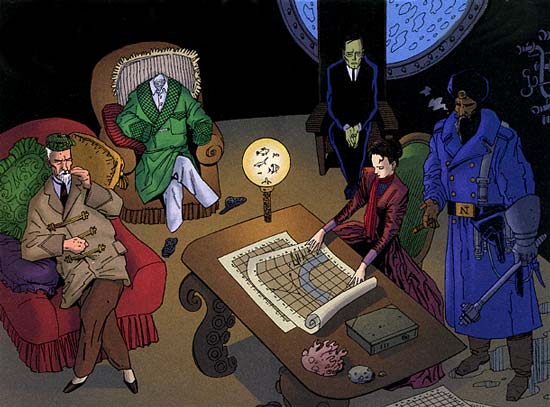
The Victorian Age saw the creation of some of the most famous characters in Western literature: Captain Nemo, usually found in his mythical ship 20,000 Leagues Under the Sea; Allan Quartermain, the adventurer who discovered King Solomon’s Mines; Mina Murray, the heroine who barely escaped from Dracula; Hawley Griffin, the original Invisible Man himself; Henry Jekyll and his alter ego, better known as Dr. Jekyll and Mr. Hyde. Comics genius Alan Moore collects them all here and turns them into team of superheroes who use their unique capabilities, powers, and experiences (not to mention Captain Nemo’s technologically-pimped out submarine) to save England from the clutches of a mysterious madman. The year is 1898, and the heroes have been gathered together in London from all corners of the globe by the head of the Secret Service. They’re a rough-and-tumble bunch, flawed and washed-up, but when a criminal mastermind with a dangerously high-tech taste in weaponry threatens to firebomb London’s East End and bring down the British Empire, these 19th century characters come to life and rally to the rescue. The illustrations are as bright and action-packed as anything out of Superman, Batman, Spiderman, or Moore’s own comic masterpiece The Watchmen. Originally published as individual comic book issues and then collected into two volumes, Moore and his team of artists at DC Comics created two additional adventures, The Black Dossier and Century 1910. Together, the series is as chock-full of superhero-style action, futuristic weaponry, and derring-do as it is of historical detail, literary references, and Victorian flair. The League of Extraordinary Gentlemen is another genre-buster that proves just how much mystery and adventure can be packed into one fantastic era.

Steampunk edited by Ann and Jeff VanderMeer, 2008, Tachyon Publications (Science Fiction/ Fantasy/ Short Story Anthology)


For an in-depth exploration of the steampunk genre, look no further than Ann and Jeff VanderMeer’s collected anthology, titled simply Steampunk. First, an excerpt from steampunk granddaddy Michael Moorcock’s 1971 novel The Warlord of the Air. Then comes a selection of short stories that revel in mad scientists, Martian mutinies, royal imposters, magic, monsters, and weird technologies while still providing humor, horror, mystery, adventure, finely-crafted characters, inventive settings, and thought-provoking plots. Don’t miss Ted Chiang’s “Seventy-Two Letters” or Michael Chabon’s “The Martian Agent, A Planetary Romance.” The VanderMeers are long-time steampunk writers themselves, which makes them ideally suited to comment, critique, and celebrate this unique avenue of science fiction and fantasy. Steampunk provides a comprehensive history of the genre’s evolution and the finest tales its writers have to offer. For both the newly initiated steampunker and the long-time fan, there’s something fresh and fantastic to be found in Steampunk.  And if you need even more steam-powered adventure, there's always Steampunk II: Steampunk Reloaded.