Tuesday, June 22, 2010

Picture Books for Big People


There are picture books that children love—The Berenstein Bears, Clifford the Big Red Dog—and picture books based on cartoons like Scooby Doo or Dora the Explorer. There are picture books that we lovingly recall even when we’re not children anymore—Where the Wild Things Are, Goodnight Moon, The Snowy Day. And then there are picture books that are meant for a wider audience. They tend to be overlooked, because we think of storybooks, with their big colorful pictures, as books that are meant for little children only. But a simple story can be just as heartfelt, dramatic, and exciting as any book double its size. You’ll be surprised at the wit, elegance, and sophistication that can be packed into a picture book’s brief but stunning pages.

The Enemy by Davide Cali, illustrated by Serge Bloch, 2009, Schwartz and Wade Books (Children’s Fiction) 


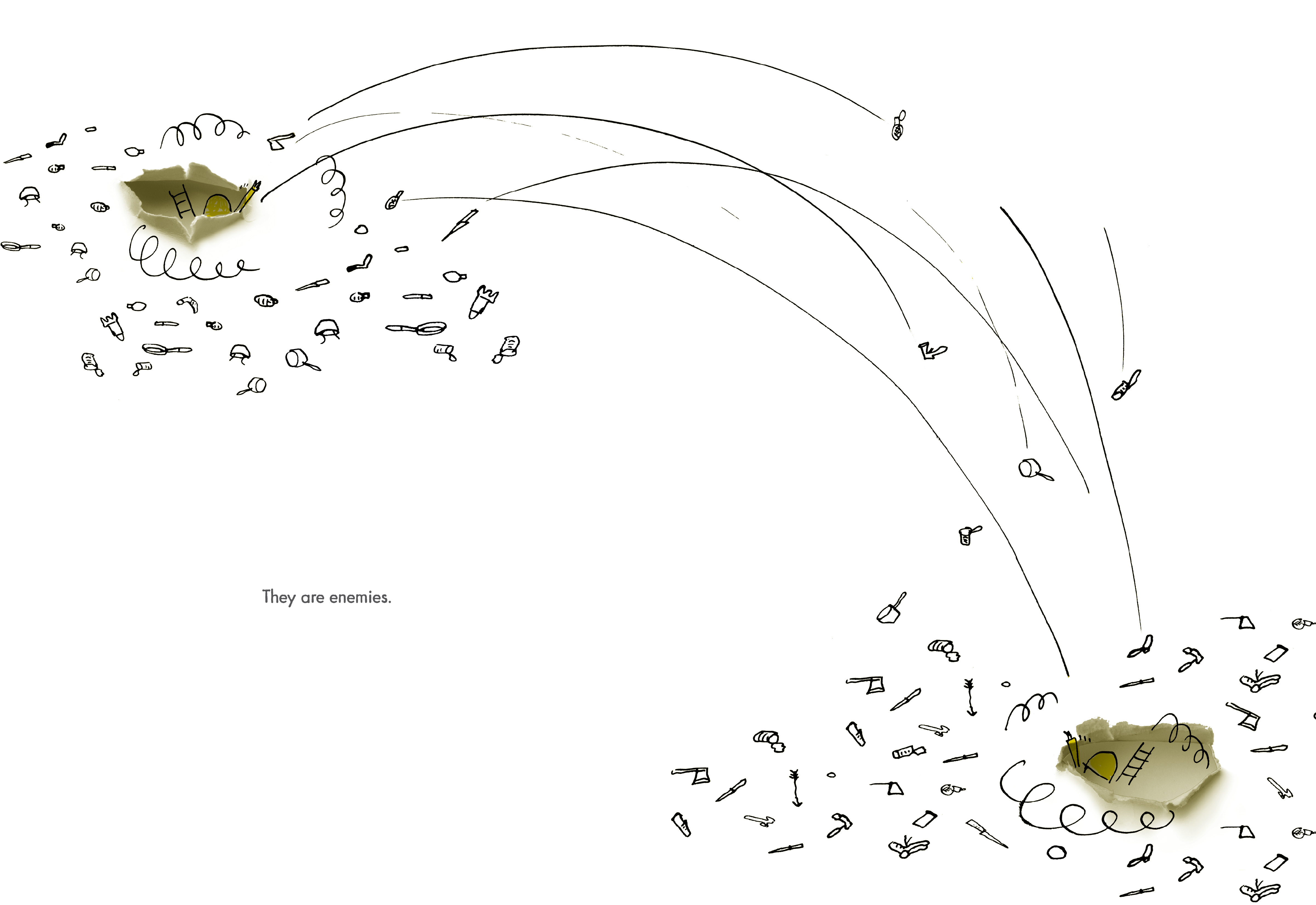
Two opposing soldiers in foxholes contemplate each other and the nature of war in this deceptively simple children’s book. At first, the soldiers think of each other only as The Enemy, a nameless, faceless, dangerous other. When it rains, the soldiers only consider their own discomfort—the thought that the enemy might be just as wet and gloomy never crosses their minds. Both soldiers consult manuals that assure them the enemy is little more than “a wild beast” whose only goal is to hurt and harm. But when the soldiers tire of their tedious duties, they end up sneaking past the other in the night and into each other’s foxholes, where they are confronted with evidence of the supposed enemy’s humanity. The choice to continue or end the war, then, becomes a great deal more complex. The two soldiers are little cartoon men existing on an otherwise blank white page; their foxholes are collaged bits of torn paper; the covers of their manuals are bright spots of red. This subtle simplicity is the work of artist Serge Bloch; the plaintive testimonies of the soldiers are penned by author Davide Cali. The result is a lesson in war and peace that we are never too old to learn.

The Rabbits by John Marsden, illustrated by Shaun Tan, 2003, Simply Read Books, originally published 1998 (Children’s Fiction)


The Rabbits is a picture book, but it is a beautiful and sophisticated picture book, the kind that can be read and reread from age eight to eighty. The story begins when a ship full of white rabbits arrives on a faraway shore, armed with black muskets and other strange technologies. The rabbits come to take rather than give, and to the marsupial-like inhabitants who have lived for generations in harmony with nature, the rabbits are terrifying indeed as they chop down trees, construct factories, and alter the land to suit their own purposes. Out of fear and anger, especially after their children are taken, the marsupials rise in rebellion against the rabbits, but by then it is too late—the rabbits are too many, the marsupials are too few, and the damage is done. Author John Marsden and illustrator Shaun Tan are from the land Down Under, and their story is an allegory for the settlement of Australia and the destruction of the aboriginal people at the hands of the self-righteous European settlers in the 19th century. It’s a mature theme indeed, highlighted by Tan’s gorgeous, highly-stylized, intricate paintings of canon-wielding rabbits marching to overcome the sand-colored marsupials armed only with their spears and their sense of right. This story book is no fairy tale, and that means its powerful message hits home with eloquence and compassion.

Woolvs in the Sitee by Margaret Wild, illustrated by Anne Spudvilas, 2005, Camberwell Press (Children’s Fantasy Fiction)


Dystopias come in all forms, even picture books. But Woolvs in the Sitee is not for little children. Told by a lonely, scared boy, this dark story features text scrawled in graffiti-like writing across the page, with words misspelled and misshapen to heighten the sense of atmospheric ruin conveyed by the bleakly elegant illustrations. Ben, a young boy who has lost his family and spends his days hiding in a dank basement, tells readers that there are “woolvs in the sitee,” but these are not forest animals, oh no, these are “shadows prowling,” hateful and dangerous beings who “will kum for me and for yoo.” Ben’s only ally is his upstairs neighbor Mrs. Radinski, who offers food and water and comfort. One night, Ben is lured outdoors by a clean blue sky (the seasons are otherwise “topsee turvee,” hinting at some devastating apocalyptic disaster). The blue sky turns out to be merely a painted wall, but Mrs. Radinski braves the dangers of the street to bring Ben home to safety. And when Mrs. Radinski disappears, Ben must decide whether or not to risk all his fears and the horrors of the city to return the favor. Australian author and illustrator team Margaret Wild and Ann Spudvilas collaborate on a gripping book with mature themes, despite its slim size. The edgy text merges with images of rusty oranges streetlights, buildings that drip with streaks of black and gray, and scratchy charcoal figures in deep shadows. A deeply evocative dystopian vision, Woolvs in the Sitee should not be overlooked.

The Miraculous Journey of Edward Tulane by Kate DiCamillo, illustrated by Bagram Ibatoulline, 2006, Candlewick Press (Children’s Fiction/ Fantasy) 


Edward Tulane is a beautiful, hand-crafted, china toy rabbit, a doll who is adored and cared for by a little girl named Abilene. Abilene loves Edward almost as much as Edward loves himself; he is, after all, a truly wonderful specimen, and as such he can’t be bothered with any emotion more serious than concern for his extensive wardrobe. But when this very vain bunny takes a tumble over the side of an ocean liner while the family is on a voyage, he embarks on a world of adventure. From the bottom of the ocean, to the net of a humble fisherman, to the backpack of a cheery hobo, to the arms of an ill little girl, Edward Tulane, rabbit extraordinaire, slowly but surely learns to love. But the lesson is painful—everyone Edward loves is eventually lost to him. As his heart (and the reader’s) breaks again and again, Edward is once again in danger of becoming a cold, distant rabbit. This elegant little fairy tale, with its shades of The Velveteen Rabbit, is an achingly beautiful story of loss and love told by master storyteller Kate DiCamillo and illustrated in sepia tones and muted color plates by Bagram Ibatoulline. Their collaboration truly brings The Miraculous Journey of Edward Tulane to life.

The Latke Who Couldn’t Stop Screaming: A Christmas Story by Lemony Snicket, illustrated by Lisa Brown, 2007, McSweeney’s Books (Children’s Fiction/ Humor) 


What’s a latke to do when Christmas lights, candy canes, and trees just don’t get it? Scream, of course, at the top of its potato pancake lungs until it gets the point across. Born of potato flakes and oil, the star of The Latke Who Couldn’t Stop Screaming leaps from his frying pan and runs shouting through the night. Confronted by ignorant, self-obsessed Christmas paraphernalia, the latke attempts to explain the meaning of Hanukkah, from the miraculous oil-burning lamp to the eight nights of gift-giving. Since this is a story by cheeky children’s author Lemony Snicket (best known for his gleefully gruesome Series of Unfortunate Events), any implied message about the holiday spirit or the meaning of the season gets turned topsy-turvy in an impish little tale that delights in the absurd and the unexpected. Artist Lisa Brown’s bright retro illustrations lend sass and spunk to Snicket’s irreverent “Christmas Story,” which is sure to tickle the funny bones of all ages and faiths, regardless of the season. Who knew latkes could be so delightfully amusing?

The Mysteries of Harris Burdick by Chris Van Allsburg, 1984, Houghton Mifflin (Children’s Fiction/ Fantasy)


This classic opens with a mysterious note from beloved children’s book author Chris Van Allsburg: The illustrations on the following pages were left at a publishing house by one Harris Burdick. Burdick delivered his portfolio for consideration, left, and was never heard of again. All that remains are fourteen illustrations for fourteen unknown stories. Each picture is accompanied by a title and a caption. In The Seven Chairs, for example, a dainty nun flies through ornate halls on a straight-backed chair while a pair of men in long robes gaze up her sedately. The caption reads, “The fifth one ended up in France.” There’s a blank spot on the dove-covered wallpaper of The Third Floor Bedroom, accompanied by the line, “It all began when someone left the window open.” Look closer, and you'll spot another dove, paper-wing lifted, about to take flight. All this mystery and fantasy is conveyed through Van Allsburg’s trademark style that can convey realism and whimsy in a single stroke. The Mysteries of Harris Burdick has been firing the imaginations of readers since its publication in 1984. A portfolio edition is now available with a new author’s introduction and one more “discovered” drawing. The interactivity of the book continues at The Mysteries of Harris Burdick website where Van Allsburg posts stories sent to him by his legions of fans, who include Stephen King (writing a solution to The House on Maple Street, where a neatly-gabled neighborhood home blasts into the sky on rocket boosters with the caption “It was a perfect lift-off”) as well as school children, amateur writers, and non-writers who couldn’t resist the lure of a good mystery. We dare you not to be inspired.

The Arrival by Shaun Tan, 2007, Arthur A. Levine (Children’s Fiction/ Fantasy/ Graphic Novel)


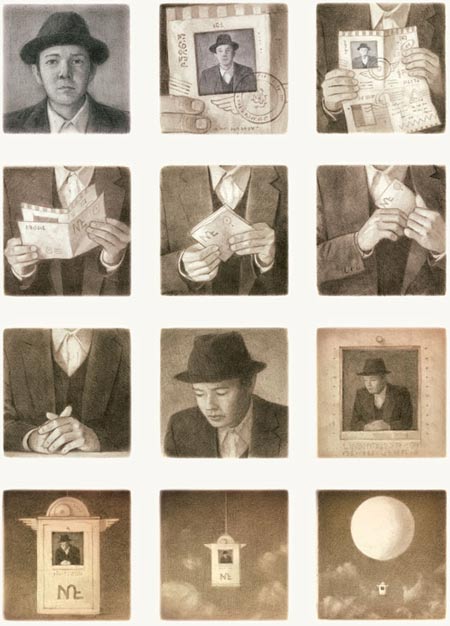
The Arrival is an elegant and haunting work of art that hovers somewhere between graphic novel, comic strip, and picture book—or maybe encompasses them all. Wordless, told entirely through sepia-toned drawings that cover the pages in comics-style panels or full-page spreads, the story of The Arrival is nonetheless clear and true and stirring. A lone immigrant leaves his homeland to embark on an unknown journey and a quest for a better life. Along the way he is confronted by the strange, the wondrous, and the terrible, because there is a healthy dose of the fantastic in this picturesque storybook. Giant dragons' tails overshadow villages, ornate cities rise from bizarre landscapes, and quirky little critters accompany the residents of the foreign country where the man finally makes a new life. At first he’s put off by the creature that adopts him—a creepy-cute round little fellow with a wide smiling mouth and a long wagging tail. But the comfort of a constant companion eventually becomes a boon, as do the histories of the friendly strangers he meets. Turn-of-the-century dress and architecture meld flawlessly with elements of science fiction that abound in The Arrival—not just the captivating little beasties, but strange methods of travel, spiraling towers, and an invented alphabet by Australian author Shaun Tan that conveys more than anything else the bewildering confusion that surrounds a refugee in a strange new land. Brimming over with visual metaphors that add layers of beauty and complexity, The Arrival is a magical tribute to the unflagging immigrant spirit.

The Invention of Hugo Cabret: A Novel in Words and Pictures by Brian Selznick, 2007, Scholastic Books (Children’s Fiction/ Illustrated Novel)


The Invention of Hugo Cabret is a 544-page picture book, and it is a fantastic, magical adventure. In 1930s Paris, twelve-year-old orphan Hugo Cabret lives a secret life behind the walls of the city’s train station. His job is to maintain the station’s many clocks, but his passion is repairing a small mechanical man that his deceased father found in a museum attic. If it ever works, the automaton’s gears will turn and it will write a message; in his grief and loneliness, Hugo believes this will somehow be a message from his father. When he is caught stealing wind-up toys for mechanical parts from the station’s toy booth, Hugo’s life changes forever. Put to work by the crotchety old toymaker and befriended by the toymaker’s inquisitive goddaughter, sensitive Hugo begins to emerge from his shell and make some intriguing connections between the toymaker’s true identity, his father’s history, and his own future. Along the way, author Brian Selznick pushes the boundaries of what the picture book can do. Subtitled A Novel in Pictures and Words, sections of the story are conveyed through silvery charcoal illustrations that zoom in and out as your turn the pages like a film on a screen. Cinema is a theme of the story, and movie stills—especially those from early French filmmaker Georges Méliès’ whimsical A Trip to the Moon—are interspersed throughout the book, as are archival photographs of the Paris of the day. More than an illustrated or graphic novel, the combination of written word and visual image is wholly unique to The Invention of Hugo Cabret, and it’s a combination that won the book the 2008 Caldecott Medal for best illustrated children’s break. Elegant, sophisticated, and charming from cover to cover, this genre-busting book is breaking new ground.

Tuesday, June 8, 2010

Past + Future = Steampunk


Steampunk: it’s one of the most entertaining sub-genres of science fiction and fantasy, and its favorite question to ask is “What if?” The past, usually the Victorian era of steam-powered trains, is re-imagined, reinvented, and recreated with all manner of futuristic technologies and fantastic creatures. The well-worn paths of history are in for some surprising twists and turns when artificially-intelligent robots and tea-sipping vampires crash into the prim and proper sitting rooms of yesteryear. The sheer inventiveness of steampunk will knock your socks off. But that’s the point, really—to blend the past and the future into stories so out of this world that they push the boundaries of what readers will believe. To try to believe is, of course, all part of the irresistible fun.

Android Karenina by Ben H. Winter and Leo Tolstoy, 2010, Quirk Books (Science Fiction/ Fantasy/ Humor)


The quirky Quirk Books ushered in a new era of literary mash-ups with the runaway success of last year’s delightful Pride and Prejudice and Zombies, which in turn spawned Sense and Sensibility and Sea Monsters. A slight shift from Regency romance to Russian classics and from monsters to robots gives us Android Karenina, a steampunked version of Anna Karenina, Leo Tolstoy’s 1877 masterpiece about love and despair set against the chilly winter backdrop of aristocratic life in Moscow and St. Petersburg. The twist comes with the titular androids. Everyone who’s anyone has one, a custom-made robot that offers comfort, support, and service with a cute nickname (the Russians love their nicknames) to boot. Cyborgs are the hot new technology trend of the moment and inter-planetary travel is a distinct possibility. The steampunk setting grows richer with anti-gravity skating rinks and dance floors, but life is not all romance, glamour, and three-dimensional waltzes. Trouble is afoot, and much of that mischief stems from the androids and the technology they wield. Against this tumult, desperate housewife Anna Karenina carries out a passionately doomed love affair with dashing Count Vronksy, and moody country boy Levin pines after pretty but pouty Kitty. In both romances the opinions and actions of the androids (Anna’s Android Karenina, Vronksy’s mechanical wolf, Levin’s hulking Socrates, and Kitty’s newly-appointed Tatiana) have as much impact as anything the human lovers do or say. How illicit love affairs and political turmoil merge is all part of the drama—and in the case of this mash-up, all part of the fun. To toy with a literary classic as heavy as Anna Karenina is a bit of a risk, but author Ben H. Winters handles his task with verve, wit, and even respect. Tolstoy’s complex portrait of 19th century life is complete and little of the story’s bulk has been trimmed (Android Karenina weighs in at 538 pages, and there are several wickedly comical illustrations). But as any fan of steampunk lit can attest to, even the classics are improved by a little extra robot mayhem.


P.S.  Tell Quirk Books where you read this review, and you may win a few quirky classics of your own!

Leviathan by Scott Westerfeld, illustrated by Keith Thompson, 2009, Simon Pulse (Science Fiction/ Fantasy/ Historical Fiction/ Teen Fiction)


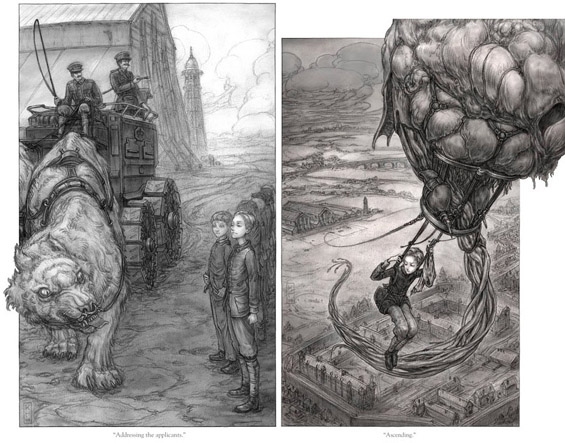
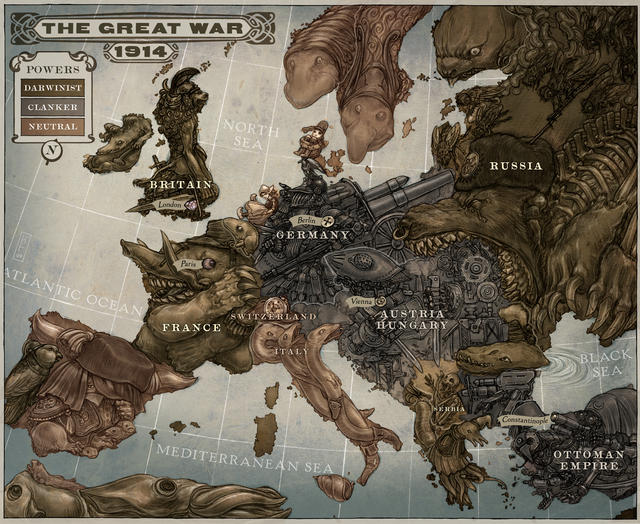
On June 28, 1914, Archduke Franz Ferdinand of Austria and his wife were assassinated, setting in motion a chain of alliances that sparks an international war. World War I, right? Well, kind of. The alliances of Leviathan’s alter-Europe are divided into the Germanic “Clankers” who build wonderfully complex and sophisticated machines, and the British “Darwinists” who genetically engineer astonishing animal crossbreeds. Prince Aleksander is a proud Austrian, but when his country turns against him after the murder of his parents, Alek is forced into exile with a small crew of loyalists and a steam-powered Stormwalker. Half a continent away, Deryn Sharp is an intelligent and skilled girl determined to make her way—disguised as a boy—as a British Air Service midshipman on board the living airship Leviathan, a massive hydrogen-breathing beastie. The fates of Clanker-born Alek and firm Darwinist Deryn seem unlikely to combine, but that’s exactly what happens when the Leviathan crashes near Alek’s Swiss mountain hideout. The only way for Alek (under the guise of a commoner) and Deryn (still dressed as a boy) to escape the approaching German army is to work together—even if that means overcoming a lifetime of suspicion about the other’s way of life and revealing their own true identities. Author Scott Westerfeld stays true to the shifting alliances that caused the Great War while inventing not one, but two, advanced new technologies. His description of the Clanker’s mechanical prowess is matched only by the complex symbiotic animal relationships that keep the Leviathan airborne. Westerfeld’s creations are visualized by illustrator Keith Thompson in inked drawings that breathe even more life into the fabulous construct that is Leviathan. The adventure continues in the upcoming sequel, Behemoth, due in October 2010.

Airborn by Kenneth Oppel, 2004, Eos Books (Science Fiction/ Fantasy/ Adventure/ Teen Fiction)


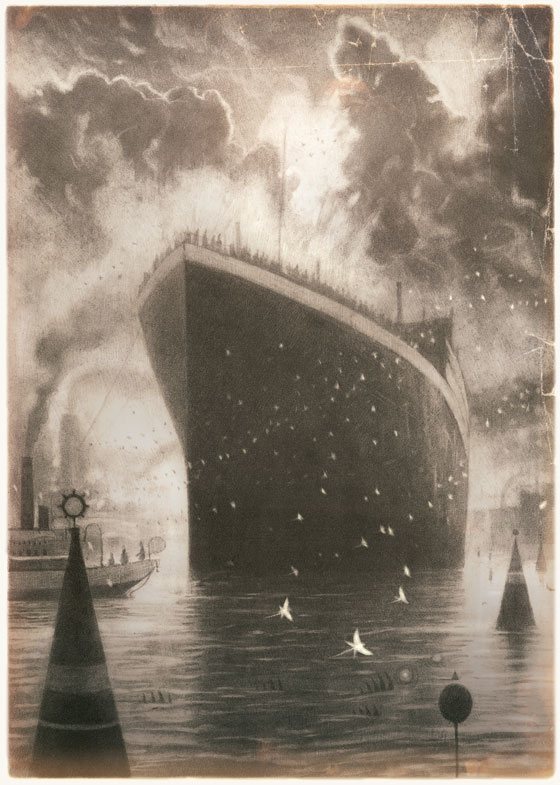
Matt Cruse was born in the air. He was born aboard a flying airship and now, fourteen years later, Matt’s a cabin boy on the luxurious passenger ship Aurora. He lives to fly; he’s devoted to his ship and is eager to pilot the Aurora himself someday. But first, Matt’s in for a very big adventure. One night while he’s on watch in the crow’s nest, Matt spots a hot air balloonist in trouble over the Pacificus Ocean. The Aurora takes the injured man on board where he dies, but not before Matt hears him whispering about mysterious winged creatures of the air. A year later the balloonist’s granddaughter, a high-spirited girl named Kate de Vries, is flying on Matt’s ship, following the trail of her grandfather’s research. Matt and Kate become friends, but before they can do more than theorize about what Kate’s grandfather saw, the ship is set upon by pirates, pushed off course into a storm, and wrecked on a tropical isle. Matt’s worried sick about the ship, but Kate brings him an interesting distraction: This is the same island where her grandfather spotted his strange bird-like animals, and Kate is confident she can find them too. But the pirates are still hot on the Aurora’s trail, ready to put the lives of passengers, crew, and winged beasts in danger. Author Kenneth Oppel reinvents the past in Airborn, setting his story in an alternate-1920s era where airships ruled the skies. Oppel draws on the stories of the Titanic and the Hindenburg and on classic adventure stories, but he’s created a unique world that’s brimming with original details and told in prose that’s precise and clear and packed with swashbuckling action. Two sequels (Skybreaker and Starclimber) push the boundaries of exploration higher and higher, with fantastic new technologies and thrilling adventures.

Boneshaker by Cherie Priest, 2009, Tor Books (Science Fiction/ Fantasy/ Historical Fiction)


It’s 1863. Gold Rush fever is running high, but Russia wants to make sure all that iced-over Klondike gold is really impossible to get before selling Alaska to the United States. Inventor Leviticus Blue is commissioned to build an immense steam-powered ice-drilling machine. But one day Dr. Blue’s Incredible Bone-Shaking Drill Engine comes bursting out of his Seattle basement and wreaks havoc on the city. Worse, the machine opens a vein of toxic subterranean gas (dubbed “the Blight”) that kills everyone who comes into contact with it—and then turns them into moaning members of the walking dead. Sixteen years later, with the Civil War still raging in the east, Seattle is an abandoned wreck surrounded by a two-hundred-foot high wall that keeps the Blight and its rotting victims contained. Outside the wall Blue’s widow, Briar Wilkes, lives a hard and lonely life with her son Zeke. Briar is resigned to her status as social outcast, but Zeke wants to know the truth about the disaster that his father caused. So he sneaks over the wall into the city that was once booming Seattle. Briar, desperate for his safety, goes after him, and as Zeke searches for answers and Briar searches for her son, they meet a rag-tag crew of survivors who have eked out a life for themselves amidst the Blight-infested ruins. Some of these people help (Lucy the barkeep and her mechanical arm; Jeremiah Swakhammer and his zombie stun-gun) and some hinder (mad scientist Dr. Minnericht, who bears an eerie resemblance to the infamous Levi Blue), but all of them add to the action-packed adventure of Boneshaker. Author Cherie Priest paints a vivid portrait of a Seattle that is both based in history and wholly its own fantastic world, gives readers a delightful pair of heroes with wiseass Zeke and his tough-as-nails mother Briar, and throws in lots of good and gory zombie action on top of a whole mess of inventive steampunk technology.

Soulless: The Parasol Protectorate, Book One by Gail Carriger, 2009, Orbit Books (Science Fiction/ Fantasy/ Historical Fiction/ Mystery/ Romance)


Almost everything about Alexia Tarabotti goes against the grain of Victorian society. Her deceased father was Italian (inferior foreigner). Her looks are swarthy, full figured, and big nosed (not a delicate English rose). Unattached at age twenty-six, she’s considered unmarriageable (spinster). Plus, she’s soulless. She still has a personality and feelings and all that, she’s just lacking a soul. This is very rare condition in Alexia’s day and age, even though in this alternate history, Victorian England has fully accepted the society of vampires and werewolves. Members of both supernatural groups hold high positions in the government and in the aristocracy. So when Alexia comes across a vampire at a ball, she’s not at all surprised. She is quite taken aback, however, when the vampire launches himself at her, fangs drawn, without so much as a formal introduction. Alexia defends herself with her handy parasol and ends up an accidental murderess. When Bureau of Unnatural Registry official/ Alpha werewolf Lord Conall Maccon shows up to investigate, Alexia is tossed into a chaotic mystery complete with newly-made vampires, vanishing werewolves, mad scientists wielding devious new technologies, creepy robot men, and a relationship with Lord Maccon that blossoms—when the two aren’t bickering. Alexia is a delightfully fresh and funny character, wielding her parasol, sleuthing in a not-so-subtle manner, and ready to defy convention at every turn—especially if convention gets in the way of a platter of treacle tarts. Author Gail Carriger has a fine sense of humor and creates a witty parody that takes the genres of fantasy, mystery, romance, historical fiction, screwball comedy, and steampunk and stands them on their head in an entirely original fashion. Alexia is set to star in a whole series of mysteries called The Parasol Protectorate; the second book is Changeless and book three, Blameless, is due September 2010.

The League of Extraordinary Gentlemen by Alan Moore, 2002, DC Comics (Science Fiction/ Fantasy/ Historical Fiction/ Graphic Novels/ Comics)


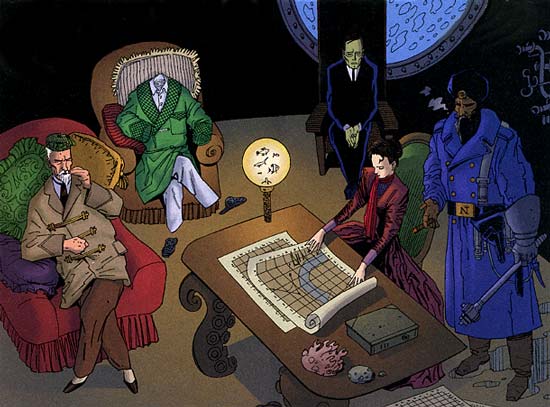
The Victorian Age saw the creation of some of the most famous characters in Western literature: Captain Nemo, usually found in his mythical ship 20,000 Leagues Under the Sea; Allan Quartermain, the adventurer who discovered King Solomon’s Mines; Mina Murray, the heroine who barely escaped from Dracula; Hawley Griffin, the original Invisible Man himself; Henry Jekyll and his alter ego, better known as Dr. Jekyll and Mr. Hyde. Comics genius Alan Moore collects them all here and turns them into team of superheroes who use their unique capabilities, powers, and experiences (not to mention Captain Nemo’s technologically-pimped out submarine) to save England from the clutches of a mysterious madman. The year is 1898, and the heroes have been gathered together in London from all corners of the globe by the head of the Secret Service. They’re a rough-and-tumble bunch, flawed and washed-up, but when a criminal mastermind with a dangerously high-tech taste in weaponry threatens to firebomb London’s East End and bring down the British Empire, these 19th century characters come to life and rally to the rescue. The illustrations are as bright and action-packed as anything out of Superman, Batman, Spiderman, or Moore’s own comic masterpiece The Watchmen. Originally published as individual comic book issues and then collected into two volumes, Moore and his team of artists at DC Comics created two additional adventures, The Black Dossier and Century 1910. Together, the series is as chock-full of superhero-style action, futuristic weaponry, and derring-do as it is of historical detail, literary references, and Victorian flair. The League of Extraordinary Gentlemen is another genre-buster that proves just how much mystery and adventure can be packed into one fantastic era.

Steampunk edited by Ann and Jeff VanderMeer, 2008, Tachyon Publications (Science Fiction/ Fantasy/ Short Story Anthology)


For an in-depth exploration of the steampunk genre, look no further than Ann and Jeff VanderMeer’s collected anthology, titled simply Steampunk. First, an excerpt from steampunk granddaddy Michael Moorcock’s 1971 novel The Warlord of the Air. Then comes a selection of short stories that revel in mad scientists, Martian mutinies, royal imposters, magic, monsters, and weird technologies while still providing humor, horror, mystery, adventure, finely-crafted characters, inventive settings, and thought-provoking plots. Don’t miss Ted Chiang’s “Seventy-Two Letters” or Michael Chabon’s “The Martian Agent, A Planetary Romance.” The VanderMeers are long-time steampunk writers themselves, which makes them ideally suited to comment, critique, and celebrate this unique avenue of science fiction and fantasy. Steampunk provides a comprehensive history of the genre’s evolution and the finest tales its writers have to offer. For both the newly initiated steampunker and the long-time fan, there’s something fresh and fantastic to be found in Steampunk.  And if you need even more steam-powered adventure, there's always Steampunk II: Steampunk Reloaded.

Saturday, April 10, 2010

Booklists Galore


Booklists for Bookworms is taking a little break! There are piles of books that need to be read so more lists of books can be made. In the meantime, here’s one last list—not of books, but of other blogs and websites that can recommend literally hundreds of new booklists and thousands of glorious, wonderful, magical books.

What Should I Read Next? at http://www.whatshouldireadnext.com/

Who hasn’t wondered “What should I read next?” Well, here’s a lovely website that can answer that looming question. Simply type in the name of a book or author you like. When you select your desired title, you are rewarded with a handy list of similar books. These titles are linked to Amazon.com, so you can easily access all of Amazon’s user-friendly details like cover art, summaries, and reviews. The recommendations come from the reviews of over a million users of What Should I Read Next?, and you are pretty much guaranteed to find something new and unexpected that will become a well-worn, beloved favorite.


WhichBook is a remarkably fun and unique way to decide which book to read next. The big question is: What are you in the mood for? The website consists of a series of sliding bars with one extreme at each end—“happy – sad,” for example, or “funny – serious.” You pick four categories of extremes, slide the cursor closer to one end the other (whatever you’re in the mood for), and then you click GO! Your result is a list of books that match your mood—it’s genius. Title, author, and a brief plot summary are provided, along with similar reads. WhichBook is U.K. based, so non-Brits will have to look up further details on a website like Amazon or local library websites. You can also search for books based on character (race, age, sexuality, gender), plot type (quest, conflicts, lots of twists and turns), and setting (anywhere in the world).


Fiction Finder lets you get really, splendidly, fantastically specific. You’re greeted by a bunch of lovely blue “subject clouds,” words that will lead you to books about that subject. You may not have even known you were interested in books about assassins, cats, grandmothers, magicians, orphans, soldiers, or wizards until you happened upon a list of such subjects at Fiction Finder. With 275 books listed about governesses alone, you know you’re in for a real treat. And when you click “browse,” a whole new batch of subject lists opens up entire new worlds of books to reads. Goody goody.


Hot lists, starred lists, featured titles lists, themed lists, monthly lists, annual lists, coming soon lists… boy oh boy. Overbooked is a classic booklist website, chock full every subject you could ever hope for. Search by genre, literary theme, literary style, summer reading, and more. Featured titles of September, 2009, for example, include Stitches (graphic novel memoir), Windup Girl (sci-fi thriller), and The Coral Thief (historical fiction mystery). Did you like The Thirteenth Tale? Here’s a list of similar reads. Wanna read books about Ireland? Here you go. Interested in exploring the works of Latino and Latina authors? No problem. We could go on and on because the booklists are practically never ending, that, of course, is the best part.

Stop, You’re Killing Me at http://www.stopyourekillingme.com/

Mystery lovers, rejoice. Stop, You’re Killing Me is a killer resource for readers who love to solve crimes on the page. True to its genre of choice, Stop, You’re Killing Me indulges in some truly inventive categories. Browse through the job index. There’s a list of books about crime-solving characters who are also archeologists and anthropologists. There are lists of mysteries that take place in the worlds of horse racing, construction, and high society. Search the historical index for mysteries that take place in ancient times, in the 1980s, and every time in between. If you like mysteries where the dog is the detective, well, you’re in luck: here’s a list of similar books. If you adore Agatha Christie, here are some author mystery writers you might fall head over heels for. With 3,300 authors, 3,700 series, and over 37,000 titles to chose from, readers can begin detecting and never have to stop. A website to die for, indeed.


Oh, historical fiction, the glory of the past: all that historical fact mixed with all that wonderfully imagined fiction. Blogger and librarian Sarah Johnson writes deliciously detailed reviews of new, unique, and unexpected historical fiction titles. In some blog posts, Johnson does a straight-forward review of her latest read. In others, Johnson goes through the ABCs of historical fiction, with posts like “I is for India.” The early months 2010 includes posts like “Tackiness Extraordinaire” featuring a selection of hilariously lurid vintage historical fiction covers, discussions of book award nominees, thoughts on the work of a variety of different authors, and reviews of over a dozen books. Complete with author interviews, guest posts, lots of reader feedback, and links to even more historical fiction blogs and websites, Reading the Past is a historical fiction fan’s best friend.


Let’s all just admit it right now: sometimes we read trashy, no-good books for the sole purpose of escapism. They’re not literary books. They’re not books that teach us anything. They haven’t won a single book award. Well, thank god for Bookgasm, because these bloggers absolutely relish the books that just plain make us feel good. Science fiction, westerns, graphic novels, comic books, and more are cherished and celebrated here at Bookgasm. Recent posts dissect the finer points of a 1975 book that combines Sherlock Holmes and War of the Worlds, admit to absolutely loving a line of WWE wrestling comic books, make fun of the covers of martial arts books, and occasionally present straight-forward reviews of genre fiction. It’s goofy and clever and and action-packed, and you will still find lots of new books to read. What could be better than that?

KDL What’s Next Books in Series Database at http://ww2.kdl.org/libcat/WhatsNextNEW.asp

There is nothing more frustrating than reading the first book in a thrilling series and not knowing which book comes second, third, fourth, or fortieth. Kent District Library in Michigan maintains a series database so that all of us can avoid precisely that problem. You can search by author, book title, series title, and genre. Before you know it, you have a wonderful list of series books in the order they are meant to be read. Soon you know for certain that Seeing a Large Cat is the ninth book in the Amelia Peabody Mystery series, that Harry Potter and the Goblet of Fire comes after Harry Potter and the Prisoner of Azkaban, and that Suzanne Collins is the author of both the Hunger Games trilogy and the Underland Chronicles series. And for the voracious reader in all of us, that is a very big relief.

More Genre Booklist Websites:

Cozy Library at http://www.cozylibrary.com/ (sweet, friendly, gentle mysteries to cozy up to)

I Love a Good Mystery at http://www.iloveagoodmystery.com/ (a mystery a day keeps the doctor away)

Urban Fiction at http://www.urbanfictionbooks.com/ (the dirty, gritty, thrilling realities of street life in the big city)

All About Romance at http://www.likesbooks.com/ (bask in the romance)

No Flying, No Tights: The Lair at http://www.noflyingnotights.com/lair/ (everything you always wanted to know about graphic novels but were afraid to ask)

Uchronia: The Alternate History List at http://uchronia.net/ (what if history took a different path?)

Webrary at http://www.webrary.org/rs/rslinks.html#5 (the ultimate list of book list resources)

Novelist

Novelist is a subscription database, but if you belong to a public library (and you should because it’s free), odds are you have access to arguably the best book resource in the business. Once you log in with your library barcode, you can search for books like crazy. Basic search includes author, title, series title, and “describe a plot,” with the added benefit of narrowing your search by audience (adults, teens, older kids, younger kids). You can also find author read-alikes, that all-important source when you’ve devoured everything your favorite author ever wrote but still can’t get enough. Genre outlines can help you explore your old favorites or branch out in new directions. Popular fiction checklists keep you up-to-date on all the hottest new releases. Award winners, recommended reads (from nice friendly book-obsessed librarians), special features, and discussion guides for your book club, there’s hardly anything about a book that you can’t find on Novelist. This database will be your new book best friend.

Saturday, April 3, 2010

Historical Figues Doing Strange, Strange Things


Famous people are meant to be remembered. The achievements of presidents, rulers, writers, and scientists go down in history, as they should. But sometimes famous people have secrets. And not the secrets you’re thinking of—there’s much more going on than skeletons in the closet and lovers on the sly. Instead, the best-known historical figures cavorted with unsavory members of the underground or snuck out at night to keep our ancestors safe and sound in their beds. Want to know what history class didn’t—or couldn’t—teach you? Read about these famous fellows and their strange secrets and hidden talents.

Jane Bites Back by Michael Thomas Ford, 2009, Ballantine Books (Fantasy/ Humor/ Historical Fiction)


We love Jane Austen. We love her so much, in fact, that even though she only wrote six books, there are dozens upon dozens of sequels, prequels, knockoffs, spin-offs, and mash-ups to be found on bookshelves everywhere. And here’s another one: Jane Bites Back. Jane Austen is still alive and well. How? She’s a vampire, of course. She’s also a bookstore owner and an aspiring author. Her last book has been rejected for nigh on two hundred years. But now she’s finally found a publisher—and a handsome one at that. She's beginning to feel truly comfortable with her daffy assistant (who reminds her of sister Cassandra) and her admiring neighbor Walter (who is not at all a Mr. Darcy, even though he’s very sweet and caring). And her books are selling better than ever (even if they have to compete with knockoffs like Pride and Prejudice and Zombies). But when Jane’s renewed fame as author “Elizabeth Jane Fairfax” of the new bestselling Constance shoves her into the spotlight, our heroine finds herself involved in a couple familiar entanglements: one a wicked battle-of-the-sexes with ex-boyfriend and fellow vampire Lord Byron, and the other a fierce catfight with Charlotte Brönte-fanatic Violet Grey. Now Jane's treasured privacy as a human and her dark vampire secret are threatened--and just when things finally seemed to be going her way. Author Michael Thomas Ford joyously plays with popular culture's current mania for all things Austen and still gifts readers with a realistically warm, witty, and sometimes sarcastic Jane who fans will recognize and relate to. The first of a planned trilogy, readers can rest assured that Jane will be back to bite again and again.

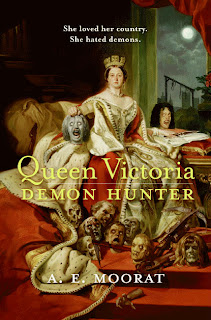
Queen Victoria, Demon Hunter by A.E. Moorat, 2010, Eos Books (Horror/ Humor/ Historical Fiction)


Ah, Queen Victoria, the stiff-upper-lipped little woman whose long rule oversaw the British Empire’s growing power in all things industrial, political, military, cultural, and scientific. She was a controversial monarch whose assassination was attempted some dozen times in her life. The first attempt, though few know it today, came on the eve of her ascension to the throne when a foul demon (yes, demon) infiltrated her bedroom and attempted to slice her into little pieces. Young Victoria, as told in author A.E. Moorat’s new biography Queen Victoria, Demon Hunter, is not too surprised that there are demons—she has received an excellent education, after all—but it does come as something of a shock that she, as queen, is to be the lead demon hunter of the land. Still, Victoria is determined to be a successful ruler in all areas, and willingly begins training under the Protektorate, a motley crew of warriors in possession of all manner of demon-slaying skills—and in Victorian England, demons come in all sizes and shapes. As Victoria learns the proper way to behead a zombie, defeat a werewolf, and tackle other evil spirits, her mind occasionally wanders to daydreams of handsome Prince Albert. Trying to balance the desires of the heart with the demands of a demon-ravaged kingdom is certainly a trial, but no one is better suited to meet the challenge than the new Queen Victoria. There’s enough gore here to thrill raving horror fans, enough historical detail to satisfy devoted Anglophiles, and plenty of dashes of humor, romance, and satire to tie it all together in a neat little bow—and then, of course, good old Vicky will come along and lop its head off.

Drood by Dan Simmons, 2009, Little, Brown and Co. (Historical Fiction/ Horror)


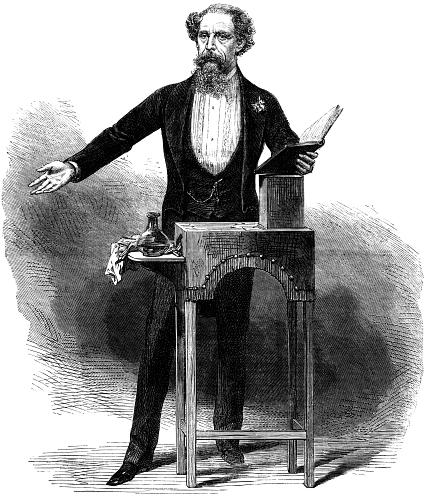
Charles Dickens may be a classic writer of fine literature today, but way back when, he was a major celebrity. Readers waited on edge for the newest installments of his novels to come out in weekly newspapers and magazines; his book readings were carefully crafted performances and boy, were they packed. And according to author Dan Simmons, Dickens was a strange and secretive man. In Drood, Dickens is the main character, though his real-life friend (“frenemy” is perhaps more accurate) Wilkie Collins narrates the story. The starting point is a horrifying and near-fatal train derailing in 1865 that Dickens survived but never entirely recovered from. Simmons uses this factual event to introduce a mysterious character who Dickens encounters amid the gore and wreckage of the train—a gaunt specter, calling himself Drood, who emits a decidedly creepy aura and has a sinister agenda of his own. Dickens becomes obsessed with tracking Drood and enlists Collins to assist him in nighttime voyages though London’s grotesque underground caverns and crypts. Collins, as portrayed in Drood, is bitterly jealous and opium-addicted; Dickens is an egomaniac of the highest order who’s keeping heavy secrets from friends and family, including the motive behind what will be his final, uncompleted book, The Mystery of Edwin Drood. Things get weirder, spookier, and more bizarre as the final years of Dickens’ life draw to a close for a wholly atmospheric blend of history, historical fiction, and supernatural horror that’s as dramatic (and melodramatic) as the novels by Dickens and Collins that inspired it. Be sure to check out Dickens’ novels (especially The Mystery of Edwin Drood), and don’t let Wilkie Collins, who remains largely in the shadow of his better-known contemporary, be forgotten again—his novels The Moonstone and The Woman in White are masterpieces in their own right.

Abraham Lincoln, Vampire Hunter by Seth Grahame-Smith, 2010, Grand Central Publishing (Horror/ Humor/ Historical Fiction)


Best known for living in a log cabin as a boy and ending slavery as our illustrious sixteenth president, a diary by the man himself (fortuitously discovered by Seth Grahame-Smith, author of Pride and Prejudice and Zombies) reveals that Abraham Lincoln was also a skilled slayer of vampires. Following his mother’s death at the hand (or bite) of a blood-sucking creature of the undead, young Abraham vows to spend the rest of his life ridding this great nation of the foul demon presence. And since slavery is a projection of the vampires’ natural desire for control over their victims, Abe vows to defeat that vile institution as well. His legendary strength and height are a definite advantage; his practiced skill with his sharp ax serves him well as he fights to crush the vampires’ political power—and just plain chop their heads off. The road to victory (and the White House) is not easy, and Abraham faces an uphill battle fraught with failed love affairs, sickly sons, dying soldiers, disguised vampires, and bloody fangs. Complete with documentary photographs, diary entries, quotes from letters, and explanatory footnotes, Abraham Lincoln, Vampire Hunter has the look and feel of a grand historical biography—but with tongue firmly in cheek. Continuing his tradition of adding scenes of gory mayhem to solid classics, Grahame-Smith might cause history buffs to grumble, but horror and humor fans will be tickled pink by the image of Honest Abe swinging his trusty ax at hoards of blood-thirsty sharp-toothed fangs.

The Pirates! In an Adventure with Scientists by Gideon Defoe, 2004, Pantheon Books (Humor/ Adventure/ Historical Fiction)


Charles Darwin changed the world with his theory of evolution. But first, he frolicked with pirates. When the very silly Pirate Captain and his crew of jolly buccaneers mistake Darwin’s ship The Beagle for a treasure ship from the Bank of England, Darwin charms the pirates with his fancy trained chimp, Mr. Bobo, who is a perfect little English gentleman and destined to be a start of the British stage. Chumming it up, Darwin and his new BFF the Pirate Captain head back to England to save the day. Darwin's brother, Erasmus, has been kidnapped by the vile Bishop of Oxford, who has invested heavily in P.T. Barnum’s traveling freak show and doesn't want any competition standing in his way—especially not from the likes of Charles Darwin and his upstart monkey. But with the pirates on the case, Darwin is certain to come out on top--if he can only convince the unruly crew to pose as scientists, dress in drag, and stop obsessing with ham. Author Gideon Defoe spins a yarn that is deliriously goofy (the 19th century characters indulge in such modern anachronisms as dental floss and post-it notes) but always endearing and charming. The Pirate Captain and his merry crew have several more adventure with noted celebrities of the age, including Karl Marx (The Pirates! In an Adventure with Communists) and Napoleon (The Pirates! In an Adventure with Napoleon), and even a run-in with the fictional Captain Ahab (The Pirates! In an Adventure with Ahab). But with Charles Darwin the Pirate Captain strikes up a true friendship (if only because Darwin has no comparable sword, beard, or ship to envy) and their adventure together is a droll, nonsensical romp with a light-hearted flair for the enjoyably ridiculous.

Friday, March 26, 2010

To Be Continued: Sequels and Second Books in Series


The only thing more satisfying that finishing a good book is being able to immediately pick up its sequel. It’s often historical fiction and science fiction that come in multiple volumes; the possibilities for elaborating on the events of the past and future are, after all, endless. Whether it’s a stirring sequel or the second in a deliciously lengthy series, book two has a big responsibility—introduce new plot twists and characters while simultaneously maintaining what readers loved about the first book and building on its momentum. The books that come before these have been reviewed in other book lists so you can go back and read them before diving into their worthy second halves.

Darcy and Elizabeth: Days and Nights at Pemberley by Linda Berdoll, (sequel to Mr. Darcy Takes a Wife: Pride and Prejudice Continues), 2006, Sourcebooks (Historical Fiction/ Romance)


For Elizabeth and Mr. Darcy, it’s a classic love story: first comes love, then comes marriage, then comes... well, that’s where Jane Austen leaves off in her beloved masterpiece Pride and Prejudice. But many Austen fans are not willing to let it end there, not by far. Many writers have resurrected the escapes of the Bennet sisters, but few have dared to write a 400-plus page action-packed continuation complete with steamy sex scenes—and then do it all over again. In Mr. Darcy Takes a Wife, Austen’s hero and heroine embark on their greatest adventure: marriage. In the sequel, Darcy and Elizabeth, the title couple is basking in the delight of newborn twins. Then Lady Catherine de Bourgh and wicked Wickham rear their interfering heads, the romantic trials and tribulations of sisters and sisters-in-law Lydia, Jane, and Georgiana take on new urgencies, and marital bliss is temporarily disrupted—though there’s still plenty of time for the occasion bedroom romp. Author Linda Berdoll good-naturedly infuses her Elizabeth and Darcy with so much personality that the novels stand on their own and are as enjoyable for romance and historical fiction fans as they are for Austen buffs. Bawdy, witty, epic in scope and tongue-in-cheek in tone, Berdoll’s Austen knock-offs are all in good fun. (Mr. Darcy Takes a Wife is reviewed in the July 2009 booklist “More Jane! For the Jane Austen Purist.”)

A Monstrous Regiment of Women: Novels of Suspense Featuring Mary Russell and Sherlock Holmes Mystery, Book 2 by Laurie R. King, 1995, St. Martin’s Press (Historical Fiction/ Mystery)


Author Laurie R. King’s richly detailed, character-driven, literary mysteries are based on another classic series: the Sherlock Holmes stories by Arthur Conan Doyle. In the first novel, The Beekeeper’s Apprentice, King focuses on a new protagonist, a gawky fifteen-year-old orphan girl who literally trips over the legendary detective one day in 1915 while he’s studying bees and her nose is buried in a book. The unlikely duo forges an unbreakable bond; the bookish girl, Mary Russell, proves the ideal intellectual match for the supposedly retired Holmes and eventually becomes his partner in detection and deduction. The second book in the series, A Monstrous Regiment of Women, features an all-grown-up Russell forging an identity of her own as a theology scholar at Oxford in 1921. Russell meets a charismatic religious mystic named Margery Childe and is both attracted to Margery’s distinct brand of feminism and skeptical of her church’s true purpose—especially when the deaths of several wealthy young women are linked to Margery’s “New Temple of God.” It is Russell’s wit and intelligence that drives the story, though Holmes’ strong presence is always in the background. And the only thing more intriguing than the mystery’s solution is the evolving relationship between the great detective and his former apprentice—not to mention the vim and vigor of King’s writing. And there’s more where that came from. Holmes and Russell solve eight more mysteries together, with a new book due in April 2010. (The Beekeeper’s Apprentice is reviewed in the February 2010 booklist “The Nine Lives of Sherlock Holmes.”)
Portrait in Sepia by Isabel Allende (sequel to Daughter of Fortune), 2001, HarperCollins (Historical Fiction/ Literary Fiction)


Set in nineteenth century Chile and San Francisco, Portrait in Sepia introduces Aurora del Valle, granddaughter of Eliza Sommers, who, in author Isabel Allende’s previous novel Daughter of Fortune, ran away from her adopted family in Chile to follow her handsome young lover to the Californian Gold Rush. Eliza found happiness and independence instead with Chinese healer Tao Chi’en; now her granddaughter is looking for some of the same. Aurora unfolds the story of her life, from her birth when her beautiful mother Lynn died, to her adoption by her redoubtable paternal grandmother Paulina, to her hastily-arranged marriage to the black sheep of a wealthy South American family. There’s also the love triangle between Aurora’s mother, her opium-addict father Matias del Valle, and Matias’ passionately devoted cousin Severo. In fact, the del Valle family is filled with eccentric and charismatic members, and they all play a part in Aurora’s life. Spanning nearly fifty years of American and Chilean history between 1862 and 1910, this is epic, historical storytelling at its finest. The fact that Portrait in Sepia has deep ties to Allende’s other stories makes the novel’s intricate layers all the more compelling. (Daughter of Fortune is reviewed in the January 2010 booklist “Long Lost Literary Love.”)

The Astonishing Life of Octavian Nothing, Traitor to the Nation: Volume II, The Kingdom on the Waves by M.T. Anderson (sequel to The Astonishing Life of Octavian Nothing, Traitor to the Nation, Volume I: The Pox Party), 2008, Candlewick Press (Historical Fiction/ Teen Fiction)


The Astonishing Life of Octavian Nothing, Traitor to the Nation is a novel in two volumes that explores the American Revolution from a new point-of-view: that of an African American boy. When the founding fathers declared independence from British rule, they did so in the name of freedom from oppression. This is certainly something of a hypocrisy when you consider that the grand notion of freedom did not extend to the large population of African slaves who also called America their home. Octavian is a young boy living in Boston on the eve of the revolution. Raised in near-isolation by a strange group of philosophers and scientists, Octavian receives a classical education of the finest order—and then uncovers a devastating truth. In Volume II: The Kingdom on the Waves, Octavian, his fancy schooling exposed as a cruel charade, is desperately searching for a real independence. He casts his lot with the British army, whose promise of emancipation has a vague ring of truth to it, and joins the rag-tag members of the Royal Ethiopian Regiment. There’s still an ocean of misguided loyalties, betrayals, abuse, and violence standing between Octavian and the freedom he longs for, but author M.T. Anderson presents us with a young hero whose pride and determination result in an elegantly philosophical version of a history we all think we know. (The Astonishing Life of Octavian Nothing, Traitor to the Nation is reviewed in the December 2009 booklist “Untold Histories.”)

Curse of the Pharaohs: Amelia Peabody Mysteries, Book 2 by Elizabeth Peters, 1981, Dodd and Mead (Historical Fiction/ Mystery)


Amelia Peabody is not your conventional prim and proper Victorian lady. She’s a gentlewoman, yes, and she’s quite well-mannered, but she’s also opinionated, indomitable, and when she wants something, damn near unstoppable. In her first adventure, Crocodile on the Sandbank, Amelia comes into an inheritance, travels to exotic Egypt, saves a damsel in distress, tackles a seemingly reanimated mummy, and meets her match in an irascible archeologist named Radcliffe Emerson. In Curse of the Pharaohs, which takes place a few years later, our heroine has gone from prickly spinster to devoted wife of dashing Emerson and mother of precocious son Ramses. But Amelia has lost none of her spirited independence; when life in dear old England begins to grow dull, she jumps at the chance to go back to her beloved Egypt—even if it is at the behest of stuffy Lady Baskerville. Sir Baskerville has met a mysterious death at his archeological site and his assistant has disappeared. While Emerson indulges in his passion for digging up ancient tombs, Amelia plunges into the murder investigation. It’s no easy task, given then number of suspects (who include an America millionaire, a German hieroglyphics expert, and a British photographer), but no one is up to the challenge like the unflappable Amelia Peabody Emerson. Author Elizabeth Peters’ mystery is clever and the historical details add spice, but the real charm is fabulously feisty Amelia, who will swoop off the page with her trusty umbrella and march straight into the hearts of her readers. (Crocodile on the Sandbank is reviewed in the November 2009 booklist “Adventure and Mystery in the Victorian Age.”)

Lost in a Good Book: Thursday Next Novels, Book 2 by Jasper Fforde, 2002, Viking Books (Fantasy/ Science Fiction/ Humor)


In author Jasper Fforde’s first installation in his best-selling Thursday Next Series, The Eyre Affair, no-nonsense Thursday Next lives in an alternate England where cloned dodo birds are the pet of choice, time traveler is common (though no one knows exactly how it works), and people and characters can move in and out of books. After saving Jane Eyre from a mastermind criminal in book one, Thursday—whose new husband, Landen, has been unfortunately eradicated from time by mega-conglomerate Goliath Inc.—is ready to get back to work. Leaving her position as a literary detective for Special-Ops, Thursday jumps into the world of books and joins Jurisfiction, the department that polices the fictional world. Thursday is paired with Miss Havisham (yep, that Miss Havisham, from Charles’ Dickens’ Great Expectations) and set on the case of the Goliath Corporation, who won’t restore Landen until Thursday returns company partner Jack Schitt, presently imprisoned in an Edgar Allan Poe poem (and Poe is very dangerous fictional territory). Assisted by her real-world partner Bowden Cable, her time-traveling father, her meddling mother, and the Cheshire Cat, Thursday also has to authenticate a new Shakespeare play, master the art of traveling through fiction, and save the world from a mysterious oozing pink sludge that threatens to engulf the entire planet. Literary allusions, puns, wordplay, and sheer fun abound in this bookish adventure that is also comedy, science fiction, alternative history, and hardboiled mystery. Few writers are as efficient in the art of genre-blending as Jasper Fforde, and few series are as witty, wild, or wickedly clever. (The Eyre Affair is reviewed in the July 2009 booklist “Sci Fi Meets the Classics.”)

The Ask and the Answer: Chaos Walking, Book 2 by Patrick Ness, 2009, Candlewick Press (Science Fiction/ Teen Fiction)


Book one of the author Patrick Ness’ Chaos Walking Trilogy is called The Knife of Never Letting Go, and it’s a hard-hitting, gripping, whopper of a dystopian tale. Thirteen-year-old Todd Hewitt has grown up on “new earth,” in a colony that fled the turmoil of our planet for a back-to-basics, simple way of life. But life on this new planet has a strange side effect: men can hear each other’s thoughts, and the result is world of terrifying chaos and pandemonium. In Prentisstown, Todd was taught that this strange phenomenon was a virus that killed the womenfolk. But when Todd stumbles across the last thing he ever expected—a girl who can’t hear what he thinks—everything he knows is about to change. In book one, Todd and the girl, Viola, flee to a city that they believe is a safe haven. But by the time they arrive, their supposed refuge has already been taken over by the vile, sadistic mayor of Todd’s hometown. After this cliffhanger ending, things go from bad to worse in book two, The Ask and the Answer. Todd and Viola, fearing all the while for each other’s lives, are separated. Todd is forced into the “Ask,” Mayor Prentiss’ oppressive regime, and Viola winds up in the care of the “Answer,” a rebel group hell-bent on stopping Prentiss. Both sides are determined to use whatever means necessary, and the result is always violent. There are no easy answers for Todd and Viola, who grow more desperate and disillusioned with the turn of each page. Still, these are two of the most determined kids in recent science fiction literature, and the reader is just as unlikely to give up hope as Todd as Viola. Provocative and un-put-down-able, readers will want the third volume (Monsters of Men, due spring 2010) close at hand. (The Knife of Never Letting Go is reviewed in the October 2009 booklist “Welcome to Dystopia.”)
Predator’s Gold: The Hungry City Chronicles, Book 2 by Philip Reeve, 2004, Eos Books (Science Fiction/ Teen Fiction) 


The Hungry City Chronicles is a dystopian series for young adults—a popular trend these days, and as author Philip Reeve so aptly demonstrates, it’s for good reason. Book one, Mortal Engines, introduces an earth devastated by untold climate and political disasters that set the world’s cities in motion—literally. Traction-cities on wheels now roam the globe, pursuing smaller towns to devour and use for resources. Tom Natsworthy is an apprentice historian London and Hester Shaw is the brutally scarred rogue assassin who sneaks onto London to kill Tom’s idol, the adventurer Valentine. But Tom stops Hester, and both are flung out of London and forced to survive in the bleak hunting grounds of Europe. Still, the unlikely duo forges a deep connection, especially when an ancient weapon is unearthed and put to use by London’s corrupt officials. In Predator’s Gold, Tom and Hester have stopped London in its tracks and set out on a romantic life together in an airship, far away from the hungry cities far below. But an idyllic existence is not meant to be—the Green Storm, a fanatic branch of the Anti-Tractionist League that has sworn to rid the world of its hungry cities, believes Hester and Tom had something to do with the death of their beloved leader. The couple seeks refuge on the city of Anchorage, a lovely but stricken city that has lost most of residents to a strange plague and is making a desperate bid for a fresh start on the “Dead Continent” of America. When Anchorage’s young and lovely leader takes a fancy to Tom and Hester’s jealousy gets the better of her, a devastating chain of events is set off involving all manner of betrayals, thievery, torture, daring rescues, and desperate hopes. With a grand scope, fresh plot twists, and suspense galore, the second volume in author Philip Reeve’s futuristic series packs an action-packed punch that will leave readers hungry for more—like books three and four, Infernal Devices and A Darkling Plain. (Mortal Engines is reviewed in the February 2010 booklist “Booklist Additions: Welcome to Dystopia.”)