The classics can be daunting. Charles Dickens, Charlotte Brontë, Jane Austen, Thomas Hardy: these are big names and they wrote big books a long, long time ago. We were made to read a few of them in school and we’ve avoided them ever since. But still, they must be classics for a reason. There must be a compelling story there somewhere hidden under all that old-fashioned language. And indeed there is—all the drama, comedy, mystery, and romance that you could wish for. One of the surest ways to tap into the classics is to watch the film adaptation. Not the Hollywood version, mind you, which tends to condense and edit until the book and the movie are little more than distant cousins. What you want are the Masterpiece Theatre movie versions. Filmed by the BBC, they air on PBS as miniseries, hours-long adaptations that are meant to be viewed over several weeks. This means that very little is left out of the original book—nearly every character is on screen and much of the dialogue is taken straight from the book. Viewers have the luxury of becoming as immersed in the world of the film as readers who spend days or weeks with the book versions. Masterpiece Theatre’s classic reinterpretations are dramatic, stirring, suspenseful, passionate, and true to the voice of their original author. Once you watch a book on TV, it becomes that much easier to access the paper and ink classic it’s based on.
· Bleak House based on the novel by Charles Dickens; 2005; directed by Justin Chadwick and Susanna White; screenplay by Andrew Davies; starring Anna Maxwell Martin, Denis Lawson, Carey Mulligan, Gillian Anderson, Charles Dance, Patrick Kennedy, Timothy West, Burn Gorman, Alun Armstrong

Once upon a time in Victorian England, a man named John Jarndyce made a will. Actually, he made a few wills, and the case deciding which will gives what amount of money to which heir is still in court. Against the background of this seemingly unending courtroom drama, the lives of those at the heart of the case play out. The current John Jarndyce (descendant of the original) takes the case’s young wards, Ada Clare and Richard Carstone, into his almost-too-kind-to-be-true kind care. Compassionate young Esther Summerson struggles to find her role in the world. And beautiful, mysterious Lady Dedlock guards a deep, dark secret. Gillian Anderson, best known for her role as skeptical Scully on TV's The X-Files, does a remarkable dramatic turn keeping her emotions in check as Lady Dedlock, with Charles Dance playing her--and everyone else’s--coldhearted nemesis Mr. Tulkinghorn. But the real star of the film is Anna Maxwell Martin, who plays Esther with a charm and intelligence that makes her the true heroine of the story. If you feel inspired to open up the book after watching the mysterious, suspenseful, absorbing film adaptation, Penguin Classics published a movie tie-in edition of Bleak House (which Dickens wrote in 1853), complete with a cover image of elegant Gillian Anderson as Lady Dedlock.
Little Dorrit based on the novel by Charles Dickens; 2008; directed by Adam Smith, Dearbhla Walsh, and Diarmuid Lawrence; screenplay by Andrew Davies; starring Claire Foy, Matthew Macfayden, Tom Courtenay, Alun Armstrong, Judy Parfitt, Eddie Marsan, Emma Pierson, Andy Serkis

Victorian gentleman Arthur Clennam little suspects that when he takes a kindly interest in his mother’s seamstress, Amy Dorrit, he will be plunged into the affairs of Amy’s father—a fellow gentleman who has been imprisoned for debt for over twenty years. Mr. Dorrit’s time in the Marshalsea Prison has far-reaching effects through a wide variety of colorful characters--landlords turned detective, lovesick turnkeys, murderous Frenchmen, desperate mothers with long-kept secrets, high-kicking sisters, and more--from all ranks of society. But Arthur never loses sight of warmhearted, humble little Amy. She is, after all, the only one who never asks him for help, and of course she’s the one who he wants to be most useful to. Dickens wrote Little Dorrit in 1857; his own father was imprisoned for debt when Dickens was a child. The atmospheric film captures Dickens’ meditation on imprisonment in all its forms, but Claire Foy as Amy Dorrit and Matthew Macfayden as Arthur Clennam (who savvy viewers might recognize as Mr. Darcy from the latest Hollywood version of Pride and Prejudice) are the real heart and soul of this film. To read this masterpiece, look for the 2008 Penguin edition or the 2009 Vintage Classics edition. PBS loves Dickens and adapts his work frequently; Little Dorrit is the most recent, a seven-time Emmy winner, and one of the best.
Jane Eyre based on the novel by Charlotte Brontë; 2006; directed by Susanna White; screenplay by Sandy Welch; starring Ruth Wilson, Toby Stephens, Lorraine Ashbourne, Pam Ferris, Cosima Littlewood, Tara Fitzgerald, Christina Cole

The story of Jane Eyre is one of the most beloved in literature, and there have been many film versions made throughout the decades. Jane Eyre is poor and plain but determined to make her way in the world. When she accepts a position as governess to the young ward at Thornfield Hall, Jane forges a deep friendship with her moody master, Mr. Rochester. But there are secrets at Thornfield, secrets that threaten Jane’s newfound happiness as well as her very sense of self. The 2006 Masterpiece Theatre adaptation features a Jane and Rochester who actually look and act the way readers have imagined them ever since Charlotte Brontë’s classic was published in 1847. Ruth Wilson is an almost perfect Jane—a plain Jane with an utterly unique charm. Toby Stephens is as rough and gruff as Mr. Rochester is written, and can really turn on the brooding intensity. Though little of the famous tale is changed, the filmmakers have some fun with the structure of the plot, livening up the story for viewers who are already familiar with it. It is an elegant, moving, faithful adaptation certain to please, whether this is your first introduction to Jane or your fifteenth. To read the book, check out the 2006 Penguin Classics edition or the attractive new 2009 Vintage Classics printing.
Cranford based on the novels by Elizabeth Gaskell; 2007; directed by Simon Curtis and Steve Hudson; screenplay by Sue Birtwistle, Susie Conklin, and Heidi Thomas; starring Judi Dench, Eileen Atkins, Lisa Dillon, Simon Woods, Imelda Staunton, Julia McKenzie, Claudie Blakley, Jim Carter

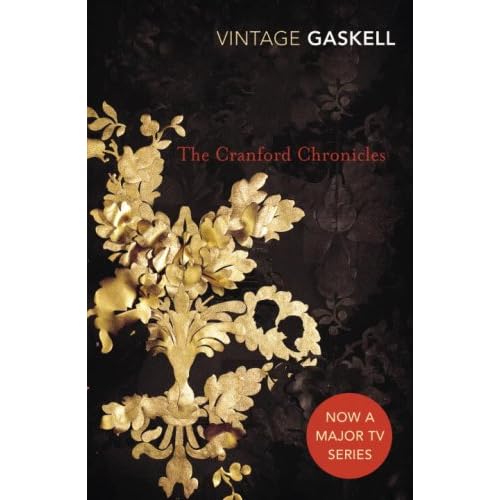
Elizabeth Gaskell is not as well known as her Victorian contemporaries Charles Dickens and Charlotte Brontë, but her stories are every bit as compelling, whether on the screen or the page. Her best-known works are her three Cranford novels, published between 1851 and 1853. Masterpiece Theatre combines the novels to chronicle the lives of the ladies--spinster sisters Matty and Deborah, their kind-hearted and observant friend Mary Smith, and their many nosey neighbors--in the market town of Cranford, a quiet village facing social and economical changes as the Victorian “Age of Progress” pushes closer and closer. Gossip rules the lives of these women, whether it is talk of the new railroad or the new bachelor doctor’s love interests. Cranford focuses on these women and the events that are important to them: love and marriage of course, but also loss, death, and consequences that result from paths not taken. With delightful performances by Judi Dench and Eileen Atkins as Matty and Deborah, Cranford is a touching portrait of the way of life of a time and place that has passed us by. Penguin Classics published a movie tie-in edition with Judi Dench as Miss Matty on the cover; Vintage Classics published The Cranford Chronicles in 2007 which combines the three Cranford novels (Dr. Harrison’s Confession, Cranford, and My Lady Ludlow) that the film is based on.
Wives and Daughters based on the novel by Elizabeth Gaskell; 1999; directed by Nicholas Renton; screenplay by Andrew Davies; starring Justine Waddell, Bill Patterson, Francesca Annis, Keeley Hawes, Tom Hollander, Anthony Howell, Michael Gambon
Wives and Daughters based on the novel by Elizabeth Gaskell; 1999; directed by Nicholas Renton; screenplay by Andrew Davies; starring Justine Waddell, Bill Patterson, Francesca Annis, Keeley Hawes, Tom Hollander, Anthony Howell, Michael Gambon

Our heroine here is young Molly Gibson, devoted daughter of a widowed country doctor. Our story begins when Molly’s ordinary life suddenly gets a whole lot more interesting. First Molly meets the proud family of Squire Hamley, including two handsome young sons. Then Molly’s father remarries, turning her world on end. Intelligent and interested even when somewhat overwhelmed, Molly becomes the confidant of her flighty stepsister Cynthia and of Osborne and Roger Hamley. Molly’s sympathetic ear gets bent a little too far, and the pressure of keeping secrets starts to weigh on all our young lovers and gossipy neighbors. Osborne Hamley is played by Tom Hollander, whose talents Hollywood has tapped into for the Pirates of the Caribbean movies and for the newest Pride and Prejudice adaptation, among other films. Michael Gambon as hot-tempered but soft-hearted Squire Hamley will be recognized by many viewers; he’s also in Masterpiece Theatre’s Cranford (not to mention playing Professor Dumbledore in the Harry Potter movies!). But Justine Waddell as Molly is the one to watch; pretty but intelligent, modest but direct, keeper of many secrets, Molly is a heroine whose happy ending we are committed to watching. When Elizabeth Gaskell died in 1866 Wives and Daughters was incomplete, though the stage was set and the loose ends were ready to be tied. Screenwriter Andrew Davies writes a charming ending to Molly’s story that satisfies completely. For Wives and Daughters in print, try the Penguin Classics edition published in 2003.
Northanger Abbey based on the novel by Jane Austen; 2007; directed by Jon Jones; screenplay by Andrew Davies; starring Felicity Jones, J.J. Feild, Carey Mulligan, William Beck, Catherine Walker, Liam Cunningham, Sylvestra Le Touzel, Hugh O’Connor

Hollywood has made film versions of every one of Jane Austen’s six novels—except Northanger Abbey. Masterpiece Theatre fills that gap with a delightful adaptation that aired in 2007. Northanger Abbey was an early Austen novel, but it remained unpublished until 1817, after Austen had died. It’s the story of Catherine Moreland, a country girl who wants desperately to be the sort of heroine she reads about. When Catherine gets the opportunity to visit Bath and mingle with society, she packs up her favorite romance and adventure books and jumps at the chance. There she meets witty Henry Tilney and manipulative Isabella Thorpe, who influence—in very different ways—Catherine’s reactions when she visits a real Gothic abbey that might just hold a real Gothic secret. Northanger Abbey has resisted adaptation because of its satirical tone, but the Masterpiece Theatre film balances the romance and the satire with clever imaginings of Catherine’s daydreams and fantasies. Felicity Jones and J.J. Feild are ideal as Catherine Moreland and Henry Tilney. Jones plays Catherine’s sweet naivety to a tee and Feild’s Tilney is as witty and charming as he is on the page. With an exceptionally charming ending to boot, viewers won’t soon forget Northanger Abbey again. Penguin Classics and Vintage Classics both have recent editions of Northanger Abbey in print.
Tess of the D’Urbervilles based on the novel by Thomas Hardy; 2008; directed by David Blaire; screenplay by David Nicholls; starring Gemma Arterton, Eddie Redmayne, Hans Matheson, Ruth Jones, Ian Puleston-Davies, Christopher Fairbank, Jo Woodcock, Steven Robertson, Hugh Skinner

When poor, plain John Durbeyfield discovers that he’s descended from the great aristocratic family of the D’Urbervilles, he gets some pretty heavy delusions of grandeur. His lovely daughter Tess is made to suffer for them when she is sent to claim kinship with the great family. Tess is innocent and overwhelmed; she is easy prey for the manipulative and possessive D’Urberville son Alec. But Tess is also proud and determined not to let one event overshadow her life’s happiness. She meets a gentleman named Angel Clare, a kindred spirit who idolizes Tess--but will he still adore her if she reveals her past? The double-standard that women were held to in the nineteenth century still resonates, and Tess’ story of love and betrayal is timeless. The love triangle is made up of a striking trio of actors—Hans Matheson from television’s The Tudors as Alec D’Urberville, Eddie Redmayne from The Other Boleyn Girl as Angel Clare, and Gemma Arterton as Tess, previously a Bond girl in Quantam of Solace. All are dramatic, passionate, and compelling, Tess most of all. Elegantly filmed, intense and romantic, Tess of the D’Urbervilles is from the most recent season of Masterpiece Theatre classics. The novel is well worth reading; Thomas Hardy’s prose is poetic and his depiction of Tess’ character is more finely wrought than any film could depict. Originally published in 1891, Penguin Classics has printed recent editions.
He Knew He Was Right based on the novel by Anthony Trollope; 2004; directed by Tom Vaughan; screenplay by Andrew Davies; starring Oliver Dimsdale, Laura Fraser, Bill Nighy, Christina Cole, Stephen Campbell Moore, Ron Cook, Anna Massey, Caroline Martin, Fenella Woolgar, Claudie Blakely, David Tennant

Louis Trevalyan is the happiest man in the world. He is has three thousand pounds a year, holds a distinguished place in society, and adores his wife Emily. But this blissful life is threatened by the arrival of Colonel Osborne, an old friend of Emily’s family who has quite a reputation with the ladies. A few whispers from society’s gossips and Louis’s jealousy is inflamed. Emily, on the other hand, is deeply insulted by Louis’s suspicions. More modern than the average Victorian woman, she struggles with the notion that a husband has the right to command the behavior of his wife. Osborne, sly and observant, takes advantage of the growing distrust between husband and wife. And Louis begins a descent into a maddening fit of jealousy that threatens to ruin all his earlier happiness, even as friends and family around him make matches of their own. The film has the characters justify their actions and speak directly into the camera, so the viewer is implicit in all manner of suspicions and decisions. Bill Nighy (a perennial favorite in British comedies like Sean of the Dead and Love Actually) is the devious Colonel Osborne, the perfect foil for doubting Louis and spirited Emily (played by Oliver Dimsdale and Laura Fraser). Anthony Trollope wrote He Knew He Was Right in 1869; he was a Victorian writer keenly interested in the relationships between men and women—particularly within the state of marriage. The most recent Penguin Classics edition of the book was published in 1996.
Note: Within the last ten years, Masterpiece Theatre’s productions have become fine examples of filmmaking. The quality is as good (and very often better) as any Hollywood period piece—beautiful cinematography, atmospheric soundtracks, professional screenwriting, and casts that include BBC regulars (who viewers will come to recognize, know, and love in whatever role) as well as Hollywood’s finest. Masterpiece Theatre movies are no longer introduced by a scholarly man who explains the story and fills in plot holes. The films speak for themselves, and they have a much to say.